Mitsubishi Electric
RFQ Ready
Mitsubishi SD-1G0A-99 PLC CPU Module
MELSEC-Q
Origin JP
PLC CPU Module
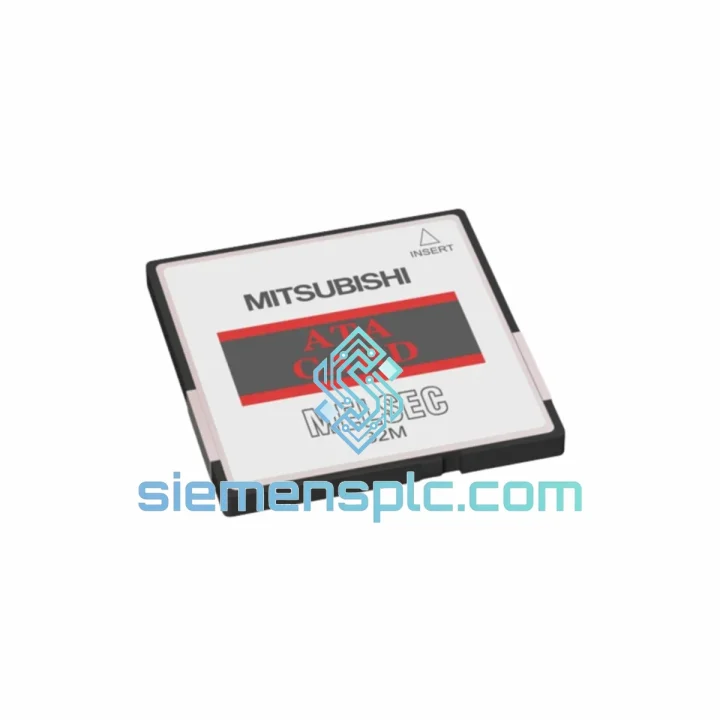
Request verified availability, condition, replacement risk review, packing options and courier lead time for Q2MEM-32MBA.
Click Request Quote and the part number is inserted into the inquiry form automatically.
Core fields for model confirmation and RFQ routing. Detailed product narrative remains below.
The Q2MEM-32MBA is a 32 MB Flash ROM memory card manufactured by Mitsubishi Electric for use with the MELSEC-Q series programmable logic controller platform. Within a Q-series control architecture, the memory card occupies the CPU module’s dedicated card slot and serves as the primary non-volatile storage medium for user program data, parameter files, and file register (ZR) data. Unlike battery-backed SRAM solutions, Flash ROM retains all stored data indefinitely without any auxiliary power source, making the Q2MEM-32MBA the preferred storage medium for installations where long-term unattended operation or frequent CPU module replacement is a design requirement.
In a typical MELSEC-Q multi-CPU configuration, the CPU reads program data from the memory card at power-on and executes directly from internal RAM after transfer. This architecture means the Q2MEM-32MBA functions as the authoritative program source: replacing a failed CPU module requires only inserting the card into the replacement unit and cycling power — no re-download from an engineering workstation is necessary. For production environments where mean time to repair (MTTR) is a contractual obligation, this characteristic alone justifies specifying Flash-based memory over SRAM alternatives.
Real-time Stock & RFQ: [email protected] | WhatsApp: +86 18359268345
| Parameter | Specification |
|---|---|
| Part Number | Q2MEM-32MBA |
| Manufacturer | Mitsubishi Electric Corporation |
| Series | MELSEC-Q |
| Memory Technology | Flash ROM (Non-volatile, battery-free) |
| Storage Capacity | 32 MB |
| Card Interface Standard | PC Card (PCMCIA) Type II — ATA Flash |
| Compatible CPU Modules | Q02HCPU, Q06HCPU, Q12HCPU, Q25HCPU, Q12PHCPU, Q25PHCPU, Q12PRHCPU, Q25PRHCPU, Q50UDEHCPU, Q100UDEHCPU (confirm firmware revision for full compatibility) |
| Operating Temperature | 0 °C to +55 °C |
| Storage Temperature | −25 °C to +75 °C |
| Relative Humidity | 5 % to 95 % RH (non-condensing) |
| Flash Write Endurance | 100,000 write cycles (typical per sector) |
| Data Retention | 10 years minimum (at 25 °C, without power) |
| Card Dimensions | 54.0 mm × 85.6 mm × 5.0 mm (Type II form factor) |
| Approximate Mass | 20 g |
| RoHS Compliance | Compliant (2011/65/EU) |
| Warranty | 12 months from date of dispatch |
The Q2MEM-32MBA implements a NOR-type Flash array architecture partitioned into independently erasable sectors. NOR Flash is selected over NAND in this application because NOR supports true random-access reads at the bit level, which is required for the Q-series CPU’s direct program verification routines during power-on self-test (POST). The CPU reads back written data sector-by-sector and compares it against a stored CRC checksum before transferring the program to internal execution RAM — a process that would be architecturally incompatible with NAND Flash’s page-read-only access model.
The PC Card (PCMCIA Type II) interface operates at 3.3 V I/O signaling with a 16-bit data bus. The Q-series CPU’s card controller manages the ATA command set, issuing IDENTIFY DEVICE, READ SECTORS, and WRITE SECTORS commands through the card’s internal controller ASIC. The card’s internal wear-leveling algorithm distributes write operations across the Flash array to prevent premature sector exhaustion in high-write-cycle applications such as frequent file register logging.
From an EMC standpoint, the card’s metal housing provides a Faraday shield that attenuates radiated emissions from the internal Flash controller clock circuitry. The card slot on the Q-series CPU module is itself shielded and bonded to the module’s chassis ground plane, creating a continuous conductive enclosure that meets IEC 61000-4-3 radiated immunity requirements at 10 V/m field strength. This is particularly relevant in panel environments co-located with variable-frequency drives (VFDs) or high-current bus bars, where broadband RF noise is a persistent concern.
The card does not incorporate an internal battery or supercapacitor. Data integrity during a write operation interrupted by a power loss event is managed by the CPU’s write-commit protocol: the Q-series CPU completes a full sector write before acknowledging the operation to the user program, and the card’s internal controller uses a two-phase commit sequence (write data → verify → update directory) to prevent partial-write corruption of the file allocation table.
Every Q2MEM-32MBA unit supplied by siemensplc.com is sourced from verified Mitsubishi Electric authorized distribution channels. Each unit is inspected upon receipt for label authenticity, holographic security markings, and original OEM packaging integrity. Counterfeit industrial memory cards are a documented problem in the secondary market; our procurement process includes cross-referencing manufacturer date codes and lot numbers against known-good reference units to identify non-genuine product before it enters our inventory.
Units are stored in an ESD-controlled warehouse environment in Xiamen, China, maintained at controlled temperature and humidity to preserve Flash cell charge retention characteristics during storage. All shipments are packed in anti-static bags with foam cushioning inside double-wall corrugated cartons rated for international air freight handling.
From our Xiamen facility, we dispatch to destinations across Southeast Asia, the Middle East, Europe, and the Americas via DHL Express, FedEx International Priority, and UPS Worldwide Expedited. In-stock orders placed before 18:00 CST are typically dispatched the same business day. Transit times to major industrial hubs: Singapore 1–2 days, Dubai 2–3 days, Frankfurt 3–4 days, Chicago 3–5 days. All shipments include a commercial invoice, packing list, and certificate of origin for customs clearance. Export classification is handled in accordance with applicable Chinese export control regulations.
A 12-month warranty covers manufacturing defects and verified OEM authenticity. Units that fail within the warranty period are replaced at no charge, including return freight. Warranty claims are processed within 5 business days of receipt of the returned unit.
Email: [email protected]
WhatsApp: +86 18359268345
Web: siemensplc.com
Location: Xiamen, China
© 2026 siemensplc.com. All rights reserved.
We check the full part number, brand, series and visible nameplate information before quotation.
Sales confirms stock path, condition option, quantity and realistic lead time for export dispatch.
DHL, FedEx, UPS or buyer courier arrangements can be reviewed with packing requirements.
Similar brand or category products for fast comparison and multi-item RFQ lists.