Bently Nevada
RFQ Ready
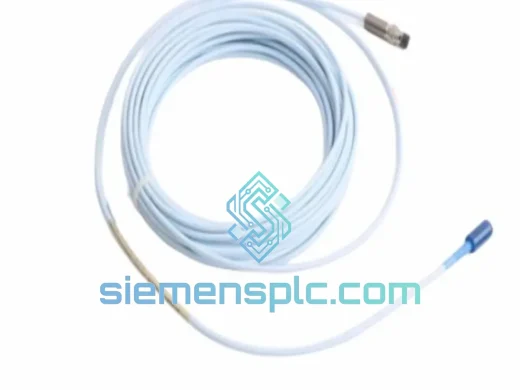
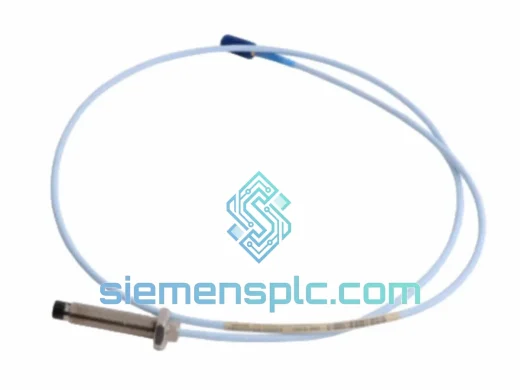
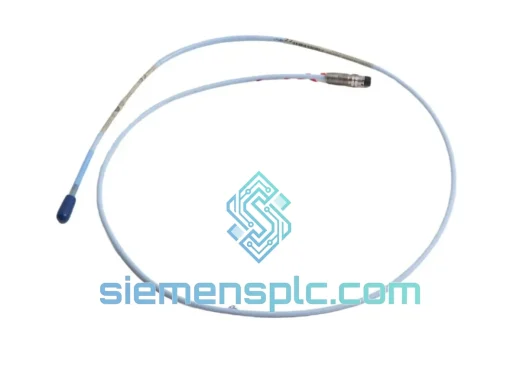
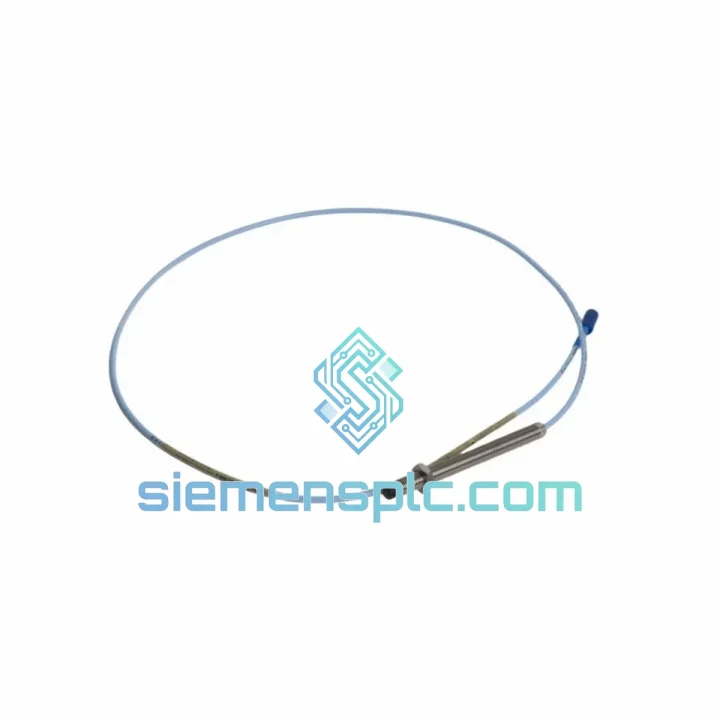
Bently Nevada 330196-05-30-10-00 Proximity Probe – 3300 XL ETR
3301
Origin US
Proximity Probe
Request verified availability, condition, replacement risk review, packing options and courier lead time for 330103-00-08-50-02-CN.
Click Request Quote and the part number is inserted into the inquiry form automatically.
Core fields for model confirmation and RFQ routing. Detailed product narrative remains below.
The Bently Nevada 330103-00-08-50-02-CN is an 8 mm diameter eddy-current proximity transducer from the 3300 XL Proximity Transducer System, designed for non-contact measurement of radial shaft vibration, axial position, and differential expansion on rotating machinery. The CN suffix designates the China-market connector interface, making this variant the correct specification for domestic CN-terminal installations and locally sourced junction boxes.
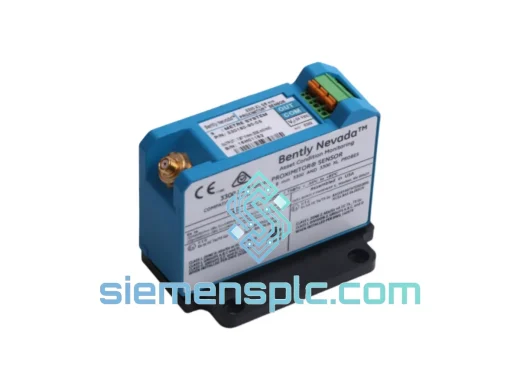
Within a machinery protection control loop, this transducer occupies the primary sensing node. It converts the physical air gap between its probe tip and the conductive shaft surface into a proportional DC voltage, which is then conditioned by a matched 3300 XL 8mm Proximitor driver and fed into a Bently Nevada 3500 Series monitor rack for alarm and trip processing. The suffix breakdown is as follows: 330103 = 8 mm probe body; 00 = standard configuration; 08 = 8 mm tip diameter; 50 = 5.0 m extension cable; 02 = armored cable jacket; CN = China connector standard. Each suffix segment carries a direct hardware implication — none are cosmetic.
The transducer operates on the eddy-current induction principle. A high-frequency oscillator within the matched Proximitor driver (typically 1.0–1.5 MHz, driver-dependent) drives a coil embedded in the probe tip. When a conductive target enters the electromagnetic field, induced eddy currents load the oscillator circuit, reducing its amplitude in proportion to the gap distance. The Proximitor linearizes this response across a calibrated range of 0.25 mm to 2.25 mm, producing a scale factor of 7.87 V/mm (200 mV/mil). The frequency response is flat from DC to 10,000 Hz (±3 dB), which is sufficient to resolve sub-synchronous instabilities, 1× and 2× running-speed components, and blade-pass frequencies in most turbomachinery applications without additional signal conditioning.
The 5.0 m armored extension cable (suffix -50-02) is factory-matched to the transducer and driver as a calibrated system. The cable length is not an arbitrary selection: the distributed capacitance and inductance of the cable form part of the oscillator tank circuit. Substituting a different cable length without a corresponding driver recalibration will shift the effective scale factor and introduce a systematic measurement error — a constraint explicitly addressed in API 670 5th Edition, Section 5.3.2. Field personnel must not interchange cable lengths between matched sets.
Real-time Stock & RFQ: [email protected] | WhatsApp: +86 18359268345
| Parameter | Specification |
|---|---|
| Part Number | 330103-00-08-50-02-CN |
| Brand | Bently Nevada (Baker Hughes) |
| Series | 3300 XL Proximity Transducer System |
| Sensing Principle | Eddy-current, non-contact inductive |
| Probe Tip Diameter | 8 mm |
| Extension Cable Length | 5.0 m (suffix -50) |
| Cable Jacket Type | Armored (suffix -02) |
| Connector Standard | CN-spec (China market terminal) |
| Calibrated Linear Range | 0.25 mm – 2.25 mm |
| Scale Factor | 7.87 V/mm (200 mV/mil) |
| Oscillation Frequency | 1.0 – 1.5 MHz (driver-dependent) |
| Frequency Response | DC – 10,000 Hz (±3 dB) |
| Supply Voltage | −24 VDC nominal |
| Output Voltage Range | −2 VDC to −18 VDC |
| Operating Temperature | −35°C to +121°C |
| Standard Target Material | AISI 4140 alloy steel |
| Probe Body Material | 316 stainless steel housing, PEEK tip encapsulant |
| Transducer Weight | ~40 g |
| Certifications | CE, ATEX (Zone 1/IIC), FM (Div. 1) |
| Compliance Standard | API 670 5th Edition |
| Warranty | 12 months against manufacturing defects and calibration drift |
The 3300 XL probe body is constructed around a precision-wound coil assembly encapsulated in a PEEK (polyether ether ketone) tip body. PEEK was selected for its combination of electrical non-conductivity (preventing coil-to-housing short circuits), dimensional stability across the full −35°C to +121°C operating range, and chemical resistance to turbine oils, seal gases, and process hydrocarbons. The coil geometry is held to tight inductance tolerances at the factory, which is the primary determinant of scale factor consistency across production batches and the reason matched-set calibration is mandatory rather than optional.
EMC Architecture: The armored cable jacket (suffix -02) provides a continuous metallic shield from the probe body to the Proximitor driver input terminal. The shield is grounded at the driver end only — a deliberate single-point grounding topology that prevents ground-loop currents from circulating through the shield conductor. Ground loops in unshielded or dual-grounded installations appear as low-frequency noise (typically 50/60 Hz and harmonics) superimposed on the output signal, which can trigger false alarms on vibration monitors set to low trip thresholds. In installations adjacent to variable-frequency drives or high-current bus bars, the armored jacket attenuates capacitively coupled interference by 40–60 dB compared to unshielded cable runs of equivalent length.
Target Material Sensitivity: The eddy-current field penetration depth is governed by the skin effect, which is a function of target electrical conductivity and magnetic permeability. AISI 4140 steel — the standard calibration target — has well-characterized electromagnetic properties at the 1.0–1.5 MHz oscillation frequency, producing the rated 7.87 V/mm scale factor. Non-standard shaft alloys such as Inconel 718, 17-4 PH stainless, or titanium exhibit different conductivity-permeability products and will produce a shifted scale factor. In these cases, a material correction factor must be applied, or the matched set must be recalibrated against a sample of the actual shaft material. This is a fundamental hardware constraint of the eddy-current measurement principle, not a software-configurable parameter.
Connector Integrity: The CN-spec connector uses gold-plated contacts with a threaded locking collar rated for a minimum of 500 mating cycles. In field installations subject to continuous mechanical vibration — such as compressor skids or gearbox housings — the locking collar prevents connector loosening, which is a common failure mode in push-fit connector designs. A loose connector produces intermittent signal dropout that is electrically indistinguishable from an actual shaft excursion, generating nuisance trips and complicating fault diagnosis.
Calibration Traceability: Each unit leaves the factory with a Certificate of Conformance recording the actual measured scale factor, zero-gap voltage, and linearity deviation for that specific transducer-cable-driver combination. This per-unit traceability is a requirement of API 670 installations where the measurement uncertainty budget must be formally documented and auditable.
Every Bently Nevada 330103-00-08-50-02-CN unit supplied by siemensplc.com is sourced from authorized distribution channels and OEM-certified inventory. Prior to dispatch, each unit undergoes a structured functional verification protocol: output linearity check across the full 0.25–2.25 mm calibrated range, scale factor measurement against the rated 7.87 V/mm value (tolerance ±1%), insulation resistance test on the armored cable jacket (minimum 100 MΩ at 500 VDC), and connector contact continuity verification. Units that fall outside the factory tolerance band are quarantined and not shipped.
Documentation supplied with each unit includes the original Bently Nevada Certificate of Conformance, functional test report, and — where available — the factory calibration data sheet with per-unit scale factor and linearity deviation records. This documentation package supports the traceability requirements of ISO 9001-compliant maintenance management systems and API 670 audit trails.
Logistics are managed from our warehouse in Xiamen, China. In-stock units are dispatched within 1–3 business days via DHL Express, FedEx International Priority, or UPS Worldwide Expedited. Typical transit times are 3–5 business days to Europe, North America, and Southeast Asia. Export documentation — commercial invoice, packing list, and HS code 9031.80 classification — is prepared for each shipment to facilitate customs clearance. For time-critical plant shutdowns, same-day dispatch is available on confirmed orders received before 14:00 CST. A 12-month warranty covers manufacturing defects and verified calibration drift beyond factory tolerance, with a 48-hour target response time on warranty claims.
Email: [email protected]
WhatsApp: +86 18359268345
Web: siemensplc.com
Location: Xiamen, China
© 2026 siemensplc.com. All rights reserved.
We check the full part number, brand, series and visible nameplate information before quotation.
Sales confirms stock path, condition option, quantity and realistic lead time for export dispatch.
DHL, FedEx, UPS or buyer courier arrangements can be reviewed with packing requirements.
Similar brand or category products for fast comparison and multi-item RFQ lists.