
Emerson
In Stock OK
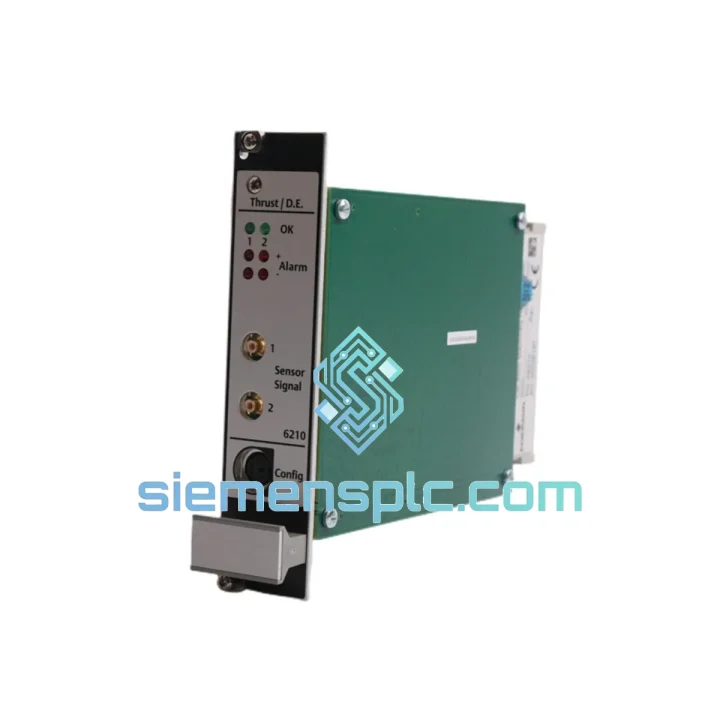
EMERSON A6210 Thrust Differential Expansion Module
Request verified availability, condition, replacement risk review, packing options and courier lead time for A6210.
BrandEmerson
Part NumberA6210
ConditionAvailability Check
Lead TimeRFQ Confirmation
DocumentsDatasheet / photos by RFQ
ShippingExport packing available
Auto-filled RFQ
A6210
Click Request Quote and the part number is inserted into the inquiry form automatically.
- Reply by email: [email protected]
- WhatsApp / Tel: +86 18359268345
- Mon-Sat 9:00-18:00 GMT+8
Procurement Data
Key Product Information
Core fields for model confirmation and RFQ routing. Detailed product narrative remains below.
- Brand
- Emerson
- Primary Part Number
- A6210
- Product Type
- DCS Input Module
- Series / Family
- Ovation
- Manufacturer
- EMERSON (Ovation / Westinghouse Process Control)
- Country of Origin
- US
- Catalog Category
- I/O Modules
- Operating Temp.
- 0°C to +60°C
- Humidity
- 5% to 95% non-condensing
Model confirmed for inquiry
A6210
Send quantity, destination and urgency. The RFQ form keeps this part number attached.
Request Quote
Product Overview
EMERSON A6210 Ovation DCS Thrust & Differential Expansion Module – Every Hour of Downtime Costs You Money. We Ship in 48 Hours.
Your turbine tripped. The DCS is throwing a channel fault on the thrust or differential expansion loop. Maintenance is standing by. Operations is calling every 15 minutes. You’ve already checked the probe, the driver, and the cable — the A6210 module itself is dead. You need a replacement now, not in six weeks from the OEM’s lead time queue.
We stock the EMERSON A6210 — the dual-channel thrust and differential expansion input module for the Ovation Distributed Control System — and we ship from Xiamen within 48 hours of order confirmation. DHL Express or FedEx International Priority gets it to your plant in Southeast Asia, the Middle East, or Europe in 2–5 business days. That’s the difference between a controlled restart and a prolonged forced outage that bleeds your production budget dry.
Every unit we supply is 100% original EMERSON Ovation hardware. No grey-market substitutes. No refurbished-as-new misrepresentation. Full documentation — Certificate of Conformance, pre-shipment inspection photos, and functional test report — ships with every order.
URGENT REQUIREMENT? Contact: [email protected] | WhatsApp: +86 18359268345
Quick Technical Datasheet
| Part Number | A6210 |
| Manufacturer | EMERSON (Ovation / Westinghouse Process Control) |
| Module Function | Dual-Channel Thrust & Differential Expansion Input |
| Platform | Ovation DCS (Distributed Control System) |
| Input Signal | Eddy-current proximity probe (Bently Nevada 3300/3500 compatible) |
| Backplane Power | 24 VDC via Ovation I/O backplane |
| Operating Temperature | 0°C to +60°C |
| Storage Temperature | -40°C to +85°C |
| Humidity | 5% to 95% non-condensing |
| Certifications | CE, UL Listed, RoHS Compliant |
| Firmware Compatibility | Ovation v3.x and above |
| Weight | Approx. 420 g |
| Stock Status | ✔ Ready to Ship – Xiamen Warehouse |
| Lead Time | Ships within 48 hours of order confirmation |
Troubleshooting & Replacement Tips
The A6210 fails in predictable ways. Here’s what I’ve seen in the field and how to handle the swap without creating new problems:
Common Fault Signatures Before Module Failure:
- Ovation Alarm: “CH1 HARDWARE FAULT” or “CH2 OPEN CIRCUIT” — The module’s internal ADC or signal conditioning circuit has failed. Probe and driver are healthy; the A6210 is the culprit. Confirm by swapping the probe cable to a known-good channel.
- Intermittent “THRUST HIGH” trips with no process change — Classic sign of a failing A/D converter inside the module generating noise spikes. Don’t chase the probe — replace the module.
- Both channels reading identical values regardless of shaft position — Internal multiplexer failure. The module is cross-talking channels. Immediate replacement required; this condition can mask a real thrust excursion.
- Module LED status: solid red or alternating red/amber — Backplane communication lost or internal watchdog timeout. Power-cycle the module first; if the fault persists after 3 cycles, the module is unrecoverable.
Replacement Procedure — Field Notes:
- Step 1 — Inhibit the protection loop. Before pulling the module, inhibit the thrust and differential expansion trips in the Ovation safety logic. Confirm with the control room that the inhibit is active. Do not pull a live module with trips armed — you will cause a spurious shutdown.
- Step 2 — Record the slot address. The A6210 uses backplane slot addressing. Note the physical slot number before removal. The replacement module must go back into the exact same slot — Ovation assigns I/O addresses by slot position, not by module serial number.
- Step 3 — Check the DIP switch configuration. Some A6210 revisions have hardware DIP switches on the PCB edge that set channel mode (thrust vs. differential expansion) and probe type (eddy-current vs. LVDT). Photograph the switch positions on the failed module before discarding it. Set the replacement to match exactly.
- Step 4 — Firmware version check. After insertion, the Ovation controller will attempt to download the module firmware. If the replacement module carries a different firmware baseline than the controller expects, you’ll get a “MODULE MISMATCH” alarm. Resolve this through Ovation Developer Studio — navigate to the I/O configuration, right-click the slot, and select “Download Module Firmware.” This takes 60–90 seconds.
- Step 5 — Channel calibration verification. Once the module is online, compare the live channel readings against the proximity probe gap voltage (measured at the driver output with a multimeter). The A6210 should report a position value consistent with the gap voltage per the probe’s sensitivity curve (typically 7.87 V/mm for Bently Nevada standard probes). If there’s a discrepancy, re-enter the calibration constants in the Ovation I/O configuration.
- Step 6 — Remove the inhibit and confirm trip setpoints. Restore the protection logic, confirm both channels are reading correctly, and verify that the trip setpoints are active. Log the replacement in the plant maintenance management system (CMMS) with the new module serial number.
Reliability in Harsh Conditions
The A6210 is designed for the realities of turbine hall environments — not a climate-controlled server room. EMERSON’s Ovation I/O modules are qualified to operate continuously in conditions that would destroy commercial-grade electronics:
- Vibration: The module’s PCB assembly is conformal-coated and component-secured to withstand continuous vibration levels consistent with IEC 60068-2-6 (sinusoidal) and IEC 60068-2-64 (random). In turbine halls where the floor itself vibrates at 50/60 Hz harmonics, the A6210 maintains signal integrity without connector fretting or solder joint fatigue.
- Thermal Cycling: Power plants cycle between cold startups and full-load operation repeatedly. The A6210’s wide operating range (0°C to +60°C) and storage range (-40°C to +85°C) mean it survives both winter cold-start conditions and summer peak-load thermal soak inside enclosures without derating.
- Humidity and Condensation: Coastal and tropical plant sites — common in Southeast Asia and the Middle East — expose control hardware to high ambient humidity. The conformal coating on the A6210 PCB provides a moisture barrier that prevents dendritic growth and corrosion on signal traces, which is the primary failure mode for uncoated boards in these environments.
- EMI/RFI Immunity: Turbine halls are electrically noisy environments. High-current motor drives, bus ducts, and grounding issues create conducted and radiated interference. The A6210’s shielded backplane interface and differential signal inputs provide common-mode rejection that keeps measurement noise below the threshold that would trigger nuisance alarms.
- ESD Handling: Every unit we ship is stored and transported in ESD-safe packaging. The A6210’s CMOS input circuitry is sensitive to electrostatic discharge — a single unprotected handling event can degrade the ADC without producing an immediate visible fault, leading to a latent failure weeks later. Our packaging protocol eliminates this risk.
Global Express Logistics
We operate from Xiamen, China — one of the most logistics-connected export hubs in Asia. When your plant is down and every hour matters, here’s exactly how your A6210 gets from our warehouse to your site:
- Order Confirmation → Warehouse Pick (Same Day): Orders confirmed before 14:00 CST are picked, inspected, and packaged the same business day. Pre-shipment photos are sent to you before the box is sealed.
- Export Documentation (Day 1): Commercial invoice, packing list, Certificate of Origin, and COC are prepared in parallel with packaging. For customers requiring specific customs commodity codes or end-user declarations, we prepare these on request — no delays.
- DHL Express / FedEx International Priority (Day 2 Dispatch): Shipments are handed to DHL or FedEx at Xiamen pickup. Transit times: Southeast Asia 1–2 days, Middle East 2–3 days, Europe 3–4 days, Americas 3–5 days. Tracking number is sent to you immediately upon carrier pickup.
- Customs Clearance Support: We declare all shipments accurately with correct HS codes for industrial control modules. For customers in countries with import licensing requirements for automation equipment, we provide the necessary documentation to support your customs broker.
- Emergency Air Freight: For absolute critical situations — turbine offline, production stopped — we can arrange next-flight-out air freight through our freight forwarder network. Contact us directly to discuss options.
Contact Information
Email: [email protected]
WhatsApp: +86 18359268345
Web: siemensplc.com
© 2026 siemensplc.com. All rights reserved.
Ready to quote
[email protected]
Send This Part Number to Sales
RFQ workflow
Quality workflow ->
Confirmation Process
01Model confirmation
We check the full part number, brand, series and visible nameplate information before quotation.
02Availability reply
Sales confirms stock path, condition option, quantity and realistic lead time for export dispatch.
03Packing & courier
DHL, FedEx, UPS or buyer courier arrangements can be reviewed with packing requirements.
Continue sourcing
Browse full catalog ->
Related Automation Parts
Similar brand or category products for fast comparison and multi-item RFQ lists.
Emerson
RFQ Ready
Emerson OVATION VE5008 5X00150G01 AMS Device Interface Module
OVATION
Origin US
DCS I/O Module
Emerson
RFQ Ready
Emerson UNI1404 DCS Universal Input Module – Ovation Series
Ovation
Origin US
DCS Universal Input Module
Emerson
RFQ Ready
Emerson UNI1401 Digital Output Module – Ovation DCS
Ovation
Origin US
Digital Output Module