KOLLMORGEN
RFQ Ready
KOLLMORGEN S7240F-NAF2NA-NA-035 Servo Motor – AKM Series
ss Servo Motor - AKM Series
Origin US
Servo Motor
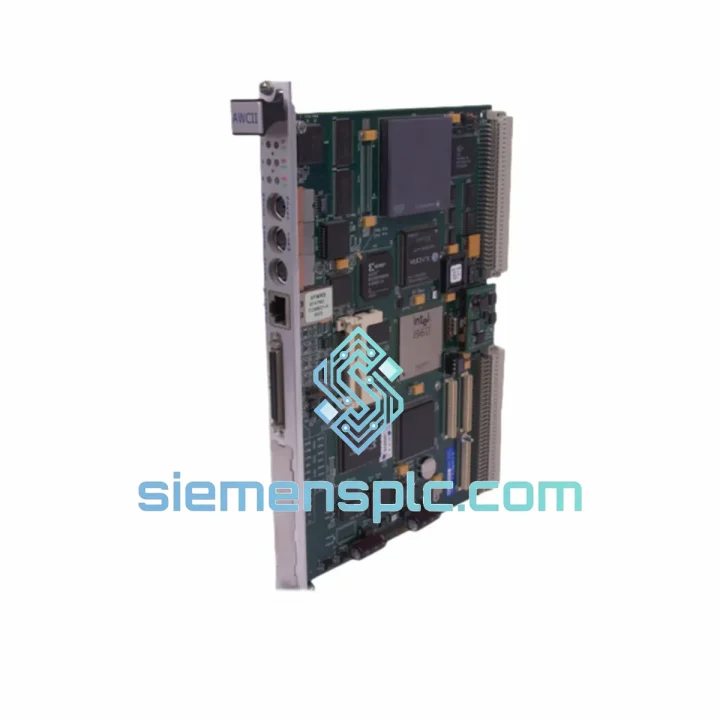
Request verified availability, condition, replacement risk review, packing options and courier lead time for AWCII-040.
Click Request Quote and the part number is inserted into the inquiry form automatically.
Core fields for model confirmation and RFQ routing. Detailed product narrative remains below.
The ADEPT AWCII-040 is the central processing unit of the AWCII controller series, a backplane-based architecture purpose-built for multi-axis robotic motion coordination and deterministic real-time task execution. Operating at a 40 MHz clock frequency, this module occupies the dedicated CPU slot on the AWCII backplane and assumes full authority over trajectory interpolation, servo loop closure timing, I/O arbitration, and V+ runtime scheduling. Unlike general-purpose embedded controllers, the AWCII-040 is engineered to sustain hard real-time constraints across concurrent motion tasks without relying on software-layer prioritization schemes.
The module interfaces directly with ADEPT SmartAmp servo amplifier cards via the proprietary AWCII backplane bus, which operates at a fixed 16-bit parallel data width with synchronous clock arbitration. This bus topology eliminates the variable latency inherent in serial fieldbus architectures, allowing the AWCII-040 to deliver servo update cycles with sub-millisecond jitter margins — a prerequisite for coordinated multi-axis path control in SCARA and Cartesian robot configurations. The processor’s internal memory map partitions program execution space, motion buffer storage, and I/O state tables into non-overlapping address regions, preventing runtime contention between the V+ interpreter and the motion kernel.
From a hardware architecture standpoint, the AWCII-040 implements a synchronous bus mastering scheme in which the CPU module asserts bus ownership during each servo cycle update, then releases the bus to peripheral I/O cards for asynchronous data exchange. This arbitration model ensures that motion-critical data paths are never preempted by lower-priority I/O transactions. The onboard clock generation circuit uses a crystal-stabilized oscillator with a specified frequency tolerance of ±50 ppm, which directly governs the determinism of the servo interrupt service routine. Any deviation in clock accuracy would propagate as positional error in closed-loop servo systems, making oscillator stability a non-negotiable design parameter at this clock rate.
The AWCII-040 supports the full ADEPT V+ programming language runtime, including real-time task switching between up to four concurrent program tasks. Task context switching is handled at the hardware interrupt level, with each task assigned a fixed priority tier. The motion kernel occupies the highest interrupt priority, ensuring that path planning computations and servo output updates are never delayed by user-program execution. This architecture is particularly relevant in applications where robot motion must be synchronized with external machine signals — for example, conveyor tracking or vision-guided pick-and-place — where any latency in the motion update cycle would result in positional offset errors.
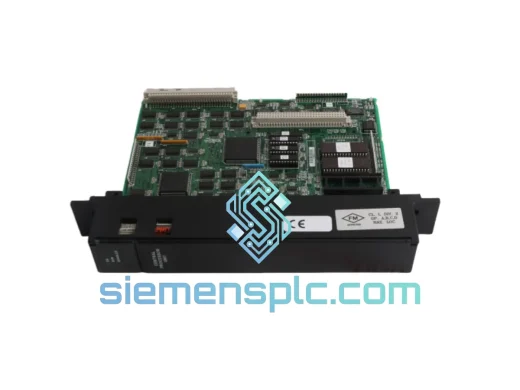
Physically, the AWCII-040 is a full-length ISA-form-factor card designed for insertion into slot 0 of the AWCII controller chassis. The card edge connector carries power rails at +5 VDC and ±12 VDC, with onboard voltage regulation providing local filtering for the processor core and memory subsystems. The PCB layout follows a ground-plane sandwich construction, with the signal layer routed between two continuous copper ground planes to suppress radiated emissions and reduce susceptibility to conducted interference from adjacent servo amplifier cards — a practical EMC measure given the high-current switching transients generated by SmartAmp modules during motor commutation.
For maintenance and spare-parts planning, the AWCII-040 is the only processor module compatible with the standard AWCII backplane. It cannot be substituted with the AWCII-030 (30 MHz variant) without verifying that the installed V+ firmware version supports the lower clock rate, as certain motion library routines have minimum clock frequency dependencies. Conversely, upgrading from an AWCII-030 to the AWCII-040 is a direct slot replacement in most chassis configurations, provided the firmware is updated to a version that enables the 40 MHz execution path.
Real-time Stock & RFQ: [email protected] | WhatsApp: +86 18359268345
| Parameter | Specification |
|---|---|
| Part Number | AWCII-040 |
| Manufacturer | ADEPT Technology |
| Module Type | CPU / Processor Module |
| Controller Series | AWCII (Adept World Controller II) |
| Processor Clock Frequency | 40 MHz |
| Bus Interface | 16-bit parallel, synchronous AWCII backplane bus |
| Backplane Slot | Slot 0 (CPU slot, mandatory) |
| Supply Voltage | +5 VDC, ±12 VDC (via backplane) |
| Form Factor | Full-length ISA-compatible card |
| Runtime Environment | ADEPT V+ real-time operating system |
| Concurrent Task Support | Up to 4 real-time program tasks |
| Compatible Robot Series | ADEPT MV, Cobra, Viper (verify per model) |
| Compatible Amplifier | ADEPT SmartAmp servo amplifier modules |
| Operating Temperature | 0°C to +55°C (controller chassis ambient) |
| PCB Construction | Ground-plane sandwich, multi-layer |
| Weight | Approx. 1,250 g |
| Condition Available | New, Refurbished (tested), Used (inspected) |
| Warranty | 12 months from date of shipment |
| Origin | United States (ADEPT Technology) |
The AWCII-040’s EMC design centers on the ground-plane sandwich PCB construction, where all high-frequency signal traces are routed between two unbroken copper ground planes. This geometry reduces the effective loop area of signal return paths to near-zero, which directly attenuates both radiated emissions and susceptibility to external magnetic field coupling. In a controller chassis populated with SmartAmp cards — each switching motor phase currents at kilohertz rates — this shielding approach is not cosmetic; it is a functional requirement for maintaining signal integrity on the CPU’s address and data buses.
The crystal-stabilized clock oscillator on the AWCII-040 uses a temperature-compensated crystal (TCXO-class tolerance) to maintain the 40 MHz base frequency within ±50 ppm across the operating temperature range. This stability directly governs the servo interrupt period. At 40 MHz with a typical servo loop divisor, the interrupt fires at a fixed interval — any clock drift would manifest as a variable servo update rate, introducing periodic velocity ripple in closed-loop motion profiles. The TCXO-class oscillator eliminates this failure mode.
Bus arbitration on the AWCII backplane uses a fixed-priority mastering scheme: the AWCII-040 asserts bus request at the start of each servo cycle, holds the bus for the duration of the motion kernel update, then releases it. Peripheral I/O cards operate as bus slaves and may only drive the bus during the release window. This deterministic arbitration model means that servo update latency is bounded by hardware design, not by software scheduling — a fundamental distinction from PC-based soft-motion controllers where OS scheduling jitter can corrupt servo timing.
The onboard memory subsystem partitions SRAM into three non-overlapping regions: the V+ program execution heap, the motion trajectory buffer, and the I/O state mirror table. Hardware address decoding enforces these boundaries at the memory controller level, preventing any software bug in the V+ interpreter from corrupting motion buffer data. This architectural separation is a key reliability feature in long-running production environments where unattended operation is required.
Every ADEPT AWCII-040 module supplied by siemensplc.com undergoes a structured incoming inspection protocol before dispatch. Each unit is subjected to visual examination for PCB damage, component displacement, and connector pin integrity. Functional verification includes power-on initialization testing, backplane bus continuity measurement, and V+ runtime boot confirmation where test fixtures permit. Refurbished units additionally undergo a 48-hour burn-in cycle under controlled thermal conditions to screen for early-life component failures.
Sourcing channels are limited to verified industrial surplus inventories, authorized distributor overstock, and documented OEM returns. Grey-market and unverified secondary-market units are excluded from the supply chain. Each shipment is accompanied by an inspection record and, upon request, a third-party test report.
Logistics operations are based in Xiamen, China, with direct access to international express freight services including DHL Express, FedEx International Priority, and UPS Worldwide Expedited. Standard dispatch lead time for in-stock units is 1–2 business days from order confirmation. Export documentation — including commercial invoice, packing list, and HS code declaration — is prepared for all international shipments to facilitate customs clearance. Electrostatic-sensitive packaging (ESD bags, foam-lined cartons) is used for all processor module shipments.
All units are covered by a 12-month warranty from the date of shipment, covering functional failure under normal operating conditions. Warranty claims are processed with a target response time of 48 hours.
Email: [email protected]
WhatsApp: +86 18359268345
Web: siemensplc.com
Location: Xiamen, China
© 2026 siemensplc.com. All rights reserved.
We check the full part number, brand, series and visible nameplate information before quotation.
Sales confirms stock path, condition option, quantity and realistic lead time for export dispatch.
DHL, FedEx, UPS or buyer courier arrangements can be reviewed with packing requirements.
Similar brand or category products for fast comparison and multi-item RFQ lists.