Deep Sea Electronics
RFQ Ready
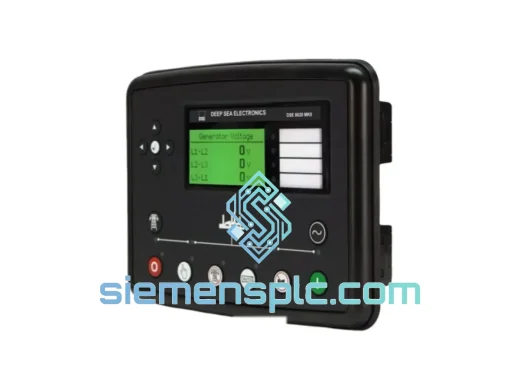
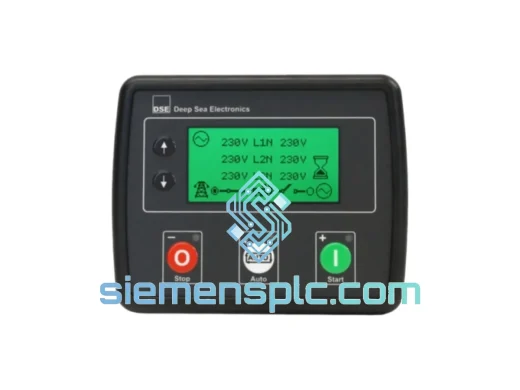
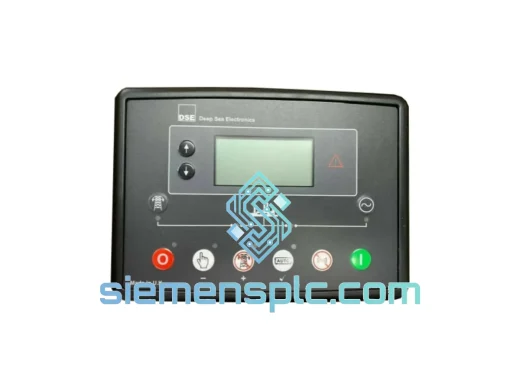
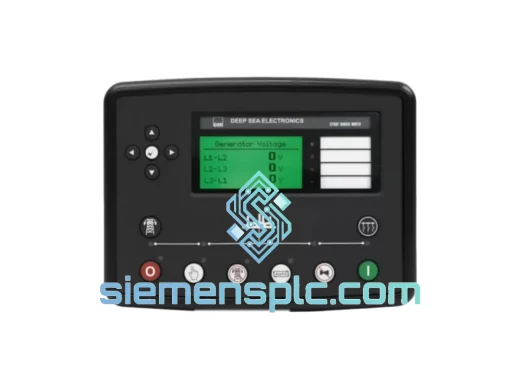
Deep Sea Electronics DSE8660 MKII Generator Control Module
Sea Electronics 8000 Series
Origin GB
Generator Control Module
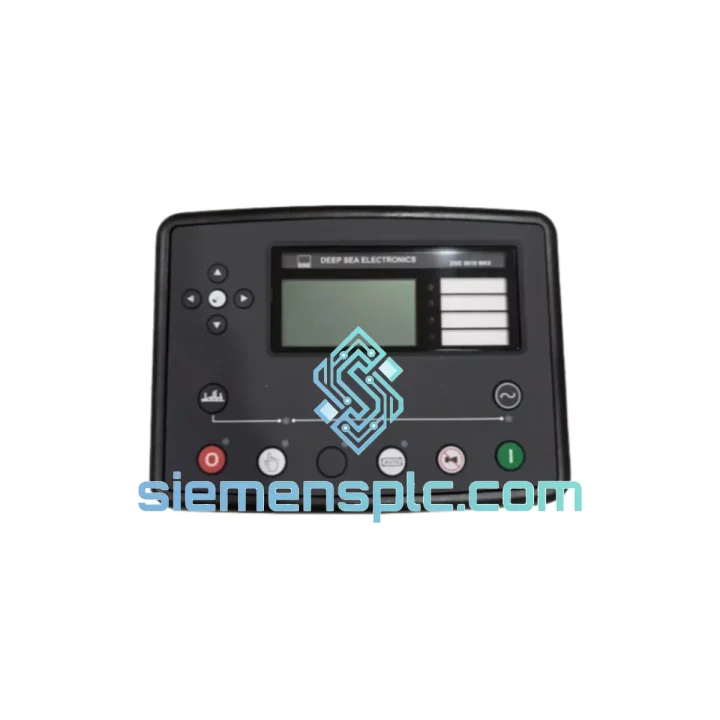
Request verified availability, condition, replacement risk review, packing options and courier lead time for DSE8610 MKII.
Click Request Quote and the part number is inserted into the inquiry form automatically.
Core fields for model confirmation and RFQ routing. Detailed product narrative remains below.
The DSE8610 MKII is a second-generation automatic mains failure (AMF) and auto-start generator control module from Deep Sea Electronics’ DSE8000 Series. It is designed for deployment in standby power systems where grid failure must trigger a deterministic, sequenced generator start within a defined time window — without operator intervention. The module handles the full AMF cycle: mains monitoring, engine crank sequencing, load transfer authorization, and return-to-mains logic, all governed by configurable timers and threshold parameters stored in non-volatile memory.
Unlike simpler relay-based AMF schemes, the DSE8610 MKII integrates a microprocessor-driven measurement engine that samples mains voltage and frequency at high resolution. When measured values deviate beyond user-defined limits — typically ±15% voltage and ±6% frequency — the module initiates a configurable pre-start delay, then activates the fuel solenoid and starter motor outputs in a controlled sequence. Crank disconnect logic prevents starter motor re-engagement once the engine fires, protecting the ring gear from mechanical damage. The MKII revision introduced improved ADC resolution across all analogue measurement channels, reducing measurement uncertainty on voltage, current, and power parameters compared to the original DSE8610.
The hardware architecture centers on a 32-bit embedded processor with dedicated peripheral controllers for relay output management, serial communication, and display driving. All relay outputs are rated for resistive and inductive loads, with suppression diodes fitted across coil-driven outputs to limit back-EMF transients. The front panel LCD operates across the full supply voltage range of 8–35 V DC, making the module compatible with both 12 V and 24 V battery systems without external regulation. The IP65-rated front bezel provides ingress protection against dust and water jets, qualifying the DSE8610 MKII for panel installations in industrial enclosures subject to wash-down or high-humidity environments.
Communication architecture supports RS-232 for local PC configuration, RS-485 for Modbus RTU integration with SCADA and BMS platforms, and a USB port for firmware updates and configuration file transfer. The DSE Configuration Suite software — freely available from Deep Sea Electronics — provides a graphical interface for mapping all configurable parameters: start/stop timers, voltage and frequency thresholds, engine protection trip levels, and I/O assignments. Configuration files are stored as binary profiles that can be cloned across multiple units, reducing commissioning time in multi-generator installations.
Engine protection inputs accept both digital (switch-to-ground) and analogue (resistive sender) signals. Standard monitored parameters include oil pressure, coolant temperature, battery voltage, charge alternator failure, and over/under speed. Each protection input can be independently configured for pre-alarm (warning) or shutdown action, with configurable delays to suppress nuisance trips during engine warm-up. The event log retains the last 250 alarm and operational events with timestamps, providing a traceable fault history for maintenance engineers performing root-cause analysis after an unplanned shutdown.
The DSE8610 MKII supports J1939 CAN bus interfaces for electronic engine management systems from Cummins, Perkins, Volvo Penta, MTU, and Caterpillar. When connected via CAN, the module reads engine parameters — speed, oil pressure, coolant temperature, fuel rate — directly from the ECU, eliminating the need for separate analogue senders and reducing wiring complexity in the generator control panel. This also enables access to manufacturer-specific fault codes, which are displayed on the LCD and logged in the event record.
In terms of EMC design, the DSE8610 MKII is CE-marked and RoHS-compliant. The PCB layout employs ground plane partitioning to isolate the analogue measurement front-end from the digital processing core, reducing susceptibility to conducted and radiated interference from the generator’s alternator and ignition system. Relay output circuits are physically separated from low-level signal traces, and all external interface connectors include transient voltage suppression (TVS) devices rated for IEC 61000-4-5 surge immunity.
Real-time Stock & RFQ: [email protected] | WhatsApp: +86 18359268345
| Parameter | Specification |
|---|---|
| Model | DSE8610 MKII |
| Manufacturer | Deep Sea Electronics (DSE), United Kingdom |
| Series | DSE8000 Series |
| Function | Automatic Mains Failure (AMF) & Auto-Start Generator Controller |
| Supply Voltage | 8–35 V DC (12 V / 24 V battery systems) |
| Quiescent Current | <35 mA @ 12 V DC (display off) |
| Operating Temperature | -30°C to +70°C |
| Storage Temperature | -40°C to +80°C |
| Front Panel Protection | IP65 (IEC 60529) |
| Display | Backlit LCD, multi-language |
| Digital Inputs | Configurable switch-to-ground inputs for engine protection and remote commands |
| Analogue Inputs | Resistive sender inputs for oil pressure and coolant temperature |
| Relay Outputs | Fuel, Start, Load Transfer, Auxiliary (configurable) |
| Communication Ports | RS-232, RS-485 (Modbus RTU), USB |
| CAN Bus | J1939 (Cummins, Perkins, Volvo Penta, MTU, Caterpillar) |
| Event Log Capacity | 250 events with timestamps |
| Certifications | CE, RoHS |
| Weight | Approx. 800 g |
| Country of Origin | United Kingdom |
| Warranty | 12 months from date of dispatch |
The DSE8610 MKII’s measurement front-end uses a dedicated analogue-to-digital conversion stage with separate sampling channels for mains L1/L2/L3 voltages, mains frequency, generator output voltage and frequency, and load current via external CTs. The MKII revision increased ADC resolution on these channels, which directly improves the accuracy of power factor calculation and kW/kVAr metering — parameters that matter in installations where the generator must operate in parallel with the mains for a brief transfer window.
The relay output driver stage uses discrete transistor arrays rather than integrated relay driver ICs, providing higher surge current tolerance during relay coil energization. Each output relay is rated for 8 A at 250 V AC resistive, with a mechanical life expectancy exceeding 10 million operations. The starter relay output includes a configurable crank disconnect speed threshold: once the engine reaches this speed (detected via magnetic pickup or W-terminal), the starter output de-energizes within one processing cycle — typically under 20 ms — preventing mechanical overrun.
EMC hardening is implemented at three levels. First, the PCB uses a four-layer stackup with dedicated power and ground planes, minimizing loop area for high-frequency return currents. Second, all external I/O lines pass through RC filter networks at the PCB boundary, attenuating conducted interference above 1 MHz. Third, the enclosure design provides a continuous metallic ground path around the front panel bezel, contributing to shielding effectiveness against radiated emissions from the generator’s alternator field winding.
The non-volatile parameter store uses EEPROM with wear-leveling logic, ensuring configuration data integrity across a minimum of 100,000 write cycles — sufficient for the expected lifetime of parameter adjustments in a typical generator installation. A watchdog timer circuit monitors the main processor; if the firmware execution path stalls for more than the watchdog timeout period, the processor is reset and the module returns to a defined safe state, preventing a locked-up controller from inhibiting generator operation during a real mains failure event.
Every DSE8610 MKII unit supplied through siemensplc.com is sourced from verified supply channels and undergoes a structured incoming inspection process at our Xiamen, China facility. Physical inspection covers label authenticity, connector integrity, and firmware version verification against the current DSE release. Batch and serial number records are maintained for full traceability from our inventory to the end customer.
Units are dispatched in original or equivalent anti-static protective packaging with foam cushioning rated for the module’s weight class. For international shipments, we use DHL Express, FedEx International Priority, and UPS Worldwide Express as primary carriers, with typical transit times of 3–5 business days to Europe, North America, Southeast Asia, and the Middle East. Sea freight consolidation is available for bulk orders where lead time permits. All shipments include a commercial invoice, packing list, and certificate of origin. Export documentation for customs clearance is prepared in accordance with the destination country’s import requirements.
A 12-month warranty applies from the date of dispatch. Warranty claims are processed through our Xiamen technical team. In the event of a confirmed manufacturing defect, replacement units are dispatched within 3 business days of fault verification. Our technical support team — staffed by engineers with hands-on experience in generator control panel design — is available via email and WhatsApp to assist with installation, configuration, and fault diagnosis queries.
Email: [email protected]
WhatsApp: +86 18359268345
Web: siemensplc.com
Location: Xiamen, China
© 2026 siemensplc.com. All rights reserved.
We check the full part number, brand, series and visible nameplate information before quotation.
Sales confirms stock path, condition option, quantity and realistic lead time for export dispatch.
DHL, FedEx, UPS or buyer courier arrangements can be reviewed with packing requirements.
Similar brand or category products for fast comparison and multi-item RFQ lists.