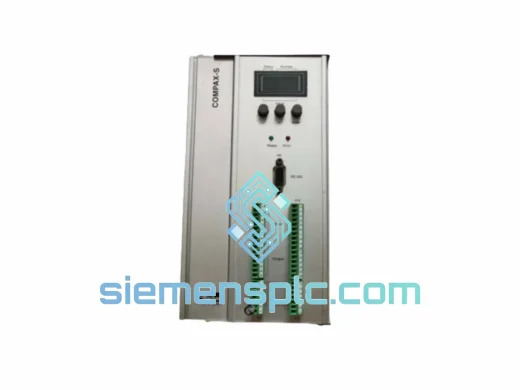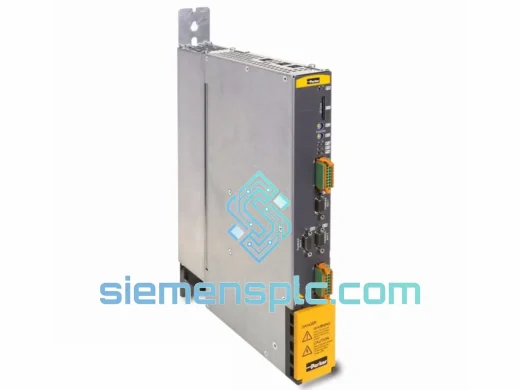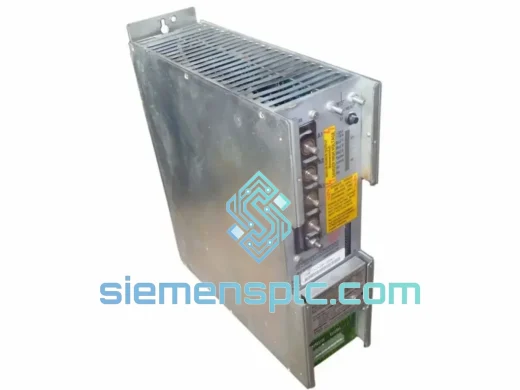
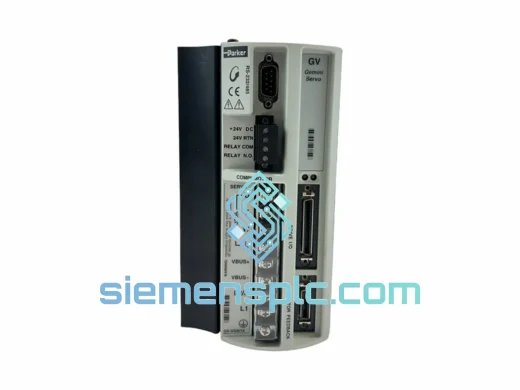
Parker Hannifin
RFQ Ready
Parker GV-U6E-310 AC Servo Drive – Compumotor GV Series
Compumotor GV Series
Origin US
AC Servo Drive
Request verified availability, condition, replacement risk review, packing options and courier lead time for TWIN5-R51.
Click Request Quote and the part number is inserted into the inquiry form automatically.
Core fields for model confirmation and RFQ routing. Detailed product narrative remains below.
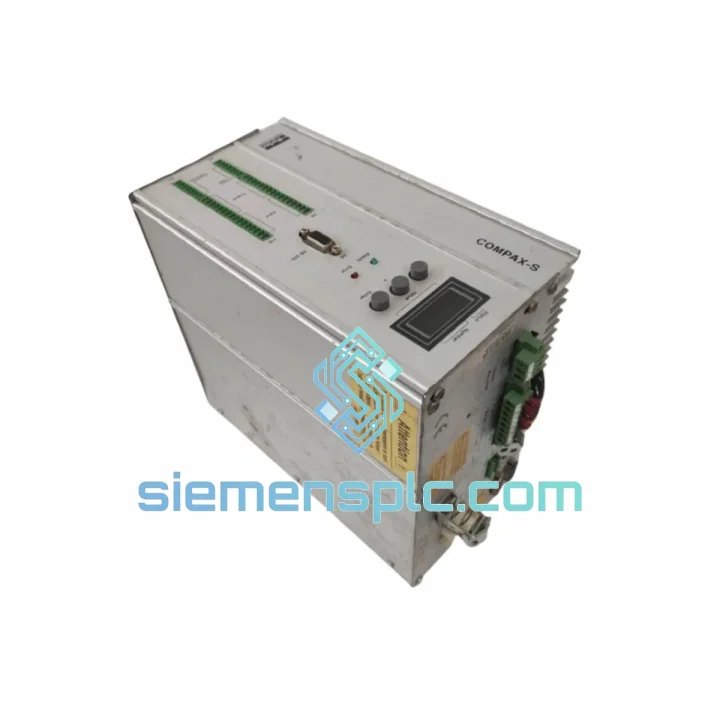
The Parker TWIN5-R51 is a twin-channel AC servo drive module within the Compax3 intelligent servo amplifier family, manufactured by Parker Hannifin. It is designed to govern two independent servo axes from a single compact housing, sharing a common DC bus rail while maintaining electrically isolated control paths per axis. In a closed-loop motion control architecture, the TWIN5-R51 occupies the power conversion and current regulation layer — receiving position or velocity setpoints from an upstream motion controller via fieldbus, executing torque commands through a three-phase IGBT bridge, and closing the position loop at the drive level using encoder or resolver feedback. This architecture eliminates the latency introduced by host-controller-based current loops, enabling sub-millisecond torque response that is essential in synchronization-critical applications such as flying shear, electronic gearing, and cam-profile following.
The Compax3 platform, of which the TWIN5-R51 is a member, implements a cascaded control structure: an outer position loop (typically 1 kHz update rate), an intermediate velocity loop (4 kHz), and an inner current/torque loop (16 kHz). The TWIN5-R51 executes all three loops onboard, offloading the host controller from real-time servo computation. The twin-axis topology shares the intermediate DC bus, which allows regenerative energy from a decelerating axis to be directly consumed by an accelerating axis on the same bus segment — reducing net energy draw from the supply and lowering thermal dissipation in the drive cabinet.
Real-time Stock & RFQ: [email protected] | WhatsApp: +86 18359268345
| Parameter | Specification |
|---|---|
| Model / Part Number | TWIN5-R51 |
| Series | Compax3 (Parker Hannifin) |
| Drive Topology | Twin-axis AC servo amplifier, shared DC bus |
| Power Stage | Three-phase IGBT bridge per axis |
| Supply Voltage | 3 × 200–480 V AC, 50/60 Hz (confirm variant) |
| DC Bus Voltage | Approx. 280–680 V DC (rectified from AC supply) |
| Continuous Output Current | Per axis — confirm with datasheet for R51 power class |
| Current Loop Bandwidth | Up to 16 kHz update rate |
| Velocity Loop Update Rate | 4 kHz |
| Position Loop Update Rate | 1 kHz |
| Feedback Interfaces | Incremental encoder (TTL/HTL), resolver, absolute encoder (Hiperface / EnDat — variant dependent) |
| Fieldbus Options | PROFIBUS-DP, CANopen, DeviceNet, RS-232/485 (variant dependent) |
| Protection Class | IP20 (panel-mount installation) |
| Ambient Operating Temperature | 0 °C to +45 °C (derate above 40 °C) |
| Storage Temperature | −25 °C to +70 °C |
| Relative Humidity | ≤ 85 % RH, non-condensing |
| Vibration Resistance | IEC 60068-2-6 compliant |
| EMC Compliance | CE marked; EN 61800-3 Category C2 |
| Weight | Approx. 1,600 g |
| Warranty | 12 months from date of shipment |
The TWIN5-R51 implements a shared-bus, split-control architecture that is mechanically and electrically distinct from two independent single-axis drives. The DC bus capacitor bank is common to both axes, which serves two functions: it acts as an energy reservoir that absorbs regenerative braking pulses from either axis without requiring an external braking resistor in moderate duty cycles, and it provides a low-impedance voltage rail that prevents cross-axis interference during simultaneous acceleration transients. The bus capacitance is sized to hold the bus voltage within ±10 % of nominal during a worst-case simultaneous deceleration event on both axes — a design constraint that Parker’s power electronics team validates during type testing.
Each axis has an independent gate-driver board driving its own IGBT module. The gate drivers are optically isolated from the control logic board, providing galvanic separation between the high-voltage power stage (up to 680 V DC bus) and the 5 V / 3.3 V DSP logic domain. This optical isolation barrier is rated to withstand transient overvoltages consistent with IEC 61800-5-1 reinforced insulation requirements, protecting the DSP and fieldbus interface circuitry from conducted transients originating in the motor cable or supply network.
The current measurement path uses Hall-effect sensors on two of the three motor phase outputs per axis. The third phase current is reconstructed by Kirchhoff’s current law (i_c = −i_a − i_b), eliminating one sensor per axis while maintaining measurement accuracy sufficient for field-oriented control (FOC). The FOC algorithm executes in the DSP at 16 kHz, transforming measured phase currents into d-q frame components, applying PI regulators in the rotating reference frame, and inverse-transforming the voltage commands back to three-phase space-vector PWM outputs. This approach decouples torque-producing (q-axis) and flux-producing (d-axis) current components, enabling linear torque control independent of rotor position — a prerequisite for high-bandwidth servo performance.
EMC design on the TWIN5-R51 follows Parker’s standard Compax3 practices: a common-mode choke on the motor output lines attenuates high-frequency leakage currents that would otherwise couple into adjacent signal cables via stray capacitance in the motor winding insulation. The control board ground plane is star-referenced to the drive chassis at a single point, preventing ground loop currents from modulating the analog feedback signals. The encoder interface uses differential line receivers (RS-422 compatible) with 120 Ω termination, providing common-mode rejection of noise induced by long cable runs in electrically noisy panel environments.
Every Parker TWIN5-R51 unit supplied by siemensplc.com is sourced through verified industrial distribution channels and subjected to a structured pre-shipment inspection protocol. Units are cross-referenced against Parker Hannifin’s official part numbering schema, with label authenticity, housing integrity, connector pin condition, and firmware revision label verified prior to dispatch. Serial numbers are recorded and provided with each shipment for traceability in the customer’s asset management system.
Packaging follows anti-static and mechanical shock protection standards appropriate for precision servo electronics: each unit is placed in an ESD-shielding bag, cushioned with closed-cell foam inserts, and enclosed in a double-wall corrugated carton rated for international air freight handling. For shipments requiring export documentation, we prepare commercial invoices, packing lists, and certificates of origin compliant with customs requirements in the destination country.
Logistics operations are based in Xiamen, China — a major international port city with direct air freight connections to DHL, FedEx, and UPS hubs serving North America, Europe, Southeast Asia, and the Middle East. Standard air freight transit times from Xiamen are 3–5 business days to most destinations in Europe and North America, and 2–3 business days to destinations within Asia. Expedited same-day dispatch is available for orders confirmed before 14:00 CST. All shipments include full tracking from origin to delivery, with proactive status updates provided to the customer.
A 12-month warranty is provided on all units from the date of shipment. Warranty coverage addresses manufacturing defects and component failures under normal operating conditions as specified in the Parker Compax3 documentation. In the event of a warranty claim, our technical team coordinates directly with the customer to assess the fault, arrange return logistics, and dispatch a replacement unit with minimum lead time.
Email: [email protected]
WhatsApp: +86 18359268345
Web: siemensplc.com
Location: Xiamen, China
© 2026 siemensplc.com. All rights reserved.
We check the full part number, brand, series and visible nameplate information before quotation.
Sales confirms stock path, condition option, quantity and realistic lead time for export dispatch.
DHL, FedEx, UPS or buyer courier arrangements can be reviewed with packing requirements.
Similar brand or category products for fast comparison and multi-item RFQ lists.