
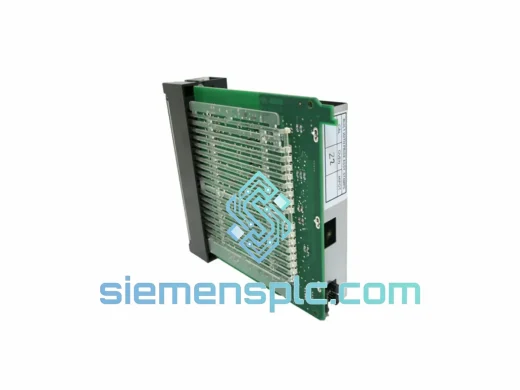
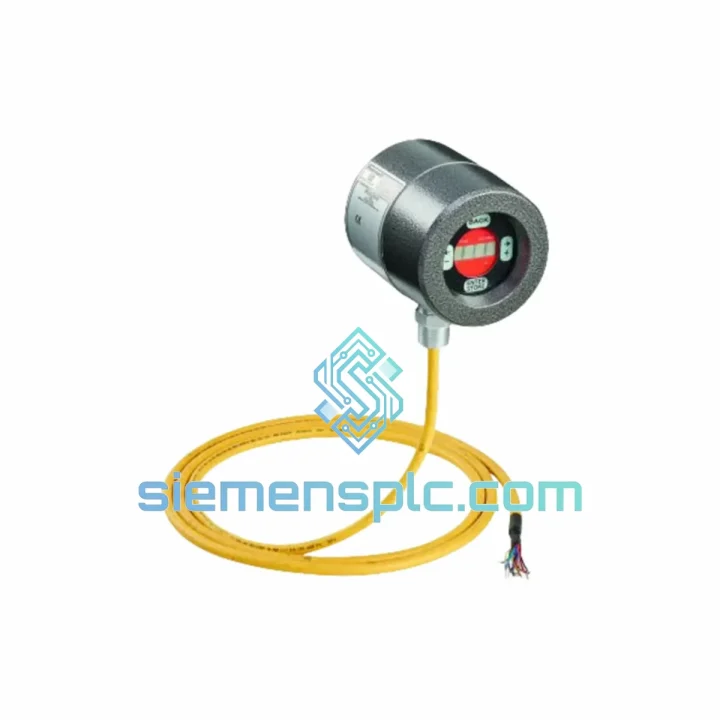
Honeywell
In Stock OK
Honeywell U2-1018S-PF Signal Processor – UDC Series
Request verified availability, condition, replacement risk review, packing options and courier lead time for U2-1018S-PF.
BrandHoneywell
Part NumberU2-1018S-PF
ConditionAvailability Check
Lead TimeRFQ Confirmation
DocumentsDatasheet / photos by RFQ
ShippingExport packing available
Auto-filled RFQ
U2-1018S-PF
Click Request Quote and the part number is inserted into the inquiry form automatically.
- Reply by email: [email protected]
- WhatsApp / Tel: +86 18359268345
- Mon-Sat 9:00-18:00 GMT+8
Procurement Data
Key Product Information
Core fields for model confirmation and RFQ routing. Detailed product narrative remains below.
- Brand
- Honeywell
- Primary Part Number
- U2-1018S-PF
- Product Type
- Signal Processor
- Product Family
- Other series
- Manufacturer
- Honeywell Process Solutions
- Country of Origin
- US
- Catalog Category
- I/O Modules
- Operating Temp.
- 0°C to +60°C
- Warranty
- 12 months from date of shipment against manufacturing defects
Model confirmed for inquiry
U2-1018S-PF
Send quantity, destination and urgency. The RFQ form keeps this part number attached.
Request Quote
Product Overview
Honeywell U2-1018S-PF Universal Signal Processor — Analog Front-End Architecture for UDC Series Process Control
The Honeywell U2-1018S-PF is a plug-in signal processing module designed for the UDC (Universal Digital Controller) series backplane. Its primary function within a control loop is to accept raw sensor signals from field instrumentation, perform hardware-level linearization and scaling, and deliver a conditioned process variable to the UDC CPU module via the internal backplane bus. This architecture removes signal conditioning burden from the controller’s main processor, preserving scan-cycle determinism in multi-loop configurations.
Unlike software-based signal scaling implemented at the controller level, the U2-1018S-PF executes linearization in dedicated analog hardware — a design choice that reduces latency between sensor excitation and process variable update, and eliminates the risk of firmware-version-dependent calibration drift. For procurement engineers managing installed-base UDC systems in refining, chemical, or power generation facilities, this module represents a direct-replacement solution with no wiring or firmware changes required.
Real-time Stock & RFQ: [email protected] | WhatsApp: +86 18359268345
Technical Parameters
| Part Number / SKU | U2-1018S-PF |
| Manufacturer | Honeywell Process Solutions |
| Product Series | UDC Series (Universal Digital Controller) |
| Module Function | Universal Signal Processor / Analog Input Conditioner |
| Supported Input Types | Thermocouple (J, K, T, E, R, S, B, N types); RTD (Pt100, Pt1000, 2-wire / 3-wire); mV (millivolt); 4–20 mA current loop; 0–10 V DC voltage |
| Cold-Junction Compensation | Hardware CJC for thermocouple inputs; accuracy ±0.5°C typical |
| ADC Resolution | 16-bit analog-to-digital conversion |
| Signal Isolation | Galvanic isolation per IEC 61010-1; field-side to backplane isolation ≥500 V AC |
| Backplane Interface | UDC series internal bus; single-slot plug-in form factor |
| Supply Voltage | 24 VDC nominal, supplied via UDC backplane rail |
| Power Consumption | ≤2.5 W (typical at full load) |
| Operating Temperature | 0°C to +60°C |
| Storage Temperature | −40°C to +85°C |
| Relative Humidity | 5% to 95% RH, non-condensing |
| EMC Compliance | EN 61000-4-2 (ESD), EN 61000-4-4 (EFT/Burst), EN 61000-4-5 (Surge) |
| Certifications | CE marked; UL Listed; RoHS 2 compliant |
| Mounting | UDC backplane slot; tool-free plug-in insertion |
| Module Weight | Approx. 0.88 kg (module + OEM packaging) |
| Country of Origin | United States |
| Warranty | 12 months from date of shipment against manufacturing defects |
Hardware Logical Analysis
The U2-1018S-PF implements a multi-stage analog signal chain that begins at the field terminal block and terminates at the backplane data bus. Understanding each stage is essential for system integrators evaluating this module for high-accuracy or safety-instrumented applications.
Input Multiplexing and Sensor Excitation: The module’s front-end incorporates a solid-state analog multiplexer that sequentially addresses each configured input channel. For RTD measurements, a precision constant-current source (typically 1 mA) is applied to the resistance element; the resulting voltage drop is measured differentially, eliminating lead-resistance error in 3-wire configurations. For thermocouple inputs, the differential amplifier stage rejects common-mode noise — a critical requirement in industrial environments where field cables run parallel to power conductors generating common-mode interference of 50–60 Hz at amplitudes exceeding 10 V.
Cold-Junction Compensation (CJC) Architecture: A dedicated on-board thermistor, mounted in thermal contact with the terminal block, continuously measures the reference junction temperature. The CJC correction is applied in hardware before the ADC stage, not in firmware post-processing. This approach ensures that CJC accuracy is independent of controller scan rate — a measurable advantage in slow-scan multi-loop configurations where firmware-based CJC correction can introduce a lag of one full scan cycle between actual junction temperature change and applied correction.
16-Bit ADC and Noise Rejection: The analog-to-digital converter operates at 16-bit resolution, providing 65,536 discrete counts across the full input span. For a 4–20 mA input mapped to a 0–100% process range, this yields a resolution of approximately 0.0015% of span per count — well below the threshold of perceptible process variable noise in most PID control applications. The ADC employs sigma-delta conversion with hardware oversampling and digital filtering, attenuating high-frequency noise above the process signal bandwidth without introducing phase lag at control-relevant frequencies (typically below 1 Hz for thermal processes).
EMC Design and Surge Protection: The module’s PCB layout follows IEC 61000-4 series test requirements. Transient voltage suppression (TVS) diodes are placed at each input terminal to clamp surge events (IEC 61000-4-5, 1 kV line-to-earth) before they reach the amplifier stage. The galvanic isolation barrier — implemented via optocoupler or transformer-coupled topology — provides a minimum 500 V AC withstand between field wiring and the backplane bus, preventing ground-loop currents from corrupting the digital data path.
Backplane Bus Protocol: Conditioned and digitized process variable data is transferred to the UDC CPU module via the internal backplane bus using a synchronous serial protocol. The module responds to CPU polling within a deterministic time window, ensuring that process variable data age does not exceed one controller scan cycle — a requirement for closed-loop PID control with derivative action, where stale PV data can cause derivative kick artifacts.
System Integration Benefits
- Universal Input Compatibility Reduces BOM Complexity: A single module type handles TC, RTD, mA, mV, and voltage inputs. Facilities maintaining mixed-sensor installations eliminate the need to stock separate signal conditioner SKUs for each sensor type, reducing spare-parts inventory cost and procurement lead time.
- Hardware-Level Linearization Preserves Scan-Cycle Determinism: Linearization executed in dedicated analog hardware removes a variable-duration software task from the CPU scan cycle. In multi-loop UDC configurations, this directly reduces worst-case scan-cycle jitter — a measurable benefit for fast-response control loops such as pressure or flow.
- Galvanic Isolation Eliminates Ground-Loop Interference: The 500 V AC isolation barrier between field terminals and backplane bus prevents ground-loop currents — common in large industrial plants with distributed earthing — from introducing DC offset or 50/60 Hz noise into the process variable signal.
- Tool-Free Plug-In Replacement Minimizes MTTR: The single-slot plug-in form factor allows module replacement without disconnecting field wiring (wiring remains on the terminal block). Mean time to repair for a failed signal processor is reduced to under 5 minutes, compared to 30–60 minutes for hardwired signal conditioner replacement.
- Direct Backward Compatibility with Existing UDC Installations: The U2-1018S-PF is a form-fit-function replacement for legacy UDC signal processor modules. No controller firmware update, no wiring modification, and no re-calibration of the control loop are required — critical for facilities operating under change-management procedures that restrict unplanned system modifications.
- On-Board Diagnostics Improve Fault Transparency: The module reports open-sensor, out-of-range, and ADC fault conditions to the UDC CPU via the backplane bus. These diagnostic codes are surfaced in the controller’s alarm register, enabling maintenance personnel to identify the specific failed module without loop-by-loop signal tracing — reducing diagnostic time from hours to minutes.
- Low Power Consumption Supports High-Density Rack Configurations: At ≤2.5 W per module, the U2-1018S-PF allows full population of high-density UDC backplanes without exceeding the backplane power budget. This is a practical constraint in retrofit projects where the existing power supply cannot be upsized.
- RoHS 2 Compliance Supports Global Export and Regulatory Clearance: Full RoHS 2 compliance ensures the module can be incorporated into equipment destined for EU markets without triggering substance-of-concern declarations. CE marking confirms conformity with EMC Directive 2014/30/EU and Low Voltage Directive 2014/35/EU.
Quality Assurance & Global Logistics
Every Honeywell U2-1018S-PF unit dispatched from our Xiamen, China facility undergoes a structured pre-shipment verification protocol. Visual inspection confirms label integrity, date code consistency, and OEM packaging condition. Part markings are cross-referenced against Honeywell’s published part number format to identify non-genuine components before they enter the supply chain. Functional continuity checks verify terminal block integrity and backplane connector pin condition.
Units are packed in anti-static ESD bags, placed in foam-lined cartons, and sealed with tamper-evident tape. Export documentation — commercial invoice, packing list, and certificate of origin — is prepared in compliance with Chinese customs export regulations and destination-country import requirements. For regulated industries (pharmaceutical, nuclear, defense), a Certificate of Conformance (CoC) is available upon request.
Logistics partners include DHL Express, FedEx International Priority, and UPS Worldwide Express. Transit times from Xiamen to major industrial hubs: Europe 3–5 business days; North America 4–6 business days; Southeast Asia 2–3 business days; Middle East 4–5 business days. Full shipment tracking is provided at time of dispatch. For time-critical plant shutdowns or emergency maintenance scenarios, same-day dispatch is available for in-stock units when orders are confirmed before 14:00 CST.
Contact Information
Email: [email protected]
WhatsApp: +86 18359268345
Web: siemensplc.com
Location: Xiamen, China
© 2026 siemensplc.com. All rights reserved.
Ready to quote
[email protected]
Send This Part Number to Sales
RFQ workflow
Quality workflow ->
Confirmation Process
01Model confirmation
We check the full part number, brand, series and visible nameplate information before quotation.
02Availability reply
Sales confirms stock path, condition option, quantity and realistic lead time for export dispatch.
03Packing & courier
DHL, FedEx, UPS or buyer courier arrangements can be reviewed with packing requirements.
Continue sourcing
Browse full catalog ->
Related Automation Parts
Similar brand or category products for fast comparison and multi-item RFQ lists.
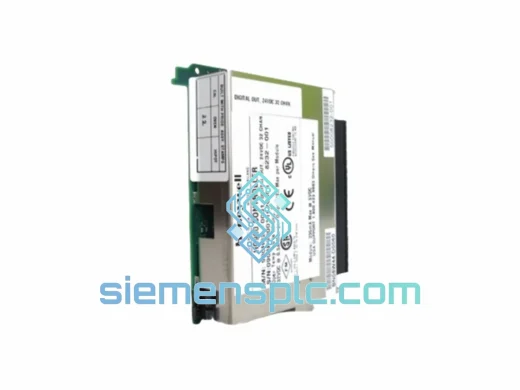
Honeywell
RFQ Ready
Honeywell 900H02-0202 Relay Digital Output Module
Origin US
Relay Digital Output Module
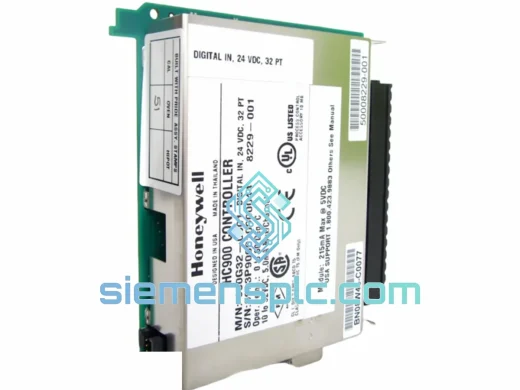
Honeywell
RFQ Ready
Honeywell 900B01-0301 Analog Output Module – HC900 Series
Origin US
Analog Output Module
Honeywell
RFQ Ready
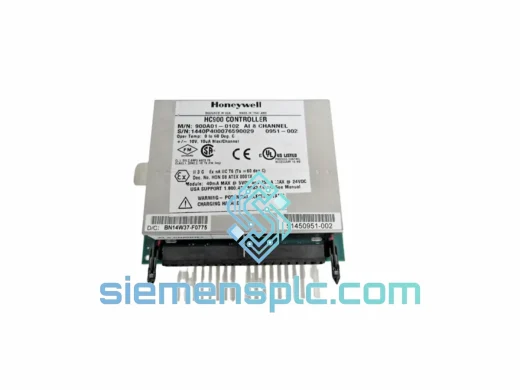
Honeywell 900A01-0001 Analog Input Module – HC900 Series
Origin US
Analog Input Module