ABB
In Stock OK
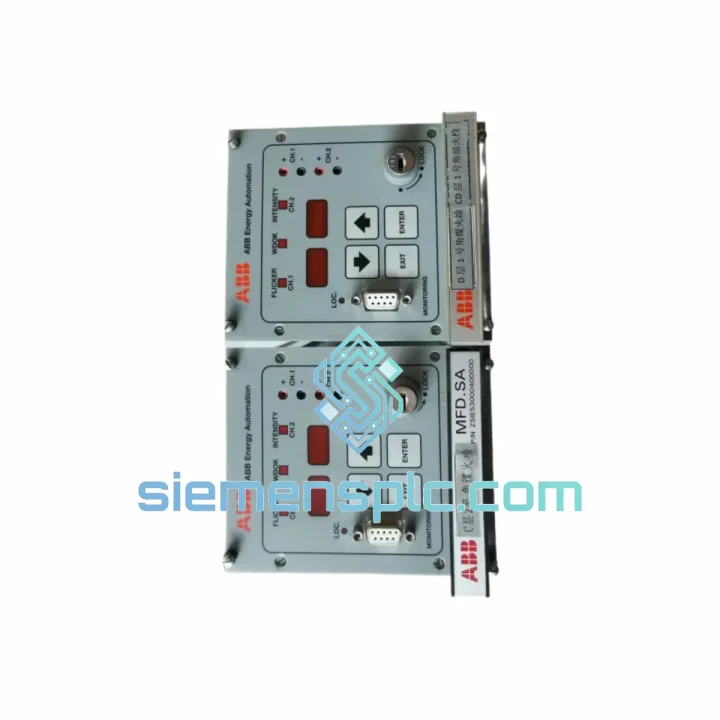
ABB ZSIE53000400000 Flame Controller – UVISOR MFD.SA
Request verified availability, condition, replacement risk review, packing options and courier lead time for UVISOR MFD.SA ZSIE53000400000.
BrandABB
Part NumberUVISOR MFD.SA ZSIE53000400000
ConditionAvailability Check
Lead TimeRFQ Confirmation
DocumentsDatasheet / photos by RFQ
ShippingExport packing available
Auto-filled RFQ
UVISOR MFD.SA ZSIE53000400000
Click Request Quote and the part number is inserted into the inquiry form automatically.
- Reply by email: [email protected]
- WhatsApp / Tel: +86 18359268345
- Mon-Sat 9:00-18:00 GMT+8
Procurement Data
Key Product Information
Core fields for model confirmation and RFQ routing. Detailed product narrative remains below.
- Brand
- ABB
- Primary Part Number
- UVISOR MFD.SA ZSIE53000400000
- Product Type
- Flame Controller
- Product Family
- Other series
- Manufacturer
- ABB
- Country of Origin
- SE
- Catalog Category
- PLCs & Controllers
- Warranty
- 12 months against manufacturing defects
Model confirmed for inquiry
UVISOR MFD.SA ZSIE53000400000
Send quantity, destination and urgency. The RFQ form keeps this part number attached.
Request Quote
Product Overview
ABB ZSIE53000400000 UVISOR MFD.SA — Flame Supervision Controller for Industrial Burner Management Systems
The ABB ZSIE53000400000 is the central processing and evaluation unit within the UVISOR MFD.SA flame controller platform, engineered specifically for continuous flame supervision in industrial combustion systems. Its primary function is to receive, condition, and evaluate analog and digital signals from UV or UV/IR flame detector heads, then execute deterministic safety logic to command burner management system (BMS) outputs — including ignition permissive, flame-failure shutdown, and fault annunciation. The module operates as the decision core of the flame detection loop: it does not merely relay sensor data but applies configurable sensitivity thresholds, response-time windows, and self-diagnostic routines to produce a verified, latched safety output that downstream BMS controllers and safety PLCs can act upon without ambiguity.
In a typical combustion control architecture, the ZSIE53000400000 sits between the detector head and the burner safety interlock chain. The detector head converts radiant energy (UV photons or combined UV/IR spectrum) into an electrical signal; the ZSIE53000400000 amplifies, filters, and compares this signal against programmed flame-presence criteria. When the signal falls below threshold for longer than the configured flame-failure response time, the module de-energizes its safety relay output within the defined SIL-rated reaction window, triggering a controlled burner shutdown. This architecture ensures that no single-point failure in the detector or wiring can produce a spurious flame-present indication — a fundamental requirement under EN 298 and IEC 61511 for burner management safety functions.
Real-time Stock & RFQ: [email protected] | WhatsApp: +86 18359268345
Technical Parameters
| Manufacturer | ABB |
| Series | UVISOR MFD.SA |
| Part Number | ZSIE53000400000 |
| Device Category | Flame Controller / Flame Amplifier Unit |
| Detection Spectrum | UV / UV+IR (dependent on paired detector head) |
| Supply Voltage | 24 VDC ±15% / 110–230 VAC 50/60 Hz (variant-dependent) |
| Power Consumption | ≤ 10 W (controller unit, excluding detector head) |
| Safety Relay Output | Potential-free NC/NO contact, rated 250 VAC / 5 A |
| Flame-Failure Response Time | Configurable: 1 s / 2 s / 3 s (application-dependent) |
| Sensitivity Adjustment | Multi-step potentiometer or DIP-switch configuration |
| Communication Interface | Serial RS-485 / PROFIBUS DP (refer to variant suffix) |
| Mounting | DIN EN 60715 rail, 35 mm |
| Operating Temperature | -20 °C to +60 °C |
| Storage Temperature | -40 °C to +70 °C |
| Relative Humidity | 5 % to 95 %, non-condensing |
| Protection Class | IP20 (controller housing) |
| EMC Compliance | EN 61000-4 series (ESD, EFT, surge, conducted/radiated immunity) |
| Safety Standard | EN 298, IEC 61511, SIL 2 capable (refer to ABB SIL certificate) |
| Certifications | CE, TÜV, UL (region-dependent) |
| Country of Origin | Germany |
| Warranty | 12 months against manufacturing defects |
Hardware Logical Analysis
The ZSIE53000400000 implements a dual-channel signal evaluation architecture. The primary channel processes the raw photocurrent from the UV detector tube or phototransistor array, passing it through a transimpedance amplifier stage that converts current to voltage with a defined gain factor. This voltage is then fed into a bandpass filter tuned to the characteristic flicker frequency of industrial flames (typically 5–50 Hz), which discriminates genuine combustion radiation from steady-state ambient light sources such as incandescent lamps or hot refractory surfaces — both of which would otherwise produce a DC-level false positive.
The filtered AC signal is rectified and compared against a threshold set by the sensitivity adjustment circuit. The comparator output drives a monoflop (retriggerable one-shot) whose time constant defines the flame-failure response time. As long as the flame signal retriggers the monoflop within the configured window, the safety relay remains energized. If the signal drops below threshold and the monoflop times out, the relay de-energizes unconditionally — there is no software override path that can hold the relay closed against a hardware timeout, which is a deliberate fail-safe design choice consistent with IEC 61508 hardware fault tolerance requirements.
EMC hardening is achieved through a combination of hardware measures: opto-isolation on all digital I/O lines provides galvanic separation of up to 2.5 kV between field wiring and the controller logic board, suppressing common-mode transients induced by nearby high-current switching equipment. Transient voltage suppression (TVS) diodes on the power supply input clamp surge events to within the safe operating area of the internal DC-DC converter. The PCB layout employs a split ground plane strategy — analog signal ground and digital logic ground are joined at a single star point near the power entry, preventing digital switching noise from coupling into the low-level detector signal path. Ferrite beads on the detector head cable interface attenuate high-frequency conducted interference above 10 MHz.
The self-diagnostic routine executes a lamp-test cycle on power-up: the controller briefly interrupts the detector supply and verifies that the safety relay de-energizes within the expected response time. If the relay fails to drop out, the controller latches a fault condition and inhibits restart — a hardware-enforced proof-test that satisfies the diagnostic coverage requirements for SIL 2 classification without requiring external test equipment.
System Integration Benefits
- Deterministic Safety Response: Hardware-timed relay dropout guarantees a worst-case flame-failure response within the configured window (≤ 3 s), independent of communication bus load or controller CPU cycle time — critical for EN 298 compliance in gas-fired burner applications.
- Direct BMS Interlock Wiring: The potential-free relay output connects directly into standard burner management interlock chains without signal conditioning, eliminating intermediate relay stages that add failure modes and wiring complexity.
- Fieldbus Diagnostic Transparency: Via the RS-485 or PROFIBUS interface, the ZSIE53000400000 transmits real-time flame signal strength, relay state, fault codes, and sensitivity margin data to the DCS or SCADA layer — enabling predictive maintenance decisions based on degrading detector performance before a nuisance trip occurs.
- Multi-Burner Scalability: Each ZSIE53000400000 unit manages one burner zone independently. Multiple units can be networked on a single PROFIBUS segment, allowing centralized monitoring of large multi-burner installations (boiler banks, process heaters, tunnel kilns) from a single operator workstation.
- Configurable Sensitivity Without Recalibration: The multi-step sensitivity adjustment allows field engineers to optimize the flame signal margin for different fuel types (natural gas, light oil, heavy fuel oil, biogas) and burner geometries without returning the unit to the factory or replacing the detector head.
- SIL 2 Functional Safety Compliance: The module’s hardware architecture and diagnostic coverage are documented in an ABB SIL certificate, providing the PFD (Probability of Failure on Demand) data required for IEC 61511 safety function verification — a mandatory deliverable for insured industrial facilities and regulated process plants.
- Galvanic Isolation Protecting Control System Integrity: Opto-isolated I/O prevents ground loops and fault currents from field wiring faults from propagating into the DCS backplane, protecting adjacent I/O modules and the process controller from damage during cable insulation failures in high-temperature furnace environments.
- Compact DIN Rail Form Factor: The 35 mm DIN rail mounting and narrow housing width allow dense installation in standard control cabinets alongside other DIN rail devices, minimizing panel space consumption in retrofit projects where cabinet real estate is constrained.
- Power-Up Self-Test Reducing Proof-Test Interval: The automatic lamp-test on each power cycle provides a documented proof-test event that can be logged by the DCS, reducing the required manual proof-test frequency and associated plant downtime under IEC 61511 maintenance planning.
- Broad Fuel and Burner Compatibility: The UV detection principle responds to the characteristic 185–260 nm emission band present in virtually all hydrocarbon and hydrogen flames, making the ZSIE53000400000 applicable across natural gas, LPG, light oil, heavy fuel oil, hydrogen, and syngas burner types without hardware changes.
Quality Assurance & Global Logistics
Every ABB ZSIE53000400000 unit supplied through siemensplc.com is sourced from verified industrial supply channels with full traceability to ABB’s authorized distribution network. Prior to dispatch, each unit undergoes a structured pre-shipment inspection protocol: visual examination of housing integrity, label legibility, connector pin condition, and factory seal verification. Units showing evidence of repackaging, remarking, or counterfeit indicators are rejected at intake — not at the point of customer complaint.
Documentation packages available on request include: ABB factory test certificate, certificate of conformity, SIL certificate reference, and datasheet. For projects requiring material traceability records (MTR) or third-party inspection, arrangements can be made prior to order confirmation.
Logistics operations are based in Xiamen, China — a major international freight hub with direct air cargo connections to Frankfurt, Amsterdam, Dubai, Singapore, Los Angeles, and Chicago. Standard export packaging uses anti-static foam inserts within double-wall corrugated cartons, with desiccant packs for humidity-sensitive electronics. Typical dispatch lead time for in-stock units is 3–5 business days from order confirmation. Express air freight options (DHL, FedEx, UPS) are available for urgent requirements, with door-to-door transit times of 3–7 days to most destinations in Europe, North America, Southeast Asia, and the Middle East. Full export documentation — commercial invoice, packing list, certificate of origin, and HS code declaration — is prepared for every shipment to facilitate customs clearance without delay.
Contact Information
Email: [email protected]
WhatsApp: +86 18359268345
Web: siemensplc.com
Location: Xiamen, China
© 2026 siemensplc.com. All rights reserved.
Ready to quote
[email protected]
Send This Part Number to Sales
RFQ workflow
Quality workflow ->
Confirmation Process
01Model confirmation
We check the full part number, brand, series and visible nameplate information before quotation.
02Availability reply
Sales confirms stock path, condition option, quantity and realistic lead time for export dispatch.
03Packing & courier
DHL, FedEx, UPS or buyer courier arrangements can be reviewed with packing requirements.
Continue sourcing
Browse full catalog ->
Related Automation Parts
Similar brand or category products for fast comparison and multi-item RFQ lists.