ABB
RFQ Ready
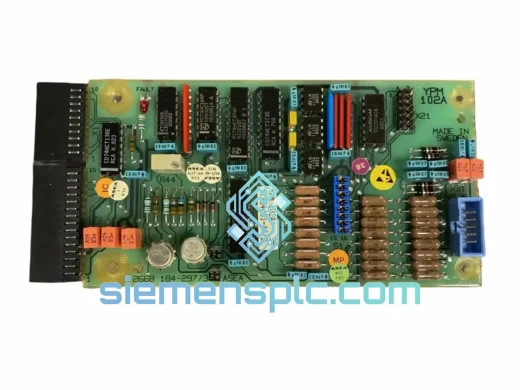
ABB YPM102A YT204001-AA Analog Output Module – AC 800M S800 I/O
S800
Origin SE
Analog Output Module
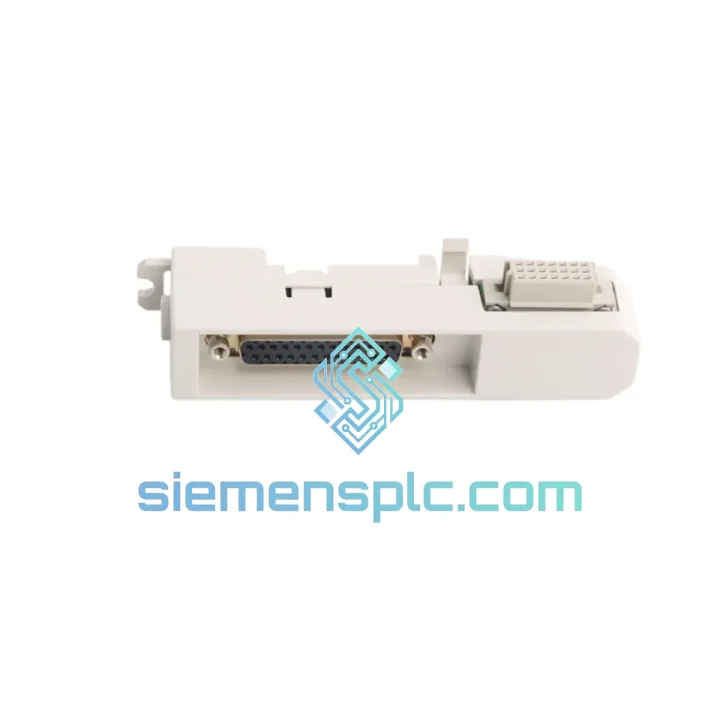
Request verified availability, condition, replacement risk review, packing options and courier lead time for TB805 3BSE008534R1.
Click Request Quote and the part number is inserted into the inquiry form automatically.
Core fields for model confirmation and RFQ routing. Detailed product narrative remains below.
Within a distributed control system built on ABB’s AC800M or AC800F platform, the integrity of the field I/O cluster depends not only on the intelligence of the controller or the accuracy of the I/O cards, but on the physical and electrical reliability of every interconnection node along the Modulebus backbone. The ABB TB805 (order reference 3BSE008534R1) is the standardized bus outlet node that performs this interconnection function — mounting on a 35 mm DIN rail, mechanically interlocking with each S800 I/O module, and simultaneously distributing Modulebus communication signals and 24 VDC auxiliary power to the connected card without requiring separate terminal blocks for either function.
The TB805 is a passive device. It contains no microprocessor, no firmware, and no active signal conditioning circuitry. This is a deliberate architectural decision by ABB: by removing active components from the bus outlet layer, the design eliminates an entire class of failure modes — firmware corruption, watchdog timeouts, and active-component thermal degradation — that would otherwise require version management and periodic replacement planning. In a process plant where a single I/O cluster may remain in continuous service for 15 to 20 years between major overhauls, this passive architecture translates directly into lower lifecycle maintenance cost and higher long-term availability.
The TB805 is a high-turnover MRO component across the global installed base of AC800M and AC800F systems. Procurement teams managing spare parts inventories for refineries, chemical complexes, and power generation facilities routinely stock TB805 units as insurance against mechanical damage during module hot-swap operations or cabinet modifications. Its compact form factor and standardized interface make it interchangeable across all S800 I/O module types — digital input, digital output, analog input, analog output, and temperature — without any configuration or parameterization step.
📩 Real-time Stock & RFQ: [email protected] | WhatsApp: +86 18359268345
| Parameter | Specification |
|---|---|
| Part Number | TB805 |
| Catalog Reference | 3BSE008534R1 |
| Manufacturer | ABB (Asea Brown Boveri) |
| Product Family | S800 I/O |
| Compatible Controllers | AC800M, AC800F, Advant Controller 450, Advant Controller 410 |
| Bus Protocol | Modulebus (ABB proprietary, RS-485 physical layer derivative) |
| Module Function | Passive bus outlet / I/O node connector |
| Mounting Standard | DIN rail EN 60715 (35 mm), mechanical interlock with S800 I/O modules |
| Auxiliary Power Distribution | 24 VDC via integrated bus connector, daisy-chain topology |
| Operating Temperature Range | 0 °C to +55 °C |
| Storage Temperature Range | −25 °C to +70 °C |
| Relative Humidity | 5 % to 95 %, non-condensing |
| Degree of Protection | IP20 (for use inside closed control cabinets) |
| Unit Weight | Approx. 40 g |
| Compliance Standards | CE marking, IEC 61131-2, IEC 61000-6-2 (immunity), IEC 61000-6-4 (emission) |
| Country of Origin | Germany |
| Warranty | 12 months from confirmed shipment date |
| Lead Time (stock units) | Ships within 1–3 business days from Xiamen warehouse |
| Lead Time (non-stock) | 7–21 business days depending on global sourcing channel |
The TB805 routes the Modulebus differential signal pair through a low-impedance PCB trace network terminated at both the upstream and downstream bus connectors. Because no active repeater or buffer stage is inserted in this path, the signal propagation delay across a single TB805 node is governed only by the PCB trace length and connector contact resistance — both of which are fixed, deterministic quantities. This matters in time-critical control loops: the AC800M controller’s Modulebus scan cycle relies on predictable round-trip latency to all cluster nodes, and any jitter introduced by active components would degrade the controller’s ability to maintain deterministic I/O update rates.
The differential signaling architecture of Modulebus provides inherent common-mode noise rejection. In a typical marshalling cabinet, the TB805 operates in close proximity to 24 VDC switching power supplies, relay output modules, and potentially variable-frequency drive control wiring — all of which generate broadband conducted and radiated interference. The differential pair rejects common-mode voltages up to the common-mode range of the Modulebus transceiver, meaning that noise induced equally on both conductors of the pair is cancelled at the receiver without requiring additional filtering hardware at each node.
The TB805 housing incorporates a grounded metal contact surface that bonds the module chassis directly to the DIN rail. When the DIN rail is properly connected to the cabinet protective earth (PE) bus — as required by IEC 60204-1 — this bonding path provides a low-impedance return route for capacitively coupled high-frequency interference. The effective shielding contribution of this chassis bond is most significant in the 1 MHz to 100 MHz range, where capacitive coupling from adjacent switching circuits is most pronounced. This passive EMC mechanism supplements the differential signal rejection and contributes to the cabinet’s overall compliance with IEC 61000-6-4 Class A emission limits without requiring additional shielding enclosures or ferrite suppression components.
The bus connector contact surfaces on the TB805 use gold plating over a copper-alloy substrate. Gold plating is specified for this application because it maintains stable contact resistance across the full operating temperature range and does not form insulating oxide layers during long-term storage or in humid environments. The contact geometry is designed to achieve and maintain a contact resistance below 10 mΩ per mated pair, which is the threshold above which resistive voltage drops begin to affect Modulebus signal levels at the far end of a fully populated cluster. This contact specification is particularly relevant for units that have been stored for extended periods before installation — a common scenario in MRO procurement where spare parts may be held in inventory for months or years before use.
All ABB TB805 3BSE008534R1 units supplied through siemensplc.com are sourced from verified industrial supply channels — authorized distributors, certified resellers, and documented decommissioning projects — and pass a structured pre-shipment inspection before dispatch. Each unit undergoes visual inspection for housing integrity, connector contact surface condition, and label authenticity. Bus connector continuity is verified using a four-wire resistance measurement to confirm contact resistance within the 10 mΩ specification. Chassis ground bonding resistance is checked between the housing metal contact and the DIN rail mounting surface. Units that fail any acceptance criterion are quarantined and excluded from customer orders.
Shipments originate from our Xiamen, China facility. Xiamen is a designated free-trade port with direct access to international air cargo services at Xiamen Gaoqi International Airport and sea freight connections through Xiamen Port — one of the top-ten container ports in China by throughput volume. This logistics infrastructure supports reliable export transit times to all major industrial markets: 2–4 business days to Europe via air freight, 3–5 business days to North America, and 1–3 business days to Southeast Asia and Japan.
Standard export documentation accompanies every shipment: commercial invoice, packing list, and certificate of origin. Customs declaration is handled in compliance with Chinese export regulations and Xiamen Customs procedures. For orders requiring supplementary documentation — RoHS conformity declarations, material composition statements, or third-party inspection certificates — these are arranged prior to shipment upon written request. All units are covered by a 12-month warranty from the confirmed shipment date. Warranty claims are processed within 5 business days of return receipt, with replacement units dispatched from Xiamen stock upon claim approval.
📧 Email: [email protected]
📱 WhatsApp: +86 18359268345
🌐 Web: siemensplc.com
📍 Location: Xiamen, China
© 2026 siemensplc.com. All rights reserved.
We check the full part number, brand, series and visible nameplate information before quotation.
Sales confirms stock path, condition option, quantity and realistic lead time for export dispatch.
DHL, FedEx, UPS or buyer courier arrangements can be reviewed with packing requirements.
Similar brand or category products for fast comparison and multi-item RFQ lists.