ABB
RFQ Ready
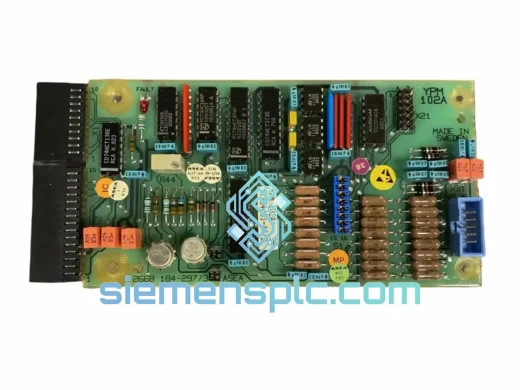
ABB YPM102A YT204001-AA Analog Output Module – AC 800M S800 I/O
S800
Origin SE
Analog Output Module
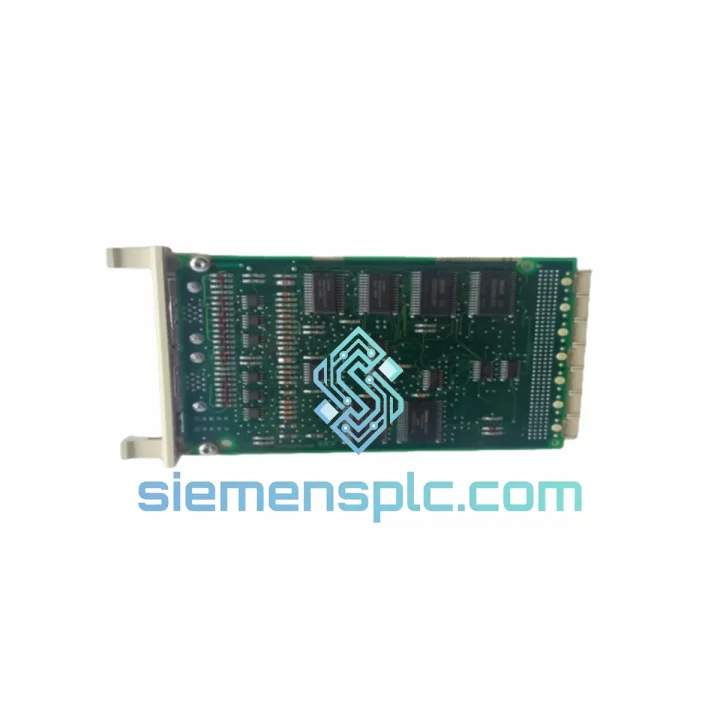
Request verified availability, condition, replacement risk review, packing options and courier lead time for 3BSE000566R1-AX670.
Click Request Quote and the part number is inserted into the inquiry form automatically.
Core fields for model confirmation and RFQ routing. Detailed product narrative remains below.
The ABB 3BSE000566R1, commercially designated AX670, is a dual-function analog I/O module designed for deployment within the S800 I/O distributed I/O platform, which interfaces natively with the ABB AC 800M process controller family. Unlike single-direction analog modules such as the AI810 or AO810, the AX670 consolidates analog input acquisition and analog output generation into a single module slot, reducing cabinet footprint and inter-module wiring complexity in high-density control panels. Its architecture is optimized for closed-loop process control applications where both measurement acquisition and actuator command signals must share a common timing domain and diagnostic framework.
In a typical AC 800M control node, the AX670 connects to the S800 ModuleBus — either via optical fiber (TB820V2) or electrical backplane (TB840A) — and is addressed automatically by the controller’s I/O configuration engine in Control Builder M. The module’s internal signal processing pipeline operates synchronously with the ModuleBus scan cycle, ensuring that AI samples and AO updates are time-coherent within the same controller task period. This deterministic behavior is critical in cascade control loops where the output of one PID block feeds directly into the setpoint of a downstream loop.
Real-time Stock & RFQ: [email protected] | WhatsApp: +86 18359268345
| Parameter | Specification |
|---|---|
| Part Number | 3BSE000566R1 |
| Model Designation | AX670 |
| Platform | ABB S800 I/O |
| Compatible Controllers | AC 800M PM860 / PM861 / PM864 / PM866 |
| Module Function | Analog Mixed — Inputs + Outputs |
| Signal Range (AI) | 4–20 mA / 0–10 V (software-configurable per channel) |
| Signal Range (AO) | 4–20 mA / 0–10 V (software-configurable per channel) |
| ADC Resolution | 16-bit |
| DAC Resolution | 16-bit |
| Channel Isolation | Galvanic channel-to-channel and channel-to-ModuleBus |
| Communication Interface | S800 ModuleBus (optical or electrical) |
| Mounting | DIN-rail via S800 cluster base unit |
| Supply Voltage | 24 VDC (via S800 power distribution) |
| Operating Temperature | 0 °C to +55 °C |
| Storage Temperature | −40 °C to +70 °C |
| Relative Humidity | 5–95 % RH, non-condensing |
| EMC Compliance | IEC 61000-4-2/3/4/5/6 (ESD, RS, EFT, Surge, CS) |
| Certifications | CE, UL 508, ATEX Zone 2, RoHS |
| Functional Safety | IEC 61508 / IEC 61511 (non-safety layer; use with S800 Safety I/O for SIL loops) |
| Weight | Approx. 350 g (module only) |
| Warranty | 12 months from date of shipment |
The AX670’s internal architecture separates the analog front-end from the ModuleBus interface logic through an optically isolated barrier on each channel group. On the input side, each AI channel passes through a precision instrumentation amplifier stage before entering a sigma-delta ADC with 16-bit effective resolution. The sigma-delta topology provides inherent noise rejection at 50/60 Hz line frequencies — a significant advantage in industrial environments where power-line interference is present on field cable runs. The ADC’s oversampling ratio is configurable, allowing engineers to trade conversion speed for noise floor performance depending on the process dynamics of the loop being measured.
On the output side, each AO channel is driven by a 16-bit DAC followed by a voltage-to-current converter with a compliance voltage headroom sufficient to drive 600 Ω loop loads at 20 mA — covering the majority of field transmitter and I/P converter specifications without external boosters. The DAC output stage includes a hold-last-value circuit that maintains the last commanded output level in the event of a ModuleBus communication timeout, preventing uncontrolled actuator movement during controller failover or communication interruption.
The module’s EMC design employs a multi-layer PCB with dedicated ground planes for analog and digital domains, separated by a split-plane boundary at the isolation barrier. Transient suppression diodes (TVS) are placed at each field terminal to clamp ESD and surge events per IEC 61000-4-5 Level 3. The module housing is a conductive plastic shell with internal EMI shielding gaskets, providing attenuation of radiated emissions from adjacent variable-frequency drives and high-current switching equipment — a common co-location scenario in motor control centers.
Hot-swap capability is implemented through a controlled power sequencing circuit that pre-charges the module’s internal capacitors before enabling the ModuleBus transceiver, eliminating the voltage glitch that would otherwise disturb neighboring modules on the same cluster. This allows online replacement of a failed AX670 without interrupting the scan cycle of adjacent I/O modules or requiring a controller restart.
Every ABB 3BSE000566R1 AX670 unit dispatched from our Xiamen, China facility is sourced directly from ABB’s authorized distribution network or from decommissioned plant assets with full traceability documentation. Prior to shipment, each module undergoes a structured inspection protocol: physical label verification against ABB’s part number database, firmware revision confirmation, visual inspection of connector pins and housing integrity, and a power-on functional check where applicable.
Units are packed in anti-static bags with humidity indicator cards, placed in foam-lined cartons rated for international air freight handling. Export documentation — commercial invoice, packing list, certificate of origin, and HS code declaration — is prepared for every shipment. We ship via DHL Express, FedEx International Priority, and UPS Worldwide, with typical transit times of 3–7 business days to Europe, North America, Southeast Asia, and the Middle East. For project-volume orders, sea freight consolidation is available with full LCL/FCL coordination. All shipments carry a 12-month warranty from the date of dispatch.
Email: [email protected]
WhatsApp: +86 18359268345
Web: siemensplc.com
Location: Xiamen, China
© 2026 siemensplc.com. All rights reserved.
We check the full part number, brand, series and visible nameplate information before quotation.
Sales confirms stock path, condition option, quantity and realistic lead time for export dispatch.
DHL, FedEx, UPS or buyer courier arrangements can be reviewed with packing requirements.
Similar brand or category products for fast comparison and multi-item RFQ lists.