ABB
RFQ Ready
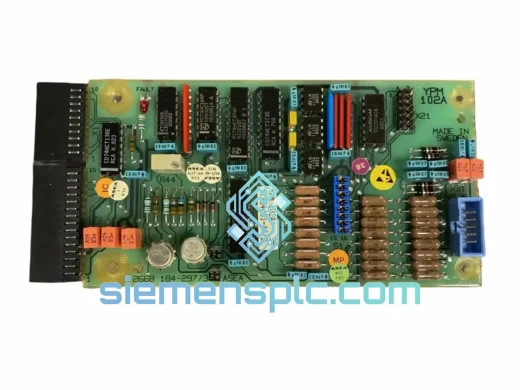
ABB YPM102A YT204001-AA Analog Output Module – AC 800M S800 I/O
S800
Origin SE
Analog Output Module
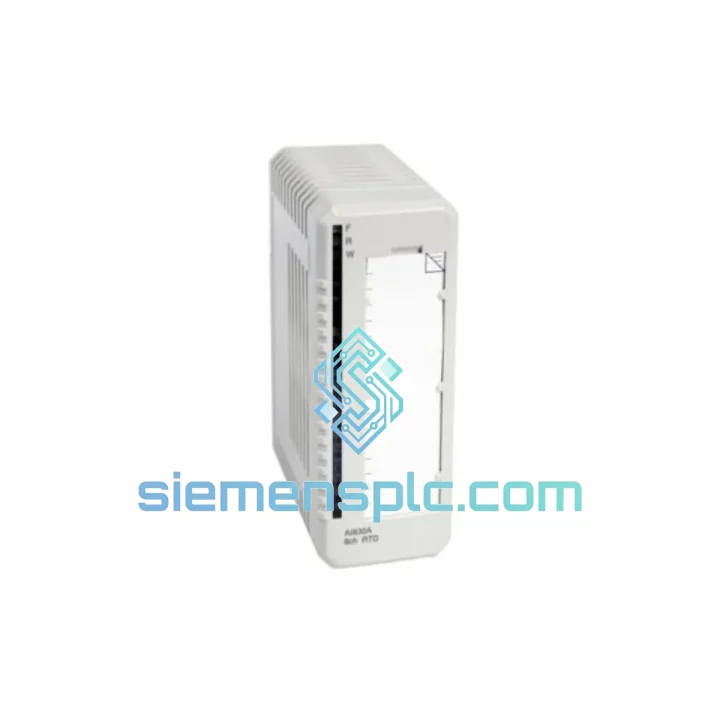
Request verified availability, condition, replacement risk review, packing options and courier lead time for AI830A.
Click Request Quote and the part number is inserted into the inquiry form automatically.
Core fields for model confirmation and RFQ routing. Detailed product narrative remains below.
The ABB AI830A is a dedicated eight-channel resistance temperature detector (RTD) analog input module engineered for the S800 I/O platform and the AC 800M Process Automation Controller family. Within a distributed control system (DCS) architecture, this module occupies the critical interface layer between field-mounted temperature sensors and the controller’s process execution environment. Its primary function is to convert raw resistance signals from PT100, PT1000, Ni100, Ni1000, Cu10, and Cu50 sensors into linearized, engineering-unit temperature values that the AC 800M CPU can act upon within its deterministic scan cycle.
Unlike general-purpose analog input modules that handle voltage or current signals, the AI830A is purpose-built for resistive sensor inputs. This specialization allows the module’s internal ASIC to apply sensor-specific linearization curves directly in hardware, offloading computational overhead from the AC 800M CPU and ensuring that temperature data arrives at the controller already corrected for the non-linear resistance-temperature relationship inherent to all RTD sensor types. The result is a tighter closed-loop response in temperature-critical control applications such as reactor jacket control, heat-exchanger bypass regulation, and turbine bearing protection.
The module mounts into a single slot on an S800 I/O ModuleBase (TB820V2 or TB840A), drawing all operating power from the ModuleBus backplane. No external 24 V DC supply is required at the module level, simplifying cabinet wiring and reducing the number of potential failure points in the field I/O assembly. Communication to the AC 800M controller travels over the S800 ModuleBus — either optical fiber or shielded twisted-pair — at a fixed high-speed cycle that guarantees deterministic data delivery regardless of the number of modules installed on the bus segment.
Real-time Stock & RFQ: [email protected] | WhatsApp: +86 18359268345
| Parameter | Specification |
|---|---|
| Part Number / SKU | AI830A |
| Manufacturer | ABB |
| Product Series | S800 I/O — AC 800M Compatible |
| Module Type | Analog Input — RTD (Resistance Temperature Detector) |
| Number of Channels | 8 (independently configurable) |
| Supported Sensor Types | PT100, PT1000, Ni100, Ni1000, Cu10, Cu50, custom RTD curves |
| Measurement Range | −200 °C to +850 °C (sensor-dependent) |
| Resolution | 0.1 °C |
| Accuracy | ±0.5 °C typical (PT100 at 0 °C reference) |
| RTD Connection Modes | 2-wire, 3-wire, 4-wire (per channel, software-selectable) |
| Channel Isolation | Galvanic isolation — channel-to-channel and channel-to-ModuleBus |
| Common-Mode Rejection | >120 dB at 50/60 Hz |
| Module Power Supply | Via S800 ModuleBus backplane (no external supply required) |
| Communication Interface | S800 I/O ModuleBus (optical or electrical) |
| Form Factor | Single-slot S800 I/O housing |
| Operating Temperature | −25 °C to +70 °C |
| Storage Temperature | −40 °C to +85 °C |
| Relative Humidity | 5–95 % RH, non-condensing |
| Protection Class | IP20 |
| EMC Compliance | EN 61000-4-2 / -4-3 / -4-4 / -4-5 / -4-6 |
| Certifications | CE, UL, ATEX Zone 2 (with approved barrier) |
| Approximate Weight | 300 g |
| Country of Origin | Germany |
| Warranty | 12 months from date of shipment |
The AI830A’s internal architecture centers on a per-channel multiplexed sigma-delta ADC front end. Each of the eight input channels is sampled sequentially through a low-leakage analog multiplexer, with the sigma-delta converter operating at an oversampling ratio sufficient to achieve 16-bit effective resolution before decimation filtering. This approach eliminates the need for individual per-channel ADCs while maintaining the 0.1 °C resolution specification across the full sensor range.
Lead-resistance compensation in 4-wire mode: When a channel is configured for 4-wire RTD connection, the module drives a precision constant-current source through the two current-carrying leads and measures the voltage drop exclusively across the two sense leads. Because no current flows through the sense leads during measurement, the lead resistance — which can reach several ohms in long cable runs — contributes zero error to the resistance calculation. In 3-wire mode, the module applies a software correction algorithm that assumes matched lead resistance on the two current-carrying conductors, achieving typical lead-resistance error below 0.2 °C for cables up to 100 m at 1.5 mm² cross-section.
Galvanic isolation architecture: Each channel group is isolated from the ModuleBus backplane through a DC-DC converter and optocoupler barrier rated at 500 V AC working isolation. This two-stage isolation topology — field side to module ground, then module ground to bus — prevents ground-loop currents from corrupting the low-level resistance measurement. In installations where field sensors are grounded at multiple points (common in legacy plant wiring), this isolation eliminates the differential ground potential that would otherwise appear as a common-mode offset on the measurement.
EMC design: The module’s PCB layout routes all analog signal traces on inner layers, shielded by ground planes on both outer layers. Ferrite beads and RC snubbers on each input terminal suppress conducted interference in the 150 kHz–30 MHz range per EN 61000-4-6. The module passes EN 61000-4-5 surge immunity at ±2 kV line-to-earth and ±1 kV line-to-line without requiring external surge protection devices on the terminal block, provided the cable shield is terminated at the ModuleBase earth stud.
Onboard linearization: RTD resistance-to-temperature conversion is performed by a dedicated microcontroller within the module using IEC 60751 (PT100/PT1000) and DIN 43760 (Ni100/Ni1000) polynomial coefficients stored in non-volatile flash. This means the AC 800M CPU receives a temperature value in °C or °F directly — not a raw resistance count — reducing the engineering effort required in Control Builder M and eliminating the risk of incorrect linearization table entry during commissioning.
Every ABB AI830A unit supplied by siemensplc.com is sourced as genuine ABB factory-manufactured hardware. Each module carries the original ABB part label with full traceability data: part number, hardware revision, serial number, and manufacturing date code. Prior to dispatch, our technical team performs a structured incoming inspection covering visual integrity, label authenticity verification, and a functional power-on test where test equipment is available. Units that do not pass inspection are quarantined and not offered for sale.
Documentation supplied with each shipment includes a packing list with serial number records, a certificate of conformity on request, and — for units with available factory test records — the original ABB factory acceptance test data sheet. For projects requiring full material traceability (nuclear, offshore, pharmaceutical), additional documentation packages can be arranged prior to order confirmation.
Logistics operations are based in Xiamen, China, a major international freight hub with direct air cargo connections to Europe, North America, Southeast Asia, the Middle East, and Australia. Standard shipments are dispatched via DHL Express or FedEx International Priority, with door-to-door transit times of 3–5 business days to most destinations. For time-critical plant shutdowns, same-day dispatch is available for in-stock units when orders are confirmed before 14:00 CST. All shipments include full tracking, commercial invoice, and packing declaration compliant with destination customs requirements. Export classification and HS code documentation are prepared for each shipment to minimize customs clearance delays.
A 12-month warranty covers all supplied units against manufacturing defects and functional failure under normal operating conditions. Warranty claims are processed with a target response time of 48 hours, and replacement units are dispatched from Xiamen stock where available.
Email: [email protected]
WhatsApp: +86 18359268345
Web: siemensplc.com
Location: Xiamen, China
© 2026 siemensplc.com. All rights reserved.
We check the full part number, brand, series and visible nameplate information before quotation.
Sales confirms stock path, condition option, quantity and realistic lead time for export dispatch.
DHL, FedEx, UPS or buyer courier arrangements can be reviewed with packing requirements.
Similar brand or category products for fast comparison and multi-item RFQ lists.