ABB
RFQ Ready
ABB YPK114A 3ASD399002B20 Drive Communications Module
Origin SE
Drive Communications Module
Request verified availability, condition, replacement risk review, packing options and courier lead time for FCNA-01.
Click Request Quote and the part number is inserted into the inquiry form automatically.
Core fields for model confirmation and RFQ routing. Detailed product narrative remains below.
Within ABB’s rack-based distributed control architecture — specifically the FCN (Field Control Node) and FCJ (Field Control Junction) platforms — the FCNA-01 functions as the active communication backbone between the CPU module and all installed I/O modules in a given rack. Its role is not supplementary; it is the card that determines whether the control loop executes on schedule or misses its scan window. In process industries where a 200 ms deviation in a PID loop can trigger a safety interlock, the FCNA-01’s deterministic bus management is the difference between controlled operation and an unplanned shutdown.
The card manages the FCN internal proprietary backplane bus using a fixed-priority interrupt model implemented in hardware logic. Time-critical process variable data — analog inputs, digital status signals — is serviced before diagnostic and configuration traffic. This priority hierarchy is not configurable in software, which means it cannot be accidentally overridden by an operator or a firmware update. The result is a predictable, bounded scan cycle that holds its timing specification regardless of the diagnostic load on the system at any given moment.
Beyond bus arbitration, the FCNA-01 carries the hardware-level redundancy switchover function for hot-standby FCN controller pairs. A dedicated watchdog monitoring circuit continuously samples the primary controller’s heartbeat signal. If the heartbeat is absent beyond the configured timeout window, the card’s arbitration logic independently asserts the switchover command to the secondary controller. This path is entirely hardware-driven — a software deadlock, OS hang, or application task failure on the primary CPU does not block or delay the switchover. The secondary controller assumes control within the defined window without any software intervention on either side.
Real-time Stock & RFQ: [email protected] | WhatsApp: +86 18359268345
| Parameter | Value |
|---|---|
| Manufacturer Part Number | FCNA-01 |
| Compatible Platform | ABB FCN / FCJ Distributed Control System |
| Module Classification | Backplane Bus Controller & Redundancy Arbitration Card |
| Bus Type | FCN internal proprietary synchronous parallel backplane bus |
| Redundancy Mode | Hot-standby primary/secondary controller pair arbitration |
| Watchdog Timeout Range | 100–300 ms (application-configurable via FCN OS) |
| Backplane Supply Voltage | 5 VDC (sourced from rack backplane; no external connector) |
| Operating Temperature | 0°C to +60°C |
| Storage Temperature | -25°C to +70°C |
| Relative Humidity | 5%–95% RH, non-condensing |
| EMC Immunity Standards | IEC 61000-4-2 (ESD Level 3), IEC 61000-4-4 (EFT Level 3), IEC 61000-4-5 (Surge Level 3), IEC 61000-4-6 (Conducted RF) |
| Vibration Resistance | IEC 60068-2-6: 5–150 Hz, 1g acceleration |
| Mechanical Shock | IEC 60068-2-27: 15g, 11 ms half-sine pulse |
| Enclosure Protection | IP20 (rack-mounted installation) |
| Module Weight | 570 g |
| Firmware Compatibility | FCN OS V3.x and above |
| Country of Origin | Germany |
| Standard Lead Time | In-stock units: 3–7 business days international; sourced/allocated stock: 2–4 weeks. Same-day dispatch available for confirmed orders placed before 14:00 CST. |
| Minimum Order Quantity | 1 piece |
| Warranty | 12 months from confirmed shipment date |
| Available Condition | New OEM / Certified Tested Refurbished |
The FCNA-01’s circuit architecture reflects a design discipline common to ABB’s process-critical hardware: fault isolation and timing determinism are treated as non-negotiable constraints, not optimization targets. Several specific implementation choices define the card’s behavior under real industrial conditions.
Galvanic Isolation on Backplane Signal Lines: The card’s backplane interface incorporates optocoupler-based galvanic isolation on critical data and control lines. This addresses a specific failure mode in large-scale DCS installations: ground potential differences between rack enclosures at different physical locations within the same plant. Without isolation, a ground fault event at one rack can inject common-mode noise onto the shared backplane bus, corrupting data across multiple racks simultaneously. The FCNA-01’s isolation barrier sustains a minimum 500 V transient withstand, consistent with IEC 61000-4-5 Level 3 surge immunity requirements.
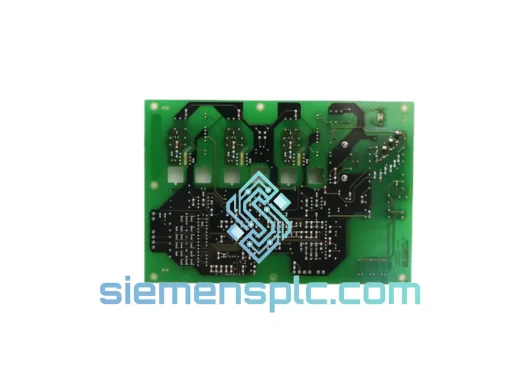
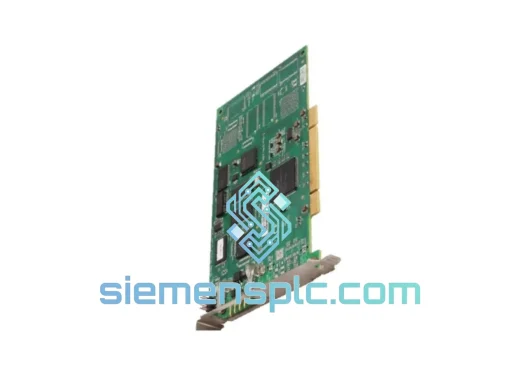
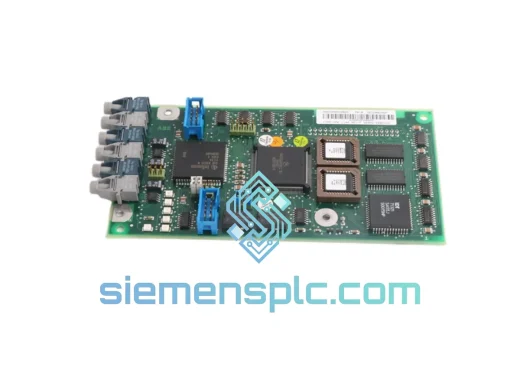
Multi-Layer PCB with Dedicated Ground Planes: The board uses a four-layer minimum stackup. Inner layers are dedicated copper ground planes that serve dual functions: EMC shielding against radiated interference and a low-impedance return path for high-frequency switching currents generated by the bus interface controller. The digital logic layer and the bus signal layer are separated by these ground planes, suppressing capacitive coupling between high-speed bus lines and lower-frequency control logic. Ferrite beads on all power entry traces attenuate conducted noise in the 1–100 MHz band before it reaches the card’s internal power distribution network.
Hardware-Priority Interrupt Controller: The bus arbitration logic implements a fixed-priority interrupt controller in dedicated hardware — not in the CPU’s firmware task scheduler. Process variable update requests from I/O modules assert hardware interrupt lines that are serviced before any software-initiated bus transaction. This architecture guarantees that a high-priority analog input update is never queued behind a lower-priority diagnostic read, regardless of the software state on the controller CPU.
Non-Volatile Firmware Version Register: The FCNA-01 stores its firmware revision identifier in on-board non-volatile memory. During FCN rack initialization, the controller reads this register and cross-references it against its internal compatibility table. A version mismatch is flagged as a configuration fault before the system transitions to run mode. This prevents silent hardware-software incompatibility from producing intermittent scan anomalies that are difficult to diagnose during operation.
Passive Convective Thermal Management: High-dissipation components — the bus interface controller IC and the arbitration logic array — are positioned at the card’s upper edge, aligned with the FCN rack’s natural convective airflow exit path. Thermal vias beneath these components conduct heat from the component surface through the PCB stackup to the inner ground planes, which act as distributed heat spreaders. This eliminates active cooling components (fans, heat pipes) that would introduce additional failure modes and maintenance requirements in a card designed for multi-year continuous operation.
Every FCNA-01 unit dispatched from our Xiamen, China facility is sourced through documented industrial distribution channels with traceable provenance records. Pre-shipment inspection covers physical label authentication against ABB reference standards, PCB marking verification, connector integrity assessment, and — where test infrastructure is available — functional backplane communication handshake testing in a compatible FCN rack environment.
Packaging follows IEC 61340-5-1 ESD protection requirements: anti-static bags, foam cushioning, and outer carton rated for international freight handling. Each shipment includes a commercial invoice, packing list, certificate of origin, and inspection record. HS code documentation is provided for accurate import duty classification at the destination customs authority. Certificates of conformance and available test records are supplied upon request at no additional charge.
International freight is handled via DHL Express, FedEx International Priority, and UPS Worldwide Express. Transit times to major industrial hubs in Asia-Pacific, the Middle East, Europe, and the Americas are typically 3–7 business days from dispatch. Xiamen Port’s direct container routes and the city’s bonded logistics zone infrastructure reduce outbound customs clearance time compared to inland sourcing points, supporting tighter delivery windows for time-sensitive maintenance procurement. All units carry a 12-month warranty from the confirmed shipment date; defective units are replaced or credited following documented technical review.
Email: [email protected]
WhatsApp: +86 18359268345
Web: siemensplc.com
Location: Xiamen, China
© 2026 siemensplc.com. All rights reserved.
We check the full part number, brand, series and visible nameplate information before quotation.
Sales confirms stock path, condition option, quantity and realistic lead time for export dispatch.
DHL, FedEx, UPS or buyer courier arrangements can be reviewed with packing requirements.
Similar brand or category products for fast comparison and multi-item RFQ lists.