
ABB
In Stock OK
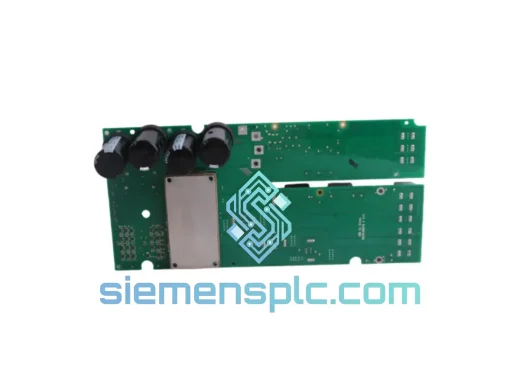
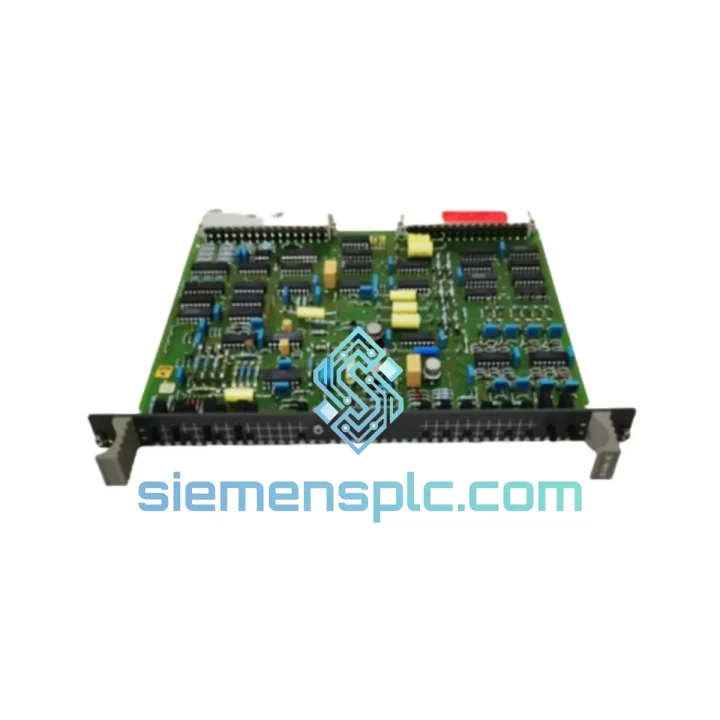
ABB TINT-6511 Variable Frequency Drive – TINT Series
Request verified availability, condition, replacement risk review, packing options and courier lead time for TINT-6511.
BrandABB
Part NumberTINT-6511
ConditionAvailability Check
Lead TimeRFQ Confirmation
DocumentsDatasheet / photos by RFQ
ShippingExport packing available
Auto-filled RFQ
TINT-6511
Click Request Quote and the part number is inserted into the inquiry form automatically.
- Reply by email: [email protected]
- WhatsApp / Tel: +86 18359268345
- Mon-Sat 9:00-18:00 GMT+8
Procurement Data
Key Product Information
Core fields for model confirmation and RFQ routing. Detailed product narrative remains below.
- Brand
- ABB
- Primary Part Number
- TINT-6511
- Product Type
- Variable Frequency Drive
- Series / Family
- TINT Series
- Country of Origin
- SE
- Catalog Category
- Motor Drives
- Warranty
- 12 months from date of shipment (manufacturing defects)
Model confirmed for inquiry
TINT-6511
Send quantity, destination and urgency. The RFQ form keeps this part number attached.
Request Quote
Product Overview
ABB TINT-6511: Wall-Mounted Low-Voltage AC Drive for Precision Motor Speed Regulation
The ABB TINT-6511 is a wall-mounted low-voltage AC variable frequency drive (VFD) belonging to ABB’s TINT series — a product line engineered for industrial motor control environments where installation footprint, thermal management, and deterministic speed regulation are primary design constraints. Unlike rack-integrated drives that depend on shared enclosure cooling infrastructure, the TINT-6511 is designed for direct wall or panel-surface mounting, enabling deployment adjacent to driven equipment and reducing power cable lengths, which in turn lowers resistive losses and improves dynamic response fidelity.
At its core, the TINT-6511 converts fixed-frequency AC mains power into a variable-frequency, variable-voltage output through a three-stage power conversion topology: an input rectifier stage that produces a regulated DC bus, a DC link capacitor bank that filters ripple and stores energy for transient load demands, and an IGBT-based inverter stage that synthesizes the output waveform via pulse-width modulation (PWM). The PWM switching frequency is configurable within the TINT platform’s parameter set, allowing engineers to balance acoustic noise, motor heating, and switching losses according to application requirements.
Speed regulation is achieved through selectable control modes. In scalar V/f mode, the drive maintains a fixed voltage-to-frequency ratio across the operating speed range, providing stable open-loop control suitable for centrifugal pump and fan loads where torque demand scales with the square of speed. For applications requiring tighter speed holding accuracy or dynamic torque response — such as conveyor tensioning or compressor control — the TINT-6511 supports vector control modes that compute real-time flux and torque components from measured motor current, enabling closed-loop speed regulation without a physical encoder in sensorless configurations.
The drive’s I/O architecture provides analog and digital signal interfaces for integration with upstream PLC or DCS controllers. Analog inputs accept 0–10 V or 4–20 mA speed reference signals, while digital inputs handle run/stop commands, fault reset, and preset speed selection. Relay outputs provide status feedback — run confirmation, fault indication, and at-speed signals — to the supervisory control layer. Fieldbus communication options extend the TINT platform’s connectivity to standard industrial networks, enabling parameter read/write, process variable monitoring, and remote diagnostics without physical access to the drive.
Thermal management in the TINT-6511 relies on an internal heatsink with forced-air cooling. The drive’s thermal model continuously estimates junction temperatures of the IGBT modules based on output current and switching frequency, triggering derating or protective shutdown before thermal limits are exceeded. This predictive thermal protection extends power semiconductor service life and prevents unplanned process interruptions in continuous-duty applications.
The TINT-6511 carries CE marking, confirming conformity with EU Low Voltage Directive and EMC Directive requirements. The drive’s internal EMC filter reduces conducted emissions on the supply side, protecting adjacent instrumentation and communication equipment from switching noise propagated through the AC mains. For installations in environments with elevated electromagnetic interference — such as proximity to large motor starters or welding equipment — the drive’s shielded cable recommendations and grounding guidelines in the ABB installation manual provide the engineering basis for a compliant installation.
Weight of 3.19 kg reflects the TINT-6511’s compact mechanical design, which simplifies single-technician installation and reduces structural loading on mounting surfaces. The unit ships from Xiamen, China, with full OEM documentation, and is supported by a 12-month warranty covering manufacturing defects under normal operating conditions.
📩 Real-time Stock & RFQ: [email protected] | WhatsApp: +86 18359268345
Technical Parameters
| Parameter | Specification |
|---|---|
| Part Number / SKU | TINT-6511 |
| Brand | ABB |
| Series | TINT (Low-Voltage AC Wall-Mounted Drive) |
| Drive Category | Variable Frequency Drive (VFD) |
| Mounting Style | Wall-Mounted |
| Voltage Class | Low Voltage (LV) |
| Control Modes | Scalar V/f, Sensorless Vector Control |
| Speed Reference Input | Analog 0–10 V / 4–20 mA; Digital preset; Fieldbus |
| Digital I/O | Run/Stop, Fault Reset, Preset Speed, Relay Outputs |
| Communication | Fieldbus-ready (TINT series platform options) |
| EMC Compliance | Internal EMC filter; CE marked |
| Regulatory Compliance | CE, RoHS |
| Country of Origin | Finland |
| Unit Weight | 3.19 kg |
| Cooling Method | Forced-air, internal heatsink with thermal model protection |
| Warranty | 12 months from date of shipment (manufacturing defects) |
Hardware Logical Analysis
The TINT-6511’s power stage is built around IGBT modules selected for low on-state voltage drop and fast switching characteristics, minimizing conduction and switching losses across the full load range. The DC bus capacitor bank is sized to sustain rated output current during brief mains interruptions — a critical requirement in process industries where a drive trip can trigger a cascade of downstream faults. Ride-through logic monitors DC bus voltage and modulates output frequency to decelerate the motor load, recovering kinetic energy back into the bus and extending the hold-up window beyond what passive capacitance alone would provide.
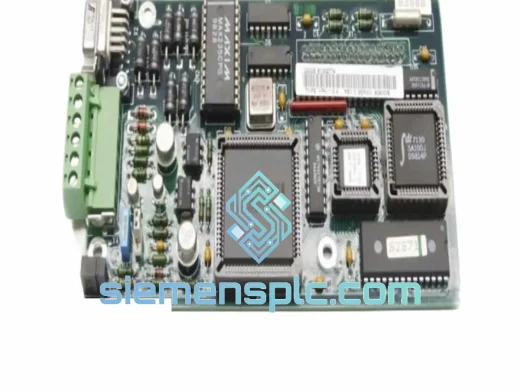
EMC design discipline is evident in the TINT-6511’s PCB layout: high-frequency switching nodes are physically separated from low-level analog signal traces, and the control board uses a split ground plane architecture that isolates digital return currents from analog measurement circuits. The internal EMC filter incorporates common-mode chokes and X/Y capacitors to attenuate both differential-mode and common-mode conducted emissions, reducing the risk of interference with 4–20 mA instrumentation loops and Profibus/Modbus communication cables sharing the same cable tray.
The gate driver circuits include desaturation detection, which monitors IGBT collector-emitter voltage during the on-state. If a short-circuit condition causes the transistor to leave saturation, the gate driver initiates a controlled soft-shutdown within microseconds — far faster than any upstream fuse or breaker — protecting the power semiconductors from destructive overcurrent. This hardware-level protection operates independently of the drive’s firmware, ensuring fault response even if the main processor is occupied with communication tasks.
The sensorless vector control algorithm runs on a dedicated DSP core, executing current measurement, coordinate transformation (Clarke and Park transforms), flux estimation, and PWM generation within a fixed interrupt cycle. This deterministic execution model ensures that speed regulation bandwidth is not degraded by communication stack activity or parameter write operations occurring on the application processor.
System Integration Benefits
- Reduced Panel Footprint: Wall-mount form factor eliminates the need for a dedicated drive enclosure, freeing panel space for PLC, I/O, and protection equipment.
- Shorter Power Cable Runs: Mounting adjacent to the motor reduces cable length, lowering resistive voltage drop and minimizing radiated EMI from unshielded motor cable sections.
- Deterministic Speed Reference Processing: Analog and fieldbus speed references are processed within the drive’s fixed control cycle, providing consistent response latency for closed-loop process control.
- Transparent Fault Diagnostics: Fault codes, warning history, and operating hour logs are accessible via the drive’s keypad and fieldbus interface, enabling root-cause analysis without specialized test equipment.
- Energy Metering Capability: The TINT platform’s energy counter function tracks kWh consumption, supporting energy audit requirements and ISO 50001 compliance documentation.
- Motor Protection Integration: Built-in electronic motor thermal model eliminates the need for a separate motor protection relay in many applications, reducing BOM cost and panel wiring complexity.
- Scalable Communication Architecture: Fieldbus option cards allow the same drive hardware to be integrated into Profibus, Modbus RTU, or Ethernet-based control architectures without hardware redesign.
- Safe Torque Off (STO) Compatibility: The TINT series platform supports STO functionality per IEC 62061 / ISO 13849, enabling integration into safety-rated machine control systems without an external safety contactor in applicable configurations.
- Parameter Backup and Cloning: Drive parameters can be stored and transferred via the keypad or PC tool, accelerating replacement unit commissioning and ensuring configuration consistency across multi-drive installations.
Quality Assurance & Global Logistics
Every ABB TINT-6511 unit dispatched from siemensplc.com is sourced through verified industrial supply channels and undergoes a pre-shipment inspection protocol covering physical integrity, label authenticity, and OEM part number cross-reference against ABB’s product catalog. Serial numbers and manufacturing date codes are recorded at intake and matched to shipping documentation, providing full traceability from origin to delivery.
Units are packed in anti-static foam-lined cartons with corner protection, designed to withstand the mechanical shock and vibration profiles of international air and sea freight. Export documentation — including commercial invoice, packing list, certificate of origin, and available test reports — is prepared in compliance with customs requirements for the destination country. Our logistics team in Xiamen, China, coordinates with DHL, FedEx, and UPS for time-critical shipments, with standard international transit times of 3–7 business days to major industrial hubs in Europe, Southeast Asia, the Middle East, and the Americas.
A 12-month warranty covers manufacturing defects under normal operating conditions. Warranty claims are processed with a target response time of 48 hours from receipt of the defective unit, with replacement or repair options depending on stock availability and fault assessment outcome.
Contact Information
📧 Email: [email protected]
💬 WhatsApp: +86 18359268345
🌐 Web: siemensplc.com
📍 Location: Xiamen, China
© 2026 siemensplc.com. All rights reserved.
Ready to quote
[email protected]
Send This Part Number to Sales
RFQ workflow
Quality workflow ->
Confirmation Process
01Model confirmation
We check the full part number, brand, series and visible nameplate information before quotation.
02Availability reply
Sales confirms stock path, condition option, quantity and realistic lead time for export dispatch.
03Packing & courier
DHL, FedEx, UPS or buyer courier arrangements can be reviewed with packing requirements.
Continue sourcing
Browse full catalog ->
Related Automation Parts
Similar brand or category products for fast comparison and multi-item RFQ lists.
ABB
RFQ Ready
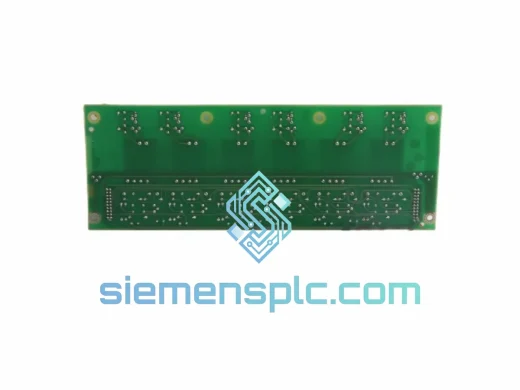
ABB ZINT-592 Fieldbus Interface Board – ZINT Series
ACS Drive
Origin SE
Interface Board
ABB
RFQ Ready
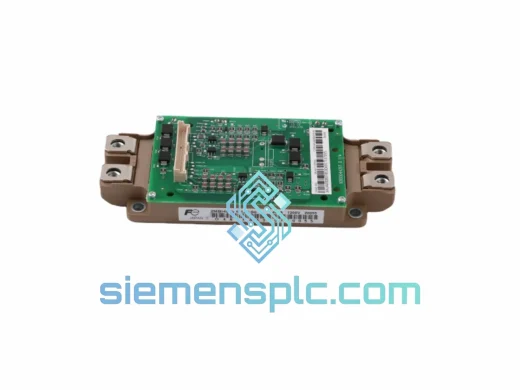
ABB YPK113A 61002774 Drive Control Board
In-Stock Xiamen
Origin SE
Drive Control Board