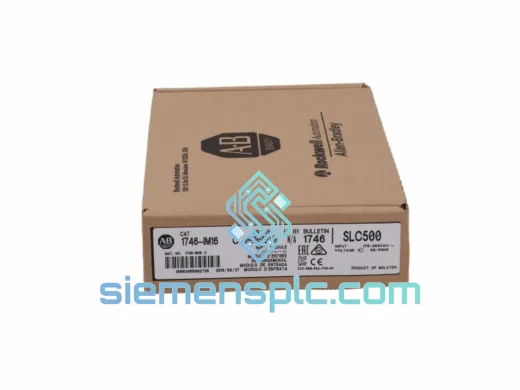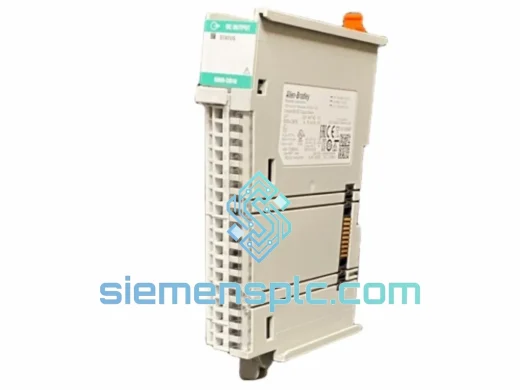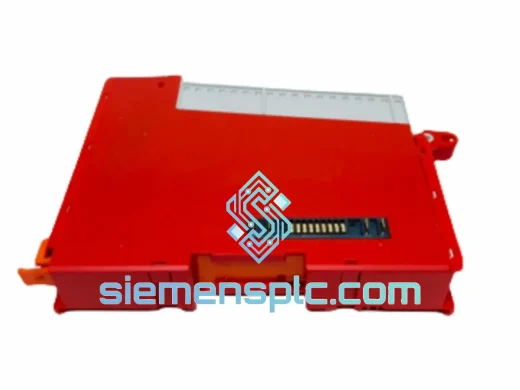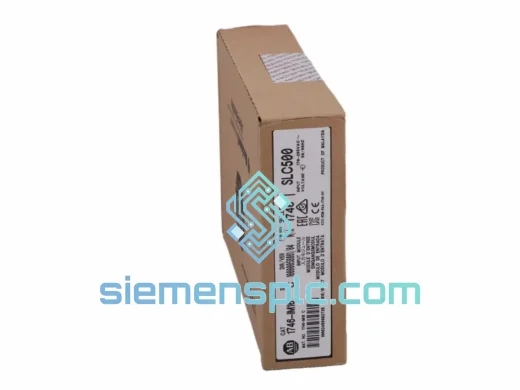
Allen-Bradley
RFQ Ready
Allen-Bradley DIM16 Discrete Input Module
SLC 500
Origin US
Discrete Input Module
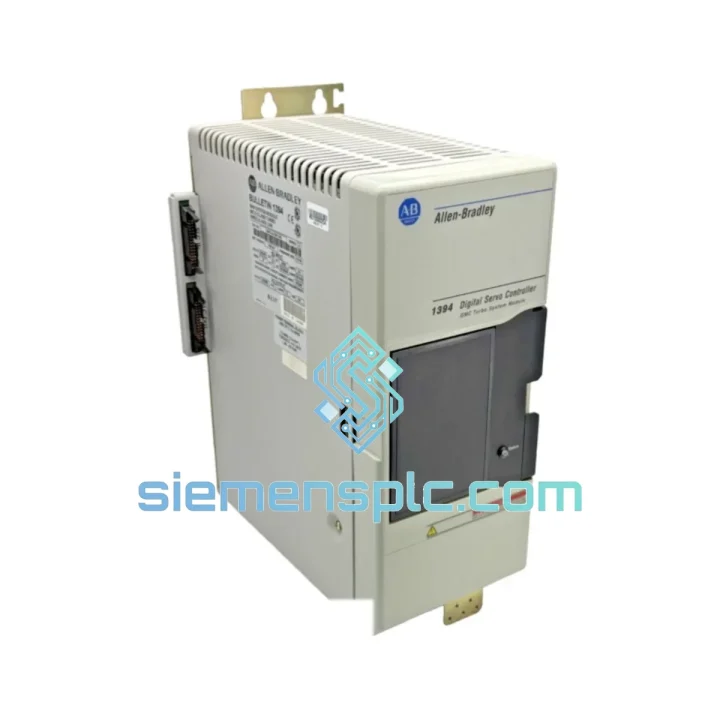
Request verified availability, condition, replacement risk review, packing options and courier lead time for 1394C-SJT05-T-RL.
Click Request Quote and the part number is inserted into the inquiry form automatically.
Core fields for model confirmation and RFQ routing. Detailed product narrative remains below.
The 1394C-SJT05-T-RL is a four-axis, 5 kW continuous-rated servo controller module within Rockwell Automation’s 1394C GMC Flex platform. It integrates drive power electronics, motion coordination logic, and Remote I/O (RIO) communication into a single chassis-mount unit. The module accepts velocity and position commands from an upstream PLC-5 or SLC 500 host over the Allen-Bradley Remote I/O link and closes independent current, velocity, and position loops for each axis at the DSP level — without relying on the host scan cycle for servo closure. This architecture decouples servo determinism from PLC ladder scan jitter, a critical requirement in multi-axis coordinated motion where inter-axis synchronization tolerances are measured in microseconds.
The “T” suffix designates the transformer-isolated AC input variant, providing galvanic separation between the incoming three-phase supply and the internal DC bus. The “RL” suffix confirms the Remote I/O communication interface, distinguishing this unit from DH+ or hardwired variants. Together, these designators define a module suited for retrofit and expansion in legacy Allen-Bradley motion networks where RIO infrastructure is already deployed.
Real-time Stock & RFQ: [email protected] | WhatsApp: +86 18359268345
| Parameter | Specification |
|---|---|
| Part Number | 1394C-SJT05-T-RL |
| Platform | Allen-Bradley 1394C GMC Flex |
| Module Class | Multi-Axis Servo Controller (Transformer-Isolated, Remote I/O) |
| Continuous Output Power | 5 kW (per system; shared DC bus) |
| Axes Supported | Up to 4 coordinated axes |
| AC Input Voltage | 380–480 VAC, 3-phase, 50/60 Hz |
| DC Bus Voltage (nominal) | 650 VDC |
| Input Isolation | Transformer-isolated (T suffix) — galvanic separation from AC supply |
| Communication Protocol | Allen-Bradley Remote I/O (1771 RIO), 57.6 kbps / 115.2 kbps / 230.4 kbps selectable |
| Encoder Feedback Type | Incremental, differential TTL (A, B, Z channels); 5 VDC supply |
| Servo Loop Update Rate | Current loop: ≤ 100 µs; Velocity loop: ≤ 1 ms; Position loop: ≤ 2 ms |
| Operating Temperature | 0 °C to +55 °C (ambient, with rated airflow) |
| Storage Temperature | −40 °C to +70 °C |
| Relative Humidity | 5–95% non-condensing |
| Enclosure Rating | IP20 (open-type, panel-mount) |
| Cooling | Forced-air (internal fan); minimum 50 mm clearance top and bottom |
| Approximate Weight | 10.68 kg |
| Certifications | UL Listed, CE (LVD + EMC), cUL |
| Country of Origin | United States |
| Warranty | 12 months — covers manufacturing defects and functional failure under rated operating conditions |
DSP-Based Closed-Loop Architecture: The 1394C-SJT05-T-RL employs a dedicated digital signal processor for each axis’s servo closure. Current regulation operates on a space-vector PWM scheme with a switching frequency in the range of 4–8 kHz, producing low harmonic distortion in motor windings and reducing thermal stress on stator insulation. The velocity loop integrates a PI compensator with anti-windup logic, preventing integrator saturation during acceleration ramps — a common failure mode in drives that lack this protection when load inertia mismatches are present.
Transformer Isolation and DC Bus Topology: The T-suffix input transformer provides galvanic isolation, attenuating common-mode noise from the AC supply before it reaches the rectifier stage. The resulting DC bus is shared across all four axis inverter stages. This shared-bus topology enables regenerative energy exchange: when one axis decelerates, its kinetic energy is returned to the DC bus and consumed by an accelerating axis on the same module — reducing net energy draw from the supply and lowering dynamic braking resistor duty cycle. Excess regenerative energy beyond what the bus can absorb is dissipated through an external dynamic braking resistor connected to the DB terminals.
EMC Design and Noise Immunity: The module’s internal layout separates high-frequency switching circuits from low-level encoder and RIO signal traces using a ground plane partition strategy. Encoder inputs are differential (RS-422 compatible), providing 20+ dB of common-mode rejection against ground-referenced noise — essential in environments with variable-frequency drives, welding equipment, or large contactors sharing the same panel. The RIO communication interface uses transformer-coupled differential signaling, maintaining signal integrity over cable runs up to 3,048 m at 57.6 kbps.
Fault Detection and Diagnostic Logic: The 1394C-SJT05-T-RL implements hardware-level fault detection for overcurrent, overvoltage, undervoltage, overtemperature, encoder loss, and RIO communication timeout. Each fault condition latches a specific fault code in the module’s internal register, readable by the host PLC via the RIO data table without requiring a separate diagnostic network. The module’s seven-segment display provides a local fault code readout, enabling field technicians to identify fault class without a laptop or programming terminal.
Motion Coordination and Interpolation: The module supports linear interpolation across axes using internally synchronized position loop updates. Inter-axis position data is exchanged over the module’s internal backplane bus at a rate that maintains synchronization error below 1 encoder count under normal load conditions. This is achieved through a hardware interrupt-driven update scheme rather than a polled software loop, eliminating the latency variability inherent in OS-scheduled tasks.
Every 1394C-SJT05-T-RL unit supplied by siemensplc.com is sourced through verified channels — authorized distribution stock or traceable surplus with documented provenance. Pre-shipment inspection covers visual examination of housing, label authenticity verification against Rockwell Automation part number and date code formats, and a functional power-on test confirming DC bus charge, fan operation, and RIO communication initialization. Units that do not pass inspection are quarantined and not offered for sale.
Shipments originate from Xiamen, China, using DHL Express and FedEx International Priority as primary carriers. Typical transit times are 3–5 business days to Southeast Asia, 4–6 business days to Europe, and 5–7 business days to North America. Export documentation — commercial invoice, packing list, and HS code declaration — is prepared to comply with destination country customs requirements, minimizing clearance delays. For orders requiring expedited delivery, same-day dispatch is available for in-stock units ordered before 14:00 CST.
A 12-month warranty covers manufacturing defects and functional failure under rated operating conditions. Warranty claims are processed with a target response time of 24 business hours. Replacement units are dispatched from Xiamen stock where available; repair-and-return service is offered for units with repairable fault conditions. Certificate of conformance is available on request for quality management system documentation purposes.
Email: [email protected]
WhatsApp: +86 18359268345
Web: siemensplc.com
Location: Xiamen, China
© 2026 siemensplc.com. All rights reserved.
We check the full part number, brand, series and visible nameplate information before quotation.
Sales confirms stock path, condition option, quantity and realistic lead time for export dispatch.
DHL, FedEx, UPS or buyer courier arrangements can be reviewed with packing requirements.
Similar brand or category products for fast comparison and multi-item RFQ lists.