Allen-Bradley
RFQ Ready
Allen-Bradley 1747-SDN PLC Scanner Module
SLC 500
Origin US
PLC Scanner Module
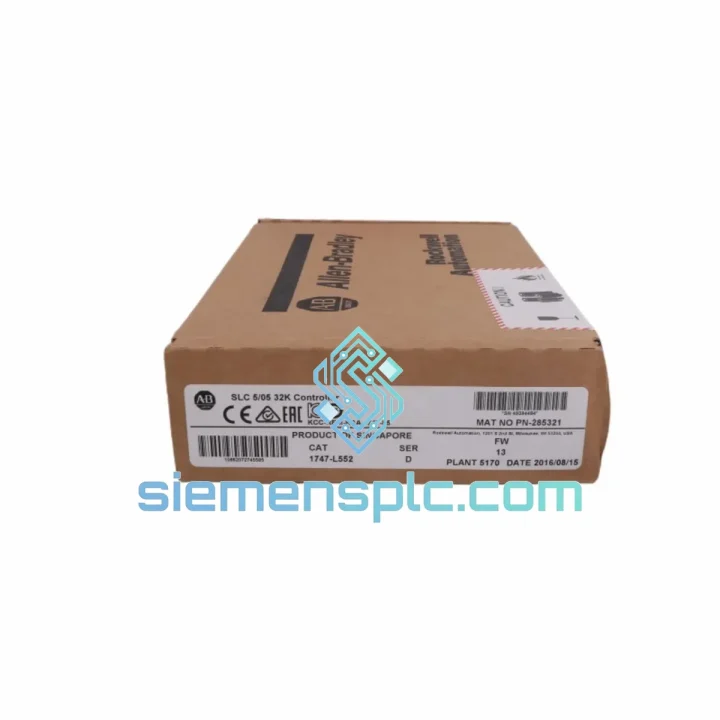
Request verified availability, condition, replacement risk review, packing options and courier lead time for 1747-L552.
Click Request Quote and the part number is inserted into the inquiry form automatically.
Core fields for model confirmation and RFQ routing. Detailed product narrative remains below.
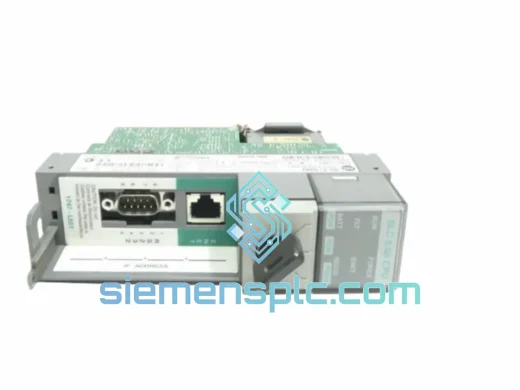
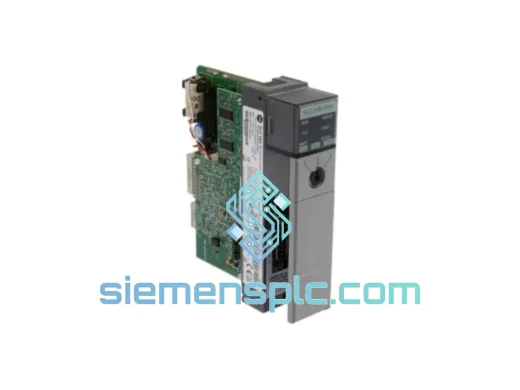
The Allen-Bradley 1747-L552 is a single-slot CPU module within the SLC 500 modular platform, classified as an SLC 5/05 processor. It provides 32,768 words (32K) of user program and data memory, a dedicated 10/100 Mbps Ethernet port (RJ-45) supporting EtherNet/IP and MSG instruction-based communication, and a Channel 0 RS-232 serial port for DF1 full-duplex, DF1 half-duplex, DH-485, and ASCII protocols. In a mid-range discrete or process control architecture, this module occupies slot 0 of any SLC 500 chassis (1746-A4 through 1746-A13) and serves as the sole program execution engine — scanning the I/O table, executing ladder logic rungs, updating output image registers, and managing all inter-module communication across the SLC 500 backplane at a nominal scan rate of approximately 1 ms per 1K of logic.
Unlike communication co-processors or bridge modules, the 1747-L552 integrates its Ethernet MAC/PHY directly on the CPU board, eliminating the latency and failure modes introduced by a separate 1747-AENTR or similar adapter. The processor supports up to 4,096 discrete I/O points and 960 analog I/O channels distributed across local and remote I/O racks, making it suitable for applications that have outgrown the SLC 5/03 (DH-485 only) but do not yet require the full ControlLogix 1756 platform.
Real-time Stock & RFQ: [email protected] | WhatsApp: +86 18359268345
| Parameter | Specification |
|---|---|
| Catalog Number | 1747-L552 |
| Processor Family | SLC 500 — SLC 5/05 |
| User Memory | 32,768 Words (32K) |
| Data Table Size | Up to 32K words (shared with program memory) |
| Ethernet Port | 10/100 Mbps, RJ-45, Auto-MDI/MDIX |
| Ethernet Protocols | EtherNet/IP (CIP), MSG instruction (PCCC encapsulation) |
| Serial Port (Ch. 0) | RS-232, DB-9, isolated |
| Serial Protocols | DF1 Full/Half-Duplex, DH-485, ASCII, System (default) |
| Max Discrete I/O | 4,096 points (local + remote) |
| Max Analog I/O | 960 channels |
| Typical Scan Rate | ~1 ms / 1K of logic (Boolean-intensive) |
| Instruction Set | Full SLC 500 ladder instruction set (relay, timer, counter, math, PID, MSG, etc.) |
| PID Loops | Up to 40 (software-based, scan-dependent) |
| Battery Backup | Lithium, 1747-BA (user-replaceable, retains program on power loss) |
| Operating Temperature | 0 °C to +60 °C |
| Storage Temperature | -40 °C to +85 °C |
| Relative Humidity | 5% to 95% non-condensing |
| Supply Voltage | Backplane-powered via SLC 500 chassis power supply |
| Backplane Current Draw | 800 mA @ 5 VDC (typical) |
| Slot Requirement | 1 slot (Slot 0 only) |
| Compatible Chassis | 1746-A4, 1746-A7, 1746-A10, 1746-A13 |
| Programming Software | RSLogix 500 v8.10 or later; RSLinx Classic for communications |
| Certifications | UL Listed, CE Marked, CSA Certified, c-UL |
| Weight | Approx. 450 g |
| Warranty | 12 months from date of shipment (new-in-box units) |
The 1747-L552 CPU board is built around a 16-bit CISC processor core with dedicated co-processor support for floating-point arithmetic and PID execution. The backplane interface uses a parallel address/data bus architecture proprietary to the SLC 500 platform, operating at a fixed backplane clock rate. Each I/O module in the chassis is addressed as a memory-mapped register block; the CPU performs a deterministic I/O scan by sequentially reading input image registers and writing output image registers across the backplane bus during each program scan cycle. This architecture guarantees that all I/O updates occur within a single scan boundary — a critical property for interlock logic in safety-adjacent applications.
Ethernet MAC/PHY Integration: The on-board Ethernet subsystem uses a dedicated MAC controller connected to the CPU via an internal peripheral bus, separate from the backplane I/O bus. This physical separation means Ethernet communication activity (MSG instruction execution, RSLinx polling, HMI data reads) does not directly stall the ladder scan. MSG instructions are queued and executed asynchronously; the CPU services the Ethernet stack during the inter-scan overhead period, keeping worst-case scan time perturbation below 5% under typical network load conditions.
EMC Design: The module’s PCB employs a multi-layer stackup with dedicated ground planes between signal layers, reducing radiated emissions and improving immunity to conducted interference. The RS-232 Channel 0 port uses an optically isolated transceiver stage, providing galvanic isolation between the CPU logic ground and the serial cable shield — a necessary design feature in environments with ground potential differences between control panels and field devices. The Ethernet port includes common-mode chokes and TVS diode arrays on the RJ-45 interface to suppress ESD transients up to ±15 kV (air discharge, IEC 61000-4-2 Level 4).
Memory Architecture: The 32K word memory space is unified — program logic and data tables share the same SRAM array, managed by the operating system firmware. The battery-backed SRAM retains both program and data on power loss without requiring a separate EEPROM backup cycle (unlike earlier SLC 5/01 and 5/02 processors). A separate flash memory sector stores the operating system firmware, which is field-upgradeable via RSLogix 500 without removing the module from the chassis.
Watchdog and Fault Handling: The CPU implements a hardware watchdog timer that triggers a major fault and forces all outputs to their last-state or de-energized condition (configurable per output module) if the scan cycle exceeds the programmed maximum scan time. The fault routine mechanism allows user-defined ladder logic to execute on minor faults, enabling graceful degradation rather than hard shutdown in non-critical fault conditions.
All Allen-Bradley 1747-L552 units supplied by siemensplc.com are sourced as genuine Rockwell Automation manufactured components. Each unit undergoes a structured pre-shipment verification process: visual inspection of PCB, connectors, and label integrity; power-on functional test confirming CPU boot sequence and fault-free status; Ethernet port connectivity verification via RSLinx ping and data table read; and serial port loopback test on Channel 0. Units are shipped with original packaging where available, or repackaged in ESD-safe anti-static bags with foam-lined double-wall cartons and moisture barrier film for international transit.
Shipments originate from our warehouse in Xiamen, China. Standard export documentation includes commercial invoice, packing list, and certificate of origin. DHL Express, FedEx International Priority, and UPS Worldwide Express are the primary carriers, with typical transit times of 3–5 business days to North America and Europe, and 2–4 business days to Southeast Asia. Expedited same-day dispatch is available for orders confirmed before 14:00 CST. All shipments are fully tracked and insured. For orders requiring specific HS code documentation, ECCN classification, or end-user certificates, our logistics team provides complete export compliance support.
Warranty terms: 12 months from shipment date on new-in-box units, covering manufacturing defects and functional failure under normal operating conditions. Warranty claims are processed with advance replacement where stock permits, minimizing production downtime.
Email: [email protected]
WhatsApp: +86 18359268345
Web: siemensplc.com
Location: Xiamen, China
© 2026 siemensplc.com. All rights reserved.
We check the full part number, brand, series and visible nameplate information before quotation.
Sales confirms stock path, condition option, quantity and realistic lead time for export dispatch.
DHL, FedEx, UPS or buyer courier arrangements can be reviewed with packing requirements.
Similar brand or category products for fast comparison and multi-item RFQ lists.