Allen-Bradley
RFQ Ready
Allen-Bradley 1747-SDN PLC Scanner Module
SLC 500
Origin US
PLC Scanner Module
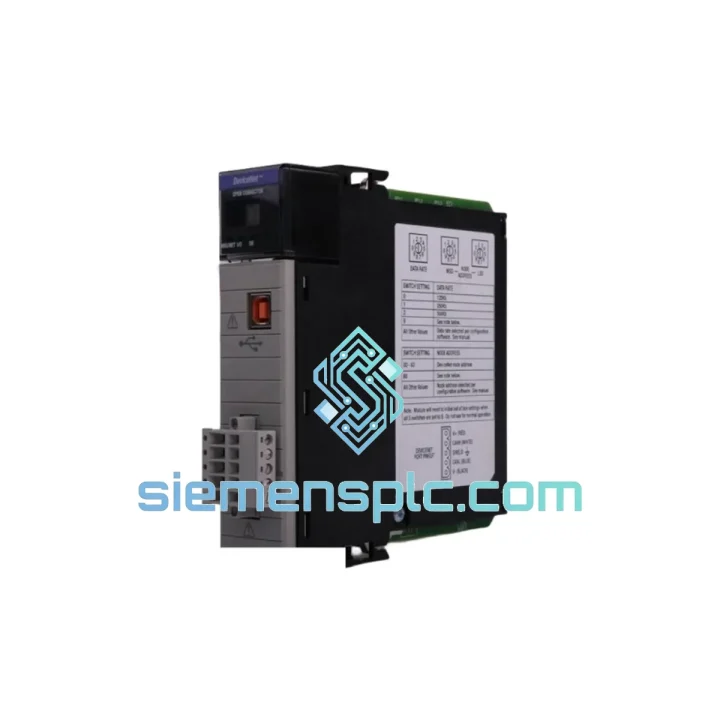
Request verified availability, condition, replacement risk review, packing options and courier lead time for 1747-L553/C.
Click Request Quote and the part number is inserted into the inquiry form automatically.
Core fields for model confirmation and RFQ routing. Detailed product narrative remains below.
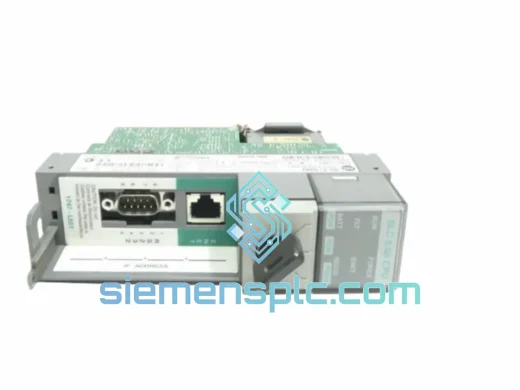
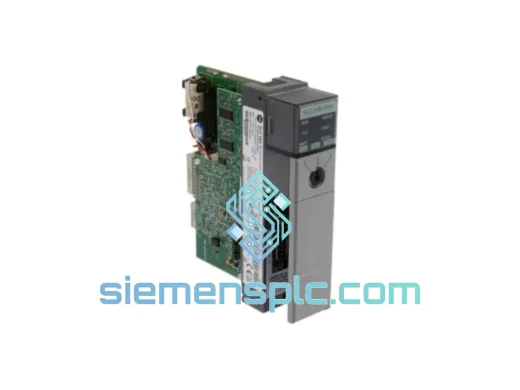
The Allen-Bradley 1747-L553/C is the highest-memory variant within the SLC 5/05 processor family, manufactured by Rockwell Automation under the Allen-Bradley brand. It occupies slot 0 of any SLC 500 modular chassis (1746-Axx series) and serves as the central execution engine for the entire I/O subsystem. With 64K words of user memory, a native 10/100 Mbps Ethernet/IP port, and a secondary RS-232 channel supporting DH-485, this processor addresses both legacy network continuity and modern TCP/IP integration requirements simultaneously — without requiring supplemental communication modules.
In a typical SLC 500 control loop, the 1747-L553/C executes ladder logic in a deterministic scan cycle. The processor reads all input image table data from the backplane, resolves the logic program sequentially, then writes output image table results back to the backplane — all within a single scan. At approximately 1 ms per 1K of logic, a 10K-word program completes a full scan in roughly 10 ms, providing adequate determinism for most discrete manufacturing and process control applications. The 64K word ceiling accommodates complex programs with large data tables, PID loops, and extensive MSG instruction sets without memory fragmentation concerns.
The Ethernet/IP port operates on TCP port 44818 using the Common Industrial Protocol (CIP), enabling direct MSG instruction communication to ControlLogix, CompactLogix, and other CIP-compliant devices. It also supports PCCC encapsulation over Ethernet, which allows legacy RSLogix 500 programming sessions and SCADA polling without protocol conversion gateways. The RS-232 port, configured for DH-485 at up to 19.2 kbps, provides a secondary programming channel and supports point-to-point or multi-drop networks of up to 32 nodes.
Real-time Stock & RFQ: [email protected] | WhatsApp: +86 18359268345
| Parameter | Specification |
|---|---|
| Catalog Number | 1747-L553/C |
| Series / Revision | SLC 5/05, Series C |
| Manufacturer | Allen-Bradley / Rockwell Automation |
| User Memory | 64K Words (65,536 words) |
| Max Digital I/O Points | 4,096 (across local + extended chassis) |
| Max I/O Chassis | 3 (1 local + 2 extended local) |
| Scan Time (typical) | ~1 ms / 1K of logic |
| Ethernet/IP Port | 10/100 Mbps, RJ-45, TCP port 44818, CIP + PCCC |
| Serial Port | RS-232, DH-485, up to 19.2 kbps, 32-node multi-drop |
| Backplane Current Draw | 800 mA @ 5 VDC |
| Operating Temperature | 0 °C to +60 °C |
| Storage Temperature | −40 °C to +85 °C |
| Relative Humidity | 5 % to 95 % (non-condensing) |
| Vibration Resistance | 2 g @ 10–500 Hz (IEC 68-2-6) |
| Shock Resistance | 30 g operational, 50 g non-operational |
| Programming Software | RSLogix 500 v8.0+; RSLinx Classic for driver configuration |
| Certifications | UL 508, CE (EN 61131-2), CSA C22.2 No. 142 |
| Chassis Compatibility | 1746-A4, A7, A10, A13 (slot 0 only) |
| Power Supply Compatibility | 1746-P1, P2, P3, P4, P7 |
| Approximate Weight | 300 g |
| Warranty | 12 months from date of shipment |
Backplane Bus Architecture: The SLC 500 backplane operates as a parallel data bus at 5 VDC logic levels. The 1747-L553/C arbitrates bus access using a token-passing protocol — the processor holds the bus token during I/O scan, releases it between scan phases, and reclaims it for the next cycle. This architecture prevents bus contention between the CPU and intelligent I/O modules (e.g., 1746-HSCE high-speed counter, 1746-NI4 analog input) that perform autonomous data acquisition between CPU scans. The result is a clean separation between CPU execution time and I/O module processing time, which is critical for analog modules requiring settling time.
Memory Map and Data Table Structure: The 1747-L553/C organizes its 64K word space into a fixed data table region and a variable program file region. Data tables include output (O:), input (I:), status (S:), binary (B:), timer (T:), counter (C:), control (R:), integer (N:), and floating-point (F:) files. The status file (S:) exposes 163 words of processor diagnostics — including scan time, fault codes, math overflow flags, and communication status — directly addressable by ladder logic for in-program diagnostics without external tools.
EMC Design and Isolation: The processor’s Ethernet/IP port incorporates transformer-coupled isolation between the RJ-45 connector and the internal logic circuitry, providing 1,500 V isolation against common-mode transients on the network cable. The RS-232 port uses opto-coupled signal conditioning on the RXD line to suppress ground loop currents in multi-drop DH-485 configurations. The backplane connector uses gold-plated contacts rated for 200 insertion cycles, maintaining contact resistance below 10 mΩ across the operating temperature range.
Fault Handling and Watchdog Logic: The 1747-L553/C implements a hardware watchdog timer that triggers a major fault if the scan cycle exceeds the configured maximum scan time (default: 500 ms, user-configurable via S:30). On major fault, the processor halts program execution, de-energizes all outputs via the backplane fault signal, and logs the fault code to S:6 (major fault bits) and S:17 (fault address). This deterministic fault response prevents undefined output states during CPU hangs — a requirement in safety-adjacent applications where uncontrolled actuator motion is unacceptable.
Ethernet/IP CIP Object Model: The processor exposes a CIP Identity Object (Class 0x01), Message Router Object (Class 0x02), and Connection Manager Object (Class 0x06). Explicit messaging (Class 3 connections) supports up to 32 simultaneous MSG instruction connections, enabling concurrent data exchange with multiple remote devices — SCADA servers, HMI panels, remote I/O adapters, and peer PLCs — without serialization delays.
Every 1747-L553/C unit shipped from our Xiamen, China facility undergoes a structured pre-shipment verification protocol. Visual inspection confirms label integrity, connector condition, and absence of physical damage. Firmware revision is verified against the Series C specification using RSLinx Classic. A functional power-on test confirms processor boot sequence, status LED behavior (RUN, FLT, BATT, FORCE indicators), and Ethernet port link negotiation. Units that fail any inspection step are quarantined and not shipped.
All units are packed in anti-static ESD bags, placed in foam-lined cartons, and sealed with tamper-evident tape. Export documentation — including commercial invoice, packing list, and certificate of origin — is prepared in compliance with Chinese customs regulations and destination-country import requirements. Shipments to North America, Europe, Southeast Asia, and the Middle East typically clear customs within 3–5 business days via DHL Express or FedEx International Priority. Expedited same-day dispatch is available for orders confirmed before 14:00 CST.
A 12-month warranty covers manufacturing defects and functional failures under normal operating conditions. Warranty claims are processed within 5 business days of receipt of the returned unit. Replacement units are dispatched from Xiamen stock, minimizing downtime for production-critical applications.
Email: [email protected]
WhatsApp: +86 18359268345
Web: siemensplc.com
Location: Xiamen, China
© 2026 siemensplc.com. All rights reserved.
We check the full part number, brand, series and visible nameplate information before quotation.
Sales confirms stock path, condition option, quantity and realistic lead time for export dispatch.
DHL, FedEx, UPS or buyer courier arrangements can be reviewed with packing requirements.
Similar brand or category products for fast comparison and multi-item RFQ lists.