Allen-Bradley
RFQ Ready
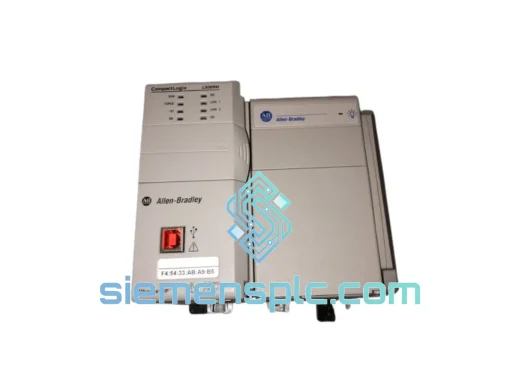
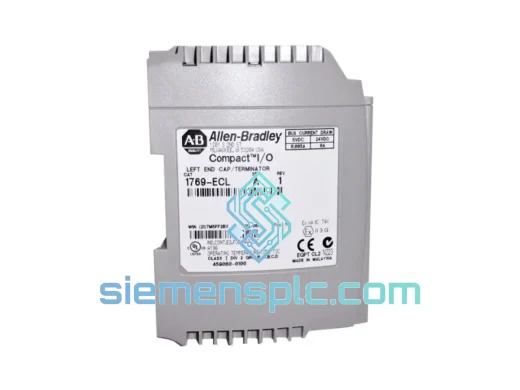
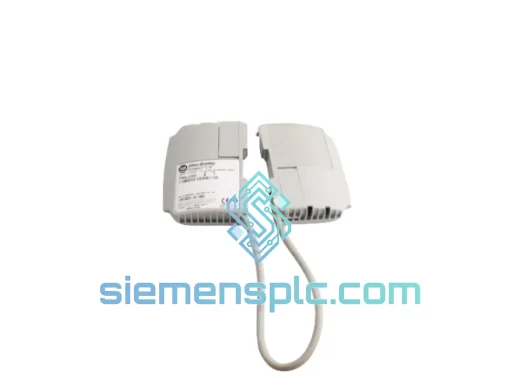
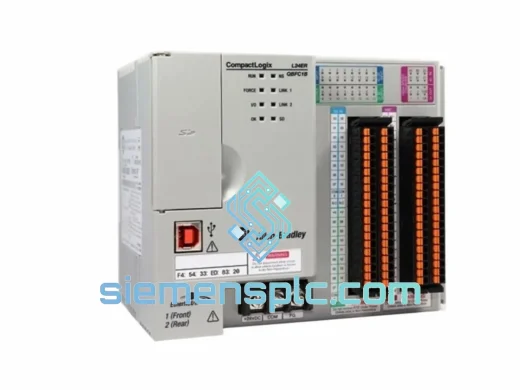
Allen-Bradley 1769-L24ERQBFC1B PLC Controller
CompactLogix
Origin US
PLC Controller
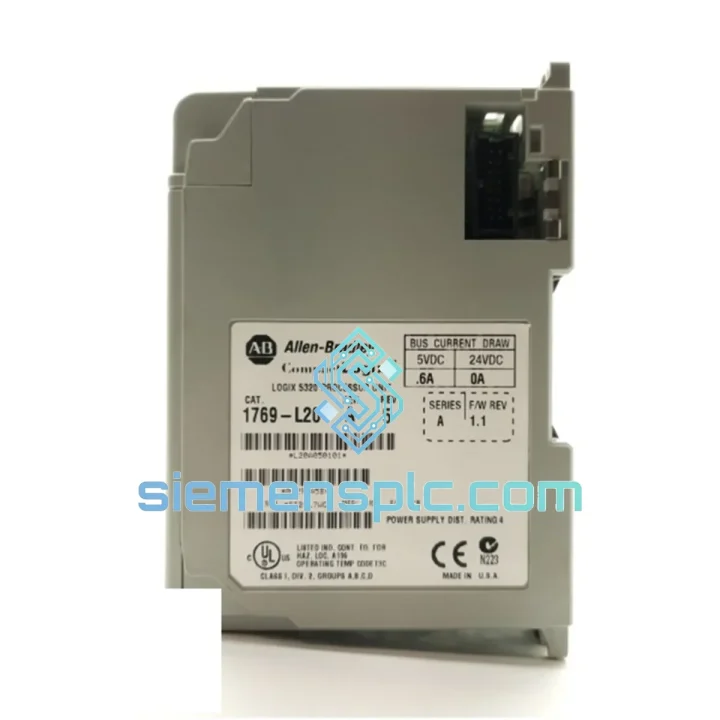
Request verified availability, condition, replacement risk review, packing options and courier lead time for 1769-L20.
Click Request Quote and the part number is inserted into the inquiry form automatically.
Core fields for model confirmation and RFQ routing. Detailed product narrative remains below.
The Allen-Bradley 1769-L20 is a CompactLogix 5320 series processor module produced by Rockwell Automation. It occupies the leftmost slot of a 1769 local chassis and functions as the sole bus master on the proprietary 1769 serial backplane, issuing timed polling frames to each installed I/O module at intervals synchronized to the configured task period. The processor maintains a unified tag database in which every I/O point, internal variable, and communication object is addressed by symbolic name rather than physical rack-slot notation — a structural departure from earlier SLC 500 and PLC-5 addressing conventions that materially reduces cross-reference errors during program development and commissioning.
With 512 KB of user memory, the 1769-L20 accommodates programs of moderate complexity: multi-axis motion sequencing, analog PID control with cascade and feedforward compensation, high-speed counter capture, and structured text state machines can coexist within a single project without external memory expansion in the majority of field deployments. The processor supports up to 16 locally connected 1769-series I/O modules, covering the full range of discrete, analog, thermocouple, RTD, and specialty function modules in the CompactLogix catalog.
Communication with a programming workstation is provided through one RS-232 serial port (DF1 full-duplex or DH-485 half-duplex protocol) and one USB Type-B programming port. The 1769-L20 does not carry a native EtherNet/IP port; network integration requires a 1769-ENET bridge module or a 1761-NET-ENI serial-to-Ethernet adapter. This hardware boundary is the primary architectural constraint to evaluate when specifying the 1769-L20 for SCADA-connected or distributed I/O topologies where real-time Ethernet messaging is a system requirement.
📦 Real-time Stock & RFQ: [email protected] | WhatsApp: +86 18359268345
| Catalog Number | 1769-L20 |
| Series | CompactLogix 5320 |
| Manufacturer | Rockwell Automation / Allen-Bradley |
| User Memory | 512 KB (expandable via 1784-CF64 CompactFlash card) |
| Max Local I/O Modules | 16 × 1769-series modules per local chassis |
| Communication Ports | 1× RS-232 (DF1 full-duplex / DH-485), 1× USB (programming only) |
| EtherNet/IP | Not native — bridge via 1769-ENET or 1761-NET-ENI required |
| Programming Software | RSLogix 5000 / Studio 5000 Logix Designer v16+ |
| IEC 61131-3 Languages | Ladder Diagram, Function Block Diagram, Structured Text, Sequential Function Chart |
| Supply Voltage | 24 VDC via 1769-PA2 (AC input) or 1769-PB2 (DC input) power module |
| Backplane Bus | Proprietary 1769 serial bus, token-passing, processor as bus master |
| Periodic Task Jitter | ±0.1 ms under rated load conditions |
| Operating Temperature | 0 °C to +60 °C |
| Storage Temperature | −40 °C to +85 °C |
| Relative Humidity | 5% to 95% non-condensing (IEC 60068-2-78) |
| Vibration Resistance | 2 g @ 10–500 Hz (IEC 60068-2-6) |
| Shock Resistance | 15 g, 11 ms half-sine (IEC 60068-2-27) |
| EMC Emissions | EN 55011 Class A (conducted and radiated) |
| Certifications | UL Listed, CE Marked, C-Tick (RCM) |
| Battery Type | CR2032 lithium coin cell, ~3-year service life at 25 °C |
| Module Weight | Approx. 200 g (processor module only, no power supply) |
| Warranty | 12 months from date of shipment |
CPU Core and Memory Architecture: The 1769-L20 executes the Logix instruction set on a 32-bit RISC-class processor core. Internal memory is partitioned into three non-overlapping address spaces: program code, tag data table, and I/O image. This segmentation prevents a runaway pointer or array overrun in the user program from writing into the I/O image — a hardware-enforced boundary that supports deployment in SIL 1 application contexts under IEC 61508 when paired with appropriate safety I/O modules. The tag data table is stored in battery-backed SRAM, retaining all variable values through a power interruption without requiring a program download on restart.
Backplane Token-Passing Protocol: The 1769 local backplane operates as a synchronous serial bus under exclusive processor control. At the start of each scan cycle, the processor issues a bus grant token to slot 1 and sequences through each occupied slot in ascending order. Each I/O module holds the token for a fixed window — typically 50–200 µs depending on module type — during which it transfers its input data to the processor and receives output data from the previous scan. A module that fails to respond within its window sets a fault bit in the controller status tag without interrupting the polling sequence for remaining slots. This fault-isolation behavior allows the processor to maintain deterministic output updates on all healthy modules while simultaneously flagging the faulted slot for operator action, a property critical in continuous-process applications where a single failed I/O module must not force a full system shutdown.
EMC Design and Grounding Architecture: The 1769-L20 module housing incorporates a grounded metal backplane connector shield that provides a low-impedance return path for high-frequency common-mode currents induced by adjacent variable-frequency drives or switching power supplies. Internal ferrite beads on the RS-232 signal lines attenuate conducted interference above 1 MHz. The 1769 chassis rail establishes a common ground reference across all installed modules, reducing ground potential differences that would otherwise appear as noise on analog input channels. Conducted emissions compliance to EN 55011 Class A is achieved in standard panel installations without external line filters, provided the chassis DIN rail is bonded to the panel protective earth at an impedance of ≤0.1 Ω at DC and ≤1 Ω at 1 MHz.
Firmware Task Scheduler: The operating system manages three concurrent task classes. Continuous tasks execute in a free-running loop, consuming all available CPU time not claimed by higher-priority tasks. Periodic tasks are triggered by a hardware timer interrupt at user-defined intervals from 1 ms to 2000 ms, with measured jitter of ±0.1 ms under rated load — a figure governed by interrupt latency in the OS kernel rather than program execution time variability. Event tasks are triggered by consumed tag updates or motion axis events, providing interrupt-driven response latencies below 1 ms for time-critical sequences such as registration mark detection, cam profile switching, or high-speed counter latch operations. This three-tier architecture allows a single processor to simultaneously manage slow supervisory logic in a continuous task, time-critical motion sequences in a 2 ms periodic task, and sub-millisecond event responses without task priority inversion.
CompactFlash Program Backup: With a 1784-CF64 CompactFlash card installed in the processor’s card slot, the 1769-L20 stores a complete image of the user program, tag data, and firmware revision to non-volatile flash memory. On power-up, the processor compares the flash image to the SRAM contents and, if a mismatch is detected (indicating SRAM corruption or a processor replacement), automatically loads the flash image without operator intervention. This capability eliminates the requirement for a connected programming terminal during unattended recovery in remote or unmanned installations.
Every Allen-Bradley 1769-L20 unit dispatched from our Xiamen, China facility passes a structured four-stage verification protocol before shipment authorization is issued. Units are sourced exclusively through traceable industrial distribution channels with documented chain of custody; no product enters inventory from unverified secondary markets.
Stage 1 — Physical Authentication: Label typography, holographic security features, housing parting-line geometry, connector pin condition, and date code format are verified against authenticated reference samples. Serial number format is cross-checked against Rockwell Automation’s published catalog number and serial structure specifications.
Stage 2 — Power-On Functional Test: Each unit is energized via a calibrated 24 VDC bench supply. Processor boot sequence completion, firmware revision display, and self-diagnostic pass/fail status are recorded in the unit test log. Units that fail to complete the boot sequence, report internal hardware faults, or display firmware revision anomalies are quarantined and excluded from shipment.
Stage 3 — Communication Port Integrity Test: RS-232 and USB ports are tested using calibrated loop-back fixtures. RS-232 bit error rate is measured at 19,200 bps (maximum DF1 rate); USB enumeration and descriptor integrity are verified against the expected device profile. Any port exhibiting elevated error rates or enumeration failures triggers unit rejection.
Stage 4 — Documentation Assembly: Each unit ships with a functional test report, sourcing declaration, firmware revision record, and available certificate of conformance. Lot traceability records are retained for a minimum of five years to support warranty claims and field failure analysis.
Export Logistics from Xiamen, China: Standard shipments depart within 2 business days of order confirmation. DHL Express, FedEx International Priority, and UPS Worldwide Express services are available, with typical transit times of 3–5 business days to North America and Western Europe. All shipments include full tracking, commercial invoice, packing list, and HS code documentation to minimize customs clearance delays. Emergency same-day dispatch is available for confirmed orders received before 14:00 CST.
Email: [email protected]
WhatsApp: +86 18359268345
Web: siemensplc.com
Location: Xiamen, China
© 2026 siemensplc.com. All rights reserved.
We check the full part number, brand, series and visible nameplate information before quotation.
Sales confirms stock path, condition option, quantity and realistic lead time for export dispatch.
DHL, FedEx, UPS or buyer courier arrangements can be reviewed with packing requirements.
Similar brand or category products for fast comparison and multi-item RFQ lists.