Allen-Bradley
RFQ Ready
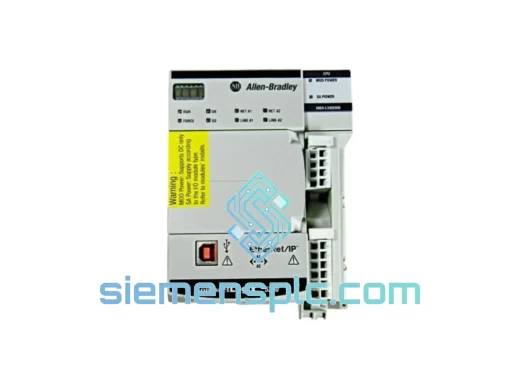
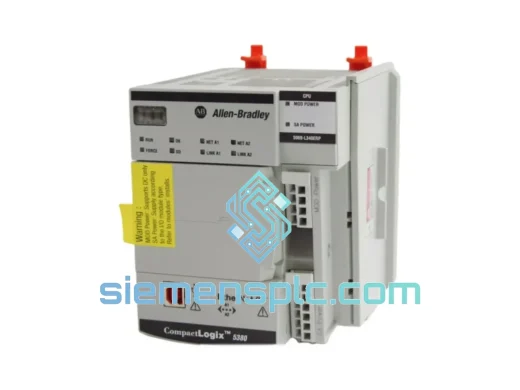
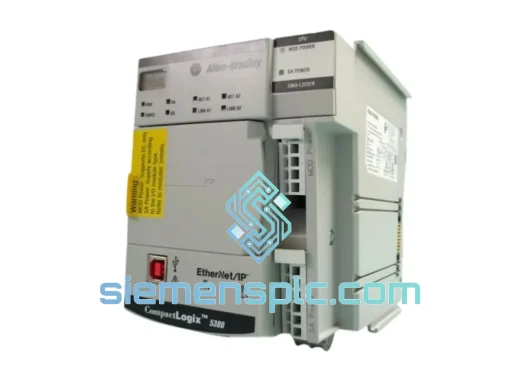
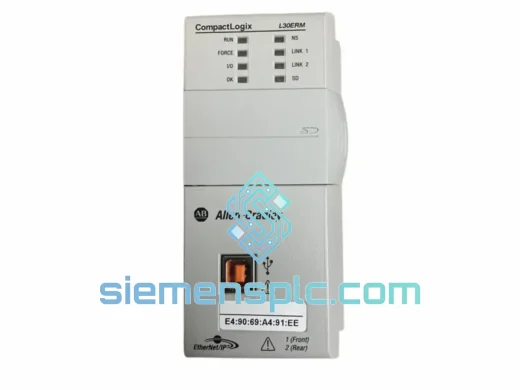
Allen-Bradley 1769-L30ERM PLC Motion Controller – CompactLogix 5370
CompactLogix
Origin US
PLC Motion Controller
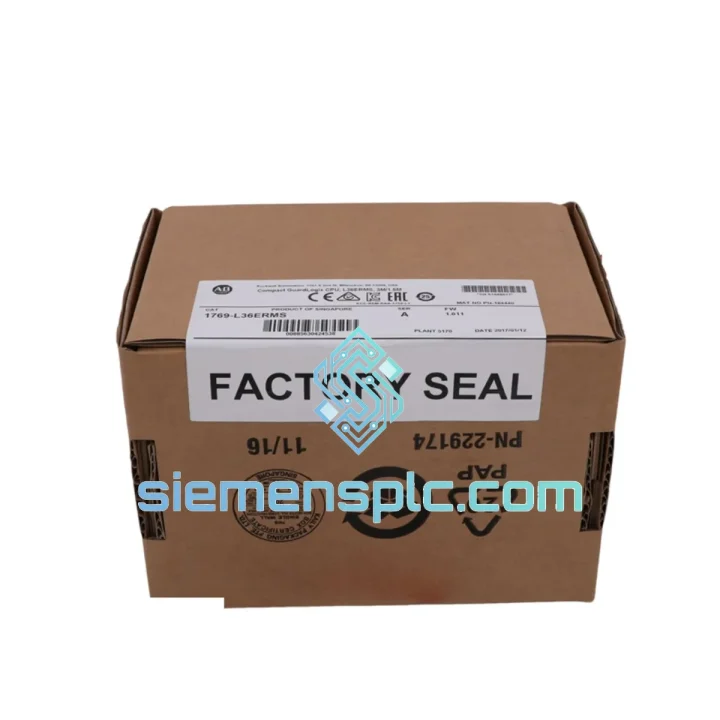
Request verified availability, condition, replacement risk review, packing options and courier lead time for 1769-L36ERM.
Click Request Quote and the part number is inserted into the inquiry form automatically.
Core fields for model confirmation and RFQ routing. Detailed product narrative remains below.
The 1769-L36ERM occupies a well-defined position in Rockwell Automation’s CompactLogix 5370 L3 controller family. It delivers 3 MB of user program memory, native EtherNet/IP CIP Motion coordination for up to 16 servo axes, and a dual-port embedded Ethernet switch — all within a single DIN-rail-mounted chassis slot. For machine builders operating in the 2–3 MB program-size envelope who require deterministic multi-axis motion without an external motion coordinator, this controller eliminates an entire hardware tier from the control architecture.
The controller executes ladder diagram, function block diagram, structured text, and sequential function chart tasks concurrently under a preemptive, priority-based scheduler. Periodic tasks execute at configurable rates as low as 1 ms, and the event task mechanism allows I/O-triggered interrupt response with sub-millisecond jitter — a characteristic that matters in cam-profile synchronization and electronic gearing applications where phase error accumulates over time.
The 1769-L36ERM communicates with Kinetix servo drives (350, 5500, 5700 series) over CIP Motion, a deterministic application layer running on standard EtherNet/IP. The drive update rate is configurable from 1 ms to 32 ms per axis group, and the controller maintains a coarse interpolation cycle that subdivides commanded trajectories into fine position increments delivered to each drive at the configured rate. This architecture keeps axis synchronization error bounded regardless of network load on the non-motion EtherNet/IP port, because the dual-port switch physically separates motion traffic from supervisory and HMI traffic at the hardware level.
Local I/O expansion uses the 1769 Compact I/O rail, supporting up to 16 modules to the right of the controller. Module types span 24 VDC digital input/output, relay output, analog voltage/current input/output, thermocouple/RTD, high-speed counter, and HART-enabled analog. The backplane communication between the controller and local I/O modules operates at a fixed scan rate synchronized to the controller’s periodic task, ensuring that I/O data presented to the program is coherent and time-stamped.
Memory architecture separates program logic, data tables, and I/O image into distinct regions. The 3 MB user memory allocation covers program code, tag database, and motion configuration data. Produced and consumed tags allow peer-to-peer data exchange with other Logix controllers over EtherNet/IP without PLC-to-PLC polling overhead, which is relevant in multi-controller machine cells where one controller supervises another’s motion state.
The USB programming port provides a local connection for Studio 5000 Logix Designer without occupying an Ethernet port, which is useful during commissioning when the Ethernet ports are already connected to the machine network. The controller supports online editing — program changes can be downloaded to a running controller without stopping the machine, subject to task-state constraints — a capability that reduces commissioning downtime in multi-shift production environments.
Power consumption is supplied by a 1769-series power supply (PA2 for 120/240 VAC input, PB2 for 24 VDC input). The controller draws its logic power from the backplane; no separate controller power wiring is required beyond the power supply connection at the left end of the rail.
Real-time Stock & RFQ: [email protected] | WhatsApp: +86 18359268345
| Parameter | Specification |
|---|---|
| Catalog Number | 1769-L36ERM |
| Controller Family | CompactLogix 5370 L3 |
| Manufacturer | Allen-Bradley / Rockwell Automation |
| User Memory | 3 MB (program + data + motion configuration) |
| Coordinated Motion Axes | Up to 16 axes via CIP Motion over EtherNet/IP |
| Ethernet Ports | 2 × 10/100 Mbps (embedded dual-port switch, linear/ring topology) |
| Programming Port | 1 × USB Type-B (local programming only) |
| Local I/O Expansion | Up to 16 × 1769 Compact I/O modules |
| Task Types | Continuous, Periodic (min. 1 ms), Event (I/O interrupt) |
| Programming Software | Studio 5000 Logix Designer v21.0 and above |
| Compatible Power Supplies | 1769-PA2 (120/240 VAC), 1769-PB2 (24 VDC) |
| Operating Temperature | 0 °C to 60 °C (IEC 60068-2-1/2) |
| Storage Temperature | −40 °C to 85 °C |
| Relative Humidity | 5% to 95% non-condensing |
| Enclosure Rating | IP20 (panel mount, open type) |
| Vibration Resistance | 2 g, 10–500 Hz (IEC 60068-2-6) |
| Shock Resistance | 15 g, 11 ms half-sine (IEC 60068-2-27) |
| Certifications | UL 508, CE (EN 61131-2), RCM, ATEX Zone 2 (II 3 G) |
| Approximate Weight | 500 g (controller only, excluding power supply) |
| Firmware Series | Series A; minimum firmware revision 20.011 |
| Warranty | 12 months against manufacturing defects from shipment date |
The 1769-L36ERM’s backplane interface uses a proprietary serial bus that operates independently of the EtherNet/IP ports. Local I/O module data is transferred across this bus at a rate synchronized to the controller’s periodic task clock, which means the I/O image presented to the user program is always from the same scan boundary — there is no asynchronous I/O update that could introduce mid-scan data inconsistency. This is architecturally distinct from distributed I/O over EtherNet/IP, where network jitter can introduce variable latency between the physical I/O event and the controller’s awareness of it.
The dual-port Ethernet switch embedded in the controller implements a store-and-forward switching fabric at the hardware level. Frames arriving on either port are forwarded to the other port and to the controller’s internal Ethernet MAC simultaneously. This allows the controller to participate in a linear daisy-chain or Device Level Ring (DLR) topology without an external managed switch. In DLR mode, the ring supervisor (which can be the controller itself or a dedicated node) detects a link fault within 3 ms and reconfigures the ring to a linear topology, maintaining communication with all surviving nodes. This fault recovery time is deterministic and does not depend on Spanning Tree Protocol convergence, which can take seconds in conventional Ethernet topologies.
EMC performance is addressed at the PCB level through ground plane partitioning that separates the digital logic domain from the backplane interface circuitry. Transient suppression on the backplane connector pins uses TVS diode arrays rated for IEC 61000-4-4 (electrical fast transient) and IEC 61000-4-5 (surge) compliance. The controller’s metal housing provides a Faraday shield that attenuates radiated emissions and improves immunity to external RF fields, which is relevant in environments with variable-frequency drives generating conducted and radiated noise on the 150 kHz–30 MHz band.
The motion engine within the controller executes a coarse interpolation algorithm that generates position set-points for each axis at the configured update rate. For a 16-axis group at a 2 ms update rate, the controller generates 8,000 set-points per second across all axes simultaneously. The set-points are transmitted to the drives over EtherNet/IP using the Implicit Messaging (Class 1) connection type, which uses UDP/IP and is scheduled by the controller’s connection manager to transmit at the configured rate with minimal jitter. The drive’s fine interpolation then subdivides each received set-point into micro-increments executed at the drive’s internal current-loop rate (typically 4–8 kHz), producing smooth torque output between controller update cycles.
Every 1769-L36ERM unit supplied through siemensplc.com is sourced from verified supply channels with full documentation traceability. Prior to shipment, each unit undergoes label authenticity verification, visual inspection for physical damage, and a functional power-on test confirming firmware version and communication port operability. Units are supplied with original Rockwell Automation packaging where available.
A 12-month warranty covers manufacturing defects from the date of shipment. Warranty claims are processed with a target response time of 2 business days. Replacement units are dispatched from Xiamen, China, using express courier services (DHL, FedEx, UPS) with typical transit times of 3–7 business days to major industrial regions in Europe, North America, Southeast Asia, and the Middle East. For time-critical requirements, same-day dispatch is available for in-stock units when orders are confirmed before 14:00 CST.
Export documentation — including commercial invoice, packing list, and certificate of origin — is prepared in compliance with destination country import requirements. HS code classification and customs value declaration are handled by our logistics team to minimize clearance delays. For customers in regions with import duty exemptions or preferential trade agreements, documentation can be structured accordingly upon request.
Email: [email protected]
WhatsApp: +86 18359268345
Web: siemensplc.com
Location: Xiamen, China
© 2026 siemensplc.com. All rights reserved.
We check the full part number, brand, series and visible nameplate information before quotation.
Sales confirms stock path, condition option, quantity and realistic lead time for export dispatch.
DHL, FedEx, UPS or buyer courier arrangements can be reviewed with packing requirements.
Similar brand or category products for fast comparison and multi-item RFQ lists.