
ATOS
In Stock OK
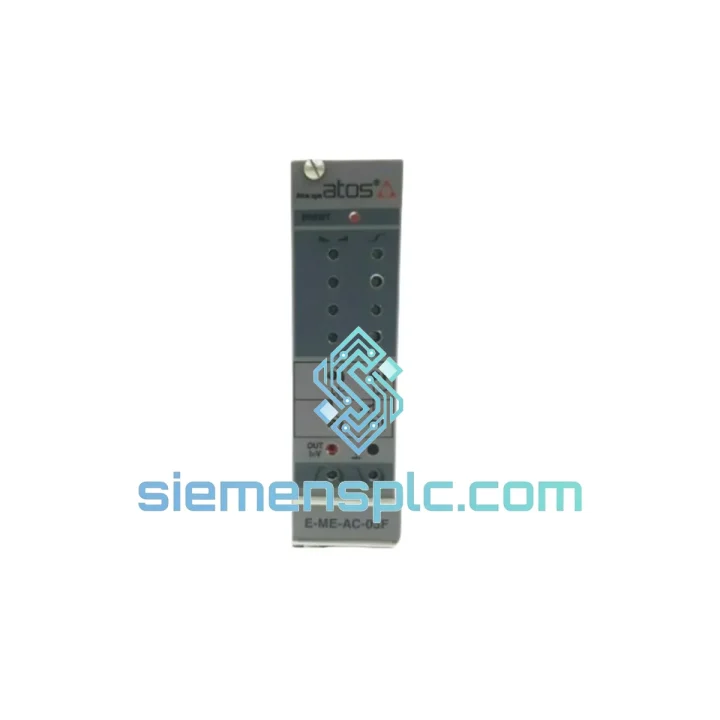
ATOS E-ME-AC-05F Proportional Valve Driver – E-ME Series
Request verified availability, condition, replacement risk review, packing options and courier lead time for E-ME-AC-05F.
BrandATOS
Part NumberE-ME-AC-05F
ConditionAvailability Check
Lead TimeRFQ Confirmation
DocumentsDatasheet / photos by RFQ
ShippingExport packing available
Auto-filled RFQ
E-ME-AC-05F
Click Request Quote and the part number is inserted into the inquiry form automatically.
- Reply by email: [email protected]
- WhatsApp / Tel: +86 18359268345
- Mon-Sat 9:00-18:00 GMT+8
Procurement Data
Key Product Information
Core fields for model confirmation and RFQ routing. Detailed product narrative remains below.
- Brand
- ATOS
- Primary Part Number
- E-ME-AC-05F
- Product Type
- Proportional Valve Driver
- Series / Family
- E-ME Series
- Manufacturer
- ATOS S.p.A., Italy
- Country of Origin
- Not specified
- Catalog Category
- Motor Drives
- Operating Temp.
- 0 °C to +50 °C
- Warranty
- 12 months from date of shipment
Model confirmed for inquiry
E-ME-AC-05F
Send quantity, destination and urgency. The RFQ form keeps this part number attached.
Request Quote
Product Overview
ATOS E-ME-AC-05F Proportional Valve Analog Driver Card – Precision Current Amplification in Closed-Loop Hydraulic Systems
The ATOS E-ME-AC-05F is a DIN-rail-mounted analog electronic driver card designed to condition and amplify PLC-sourced command signals into precisely regulated solenoid drive currents for proportional hydraulic directional and pressure control valves. Within a closed-loop hydraulic control architecture, this module occupies the critical interface layer between the controller’s analog output stage and the proportional solenoid actuator — a position where signal fidelity, current linearity, and noise immunity directly determine the repeatability and stability of the entire control loop.
Unlike digital fieldbus-based amplifiers, the E-ME-AC-05F operates on a pure analog signal chain: the command input (±10 V DC or 4–20 mA, selectable) is received, scaled, and converted to a PWM-modulated output current that drives the proportional solenoid coil. The internal current feedback loop continuously compares the actual solenoid current against the demanded setpoint, correcting for coil resistance drift caused by temperature variation — a mechanism that maintains valve spool positioning accuracy across the full operating temperature range without requiring external compensation.
The module’s dither injection circuit superimposes a low-amplitude, high-frequency oscillation (50–400 Hz, field-adjustable) onto the solenoid drive current. This controlled micro-vibration prevents the valve spool from adhering to the bore wall due to static friction (stiction), reducing effective hysteresis to levels that allow repeatable positioning at sub-millimeter spool displacements. In high-cycle applications such as injection molding clamping circuits or steel mill roll gap control, this characteristic directly translates to reduced cycle-to-cycle variation and extended valve service intervals.
Independent ramp generators for the rising and falling command edges (0.05–10 s, each independently adjustable) limit the rate of change of solenoid current, preventing abrupt pressure transients and hydraulic shock in actuator circuits. This is particularly relevant in large-bore cylinder applications where sudden valve opening would otherwise generate water-hammer-equivalent pressure spikes capable of damaging seals, hoses, and manifold blocks.
The hardwired enable input (24 V DC logic level) provides a deterministic hardware interlock: the driver output is unconditionally inhibited when the enable signal is de-asserted, regardless of the analog command level present at the input. This architecture is compatible with safety relay outputs and emergency-stop circuits, supporting integration into machine safety designs where the drive stage must be independently de-energized without relying on PLC software state.
On-board LED indicators for power supply status, enable state, and fault conditions reduce commissioning time and simplify field diagnostics. Fault conditions — including supply undervoltage and output short-circuit — are flagged without requiring an oscilloscope or current clamp, enabling maintenance personnel to isolate faults at the cabinet level before engaging the hydraulic system.
Real-time Stock & RFQ: [email protected] | WhatsApp: +86 18359268345
Technical Parameters
| Parameter | Specification |
|---|---|
| Model | E-ME-AC-05F |
| Manufacturer | ATOS S.p.A., Italy |
| Series | E-ME (Analog Electronic Driver) |
| Command Input Signal | ±10 V DC or 4–20 mA (selectable via internal jumper) |
| Input Impedance (Voltage Mode) | ≥ 10 kΩ |
| Input Impedance (Current Mode) | ≤ 250 Ω |
| Output Current per Channel | 0–2.5 A continuous |
| Number of Output Channels | 2 (independent, for double-solenoid valves) |
| Current Regulation Method | PWM with closed-loop current feedback |
| Supply Voltage | 24 V DC ±10% (SELV) |
| Power Consumption | ≤ 15 W (at full output load) |
| Dither Frequency | 50–400 Hz, adjustable via trimmer potentiometer |
| Ramp Time (Rise / Fall) | 0.05–10 s each, independently adjustable |
| Enable Input | 24 V DC logic, hardwired (active HIGH) |
| Mounting | DIN rail EN 60715 (35 mm) |
| Protection Class | IP20 |
| Operating Temperature | 0 °C to +50 °C |
| Storage Temperature | −20 °C to +70 °C |
| Relative Humidity | ≤ 90% RH, non-condensing |
| Weight | Approx. 500 g |
| Certifications | CE (LVD 2014/35/EU, EMC 2014/30/EU), RoHS 2011/65/EU |
| Warranty | 12 months from date of shipment |
Hardware Logical Analysis
The E-ME-AC-05F is built around a linear-to-PWM conversion architecture where the analog command signal is first buffered and scaled by a precision instrumentation amplifier stage, then fed into a voltage-controlled PWM generator. The PWM output drives a half-bridge MOSFET power stage that switches the solenoid coil current at a carrier frequency well above the dither band, ensuring the dither oscillation is cleanly superimposed without intermodulation artifacts.
Current Feedback Topology: A low-side shunt resistor in series with each solenoid output channel provides a voltage proportional to actual coil current. This feedback signal is compared against the scaled command in a dedicated error amplifier, and the resulting correction signal modulates the PWM duty cycle in real time. The closed-loop bandwidth is sufficient to reject coil resistance changes of ±20% caused by thermal drift — a common failure mode in analog drivers that rely on open-loop voltage drive.
EMC Design: The module’s PCB layout separates the analog signal ground plane from the power switching ground, with a single-point star connection at the supply terminal. This topology prevents switching noise from the MOSFET stage from coupling into the command input circuitry. The supply input incorporates a transient voltage suppressor (TVS) and a common-mode choke to attenuate conducted emissions from the 24 V DC bus — a necessary measure in cabinets where variable-frequency drives or servo amplifiers share the same DC rail.
Dither Injection Mechanism: The dither oscillator is a dedicated RC-based low-frequency generator whose output is summed into the current reference signal after the ramp generator stage. This sequencing ensures that ramp transitions are not distorted by dither amplitude, and that the dither frequency remains stable regardless of command level. The trimmer potentiometer allows field adjustment without opening the enclosure, accessible through a front-panel aperture.
Ramp Generator Logic: The ramp circuit uses a charge/discharge capacitor network with separate time constants for the rising and falling edges. The ramp output is clamped to the command signal level at both ends, preventing integrator windup when the command is held at a fixed setpoint. This design avoids the overshoot artifacts seen in software-implemented ramps that do not account for integrator state at the moment of command change.
System Integration Benefits
- Direct PLC Analog Output Compatibility: Accepts ±10 V DC and 4–20 mA without external signal conditioning, compatible with analog output modules from Siemens S7-300/400/1500, Allen-Bradley ControlLogix, Beckhoff EL4xxx, and equivalent platforms.
- Deterministic Hardware Enable: The hardwired enable input provides a response time of <1 ms from de-assertion to output inhibit, faster than any software-based safe-state transition, supporting SIL 1 machine safety architectures when combined with a certified safety relay.
- Reduced Valve Hysteresis: Dither injection reduces effective valve hysteresis from a typical 3–5% of full stroke (open-loop) to <1%, improving closed-loop position controller gain margins and reducing steady-state error in pressure and flow control loops.
- Hydraulic Shock Elimination: Independent ramp control limits pressure rise rates to values compatible with system hose and seal ratings, reducing maintenance intervals on high-cycle circuits by preventing fatigue-mode seal failures.
- Thermal Stability: Closed-loop current regulation maintains solenoid force output within ±2% across the 0–50 °C operating range, eliminating the need for temperature compensation in the PLC control algorithm.
- Compact Cabinet Footprint: DIN rail mounting on a standard 35 mm rail requires no custom brackets or panel cutouts, reducing cabinet assembly time and allowing integration into existing control panel layouts without redesign.
- On-Board Diagnostics: LED indicators for power, enable, and fault states allow first-level fault isolation without test instruments, reducing mean time to repair (MTTR) in production environments.
- Double-Solenoid Valve Support: Two independent output channels on a single module drive both solenoids of a proportional directional control valve, eliminating the need for a second driver card and reducing wiring complexity.
- Wide Solenoid Compatibility: Output current range of 0–2.5 A per channel covers the full range of ATOS proportional solenoid coils and is compatible with third-party proportional valves within the same current specification.
- No Fieldbus Configuration Required: Analog interface eliminates the need for fieldbus node addressing, network commissioning, or firmware updates, reducing integration complexity in retrofit and upgrade projects.
Quality Assurance & Global Logistics
Every ATOS E-ME-AC-05F unit supplied by siemensplc.com is sourced through verified industrial distribution channels with full traceability to ATOS S.p.A. factory production records. Incoming inspection at our Xiamen facility includes visual verification of ATOS factory labels and serial numbers, functional power-on testing at 24 V DC, output current verification across the full command input range (0–100%), and anti-static packaging with humidity indicator cards prior to storage.
Units are stored in a humidity-controlled warehouse environment (≤ 60% RH, 15–25 °C) to preserve PCB surface finish and connector contact integrity during storage periods. Original ATOS packaging and documentation are retained and shipped with each unit.
Shipments from Xiamen, China are dispatched via DHL Express, FedEx International Priority, and UPS Worldwide Expedited. In-stock units are processed within 1–2 business days of order confirmation. Export documentation including commercial invoice, packing list, and certificate of origin is prepared for all international shipments. DDP, DAP, and EXW Incoterms are available. Typical transit times: Southeast Asia 2–4 days, Europe 3–5 days, North America 4–6 days.
All units carry a 12-month warranty from the date of shipment, covering manufacturing defects and component failures under normal operating conditions. Warranty claims are processed with replacement unit dispatch within 5 business days of confirmed fault diagnosis.
Contact Information
Email: [email protected]
WhatsApp: +86 18359268345
Web: siemensplc.com
Location: Xiamen, China
© 2026 siemensplc.com. All rights reserved.
Ready to quote
[email protected]
Send This Part Number to Sales
RFQ workflow
Quality workflow ->
Confirmation Process
01Model confirmation
We check the full part number, brand, series and visible nameplate information before quotation.
02Availability reply
Sales confirms stock path, condition option, quantity and realistic lead time for export dispatch.
03Packing & courier
DHL, FedEx, UPS or buyer courier arrangements can be reviewed with packing requirements.
Continue sourcing
Browse full catalog ->
Related Automation Parts
Similar brand or category products for fast comparison and multi-item RFQ lists.
ABB
RFQ Ready
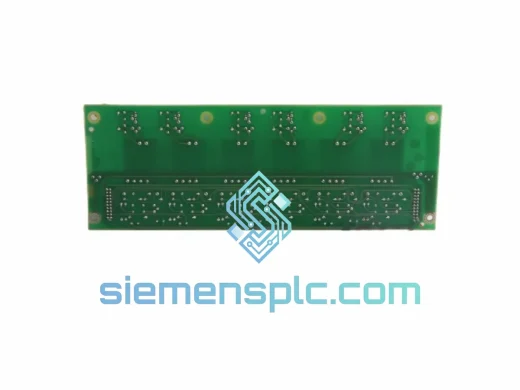
ABB ZINT-592 Fieldbus Interface Board – ZINT Series
ACS Drive
Origin SE
Interface Board
ABB
RFQ Ready
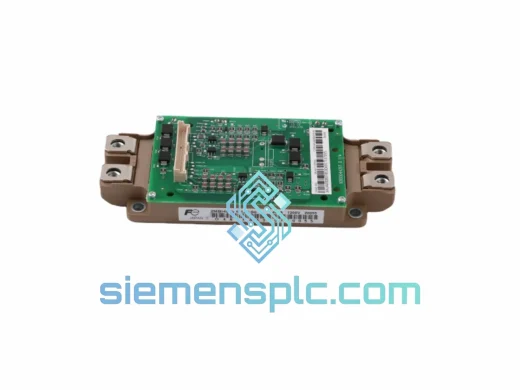
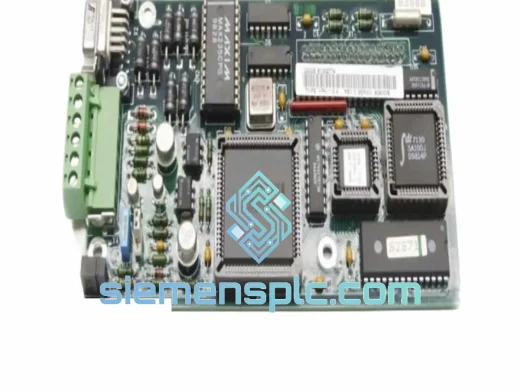
ABB YPK113A 61002774 Drive Control Board
In-Stock Xiamen
Origin SE
Drive Control Board