Bently Nevada
RFQ Ready
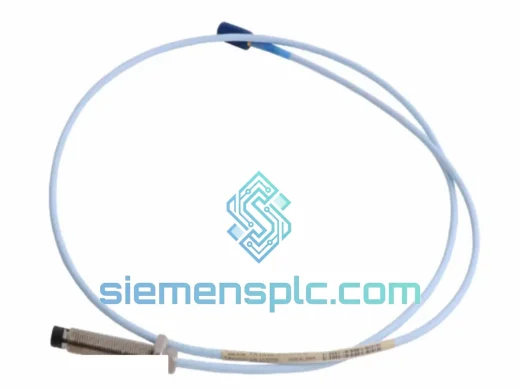
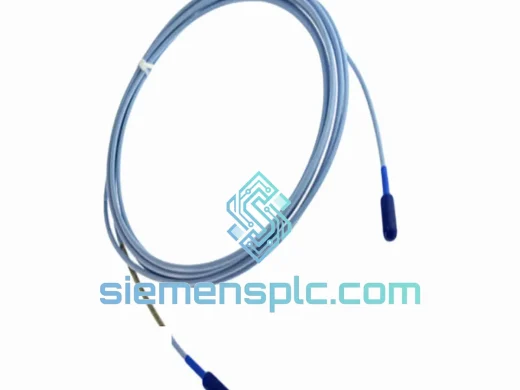
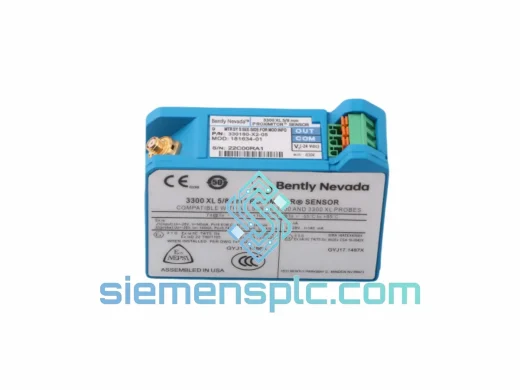
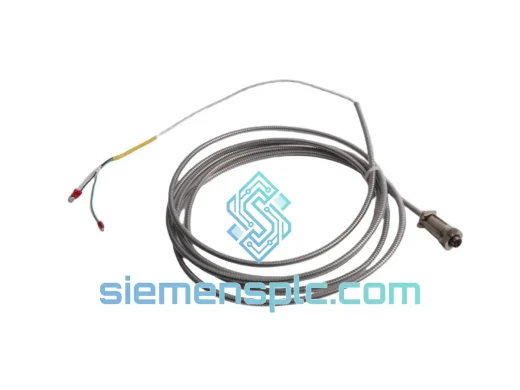
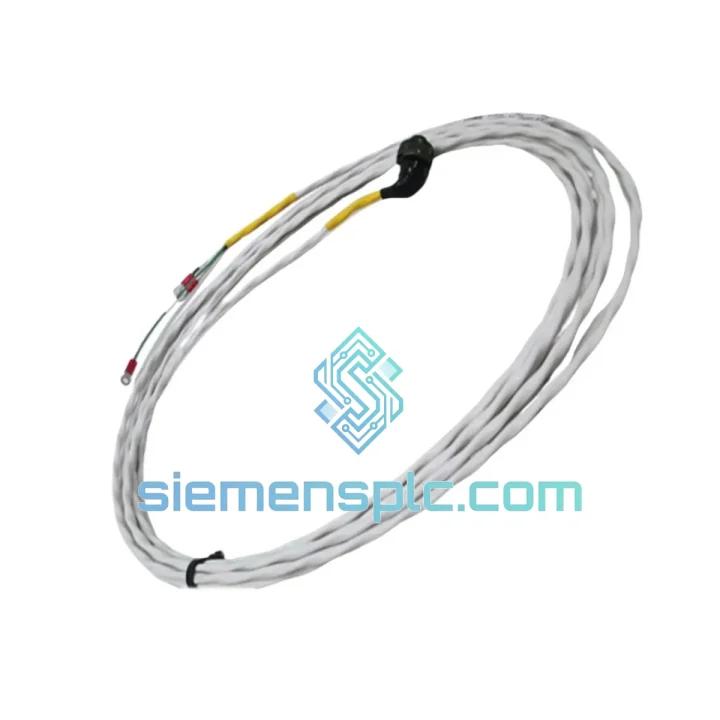
Bently Nevada 84661-12 Velomitor Interconnect Cable
3300 Series
Origin US
Vibration Monitoring Cable
Request verified availability, condition, replacement risk review, packing options and courier lead time for 89477-17.
Click Request Quote and the part number is inserted into the inquiry form automatically.
Core fields for model confirmation and RFQ routing. Detailed product narrative remains below.
The Bently Nevada 89477-17 is a precision-matched interconnect cable engineered for deployment within eddy-current proximity transducer systems, specifically the 3300 XL and 7200 Series platforms. Its primary function is to bridge the proximity probe body and the extension cable, completing the three-component transducer chain — probe, interconnect, and extension — that must be calibrated as a unified electrical system to deliver traceable vibration, axial position, and rotational speed data to the monitor rack.
In a proximity transducer system, the interconnect cable is not a passive conductor. It forms part of the resonant LC circuit that the oscillator-demodulator driver uses to generate a radio-frequency field at the probe tip. The 89477-17 carries a coaxial signal path with controlled characteristic impedance, ensuring that the RF energy propagating from the driver to the probe tip is not attenuated or reflected by impedance discontinuities. Any deviation in cable geometry, dielectric constant, or connector contact resistance directly shifts the system’s scale factor — the millivolt-per-mil or millivolt-per-millimeter output sensitivity — and introduces measurement error that cannot be corrected in software without full system recalibration.
The –17 suffix in the part number designates a specific cable length configuration within the 89477 interconnect family. Bently Nevada proximity systems are calibrated to a defined total cable length: the arithmetic sum of the probe body length, interconnect length, and extension cable length must match the value specified on the driver’s calibration label. Substituting an interconnect of a different length without corresponding adjustment of the extension cable will shift the system’s gap voltage curve and invalidate the calibration, producing erroneous displacement readings at the monitor output.
The 89477-17 is constructed with a fluoropolymer-insulated center conductor and a braided outer shield, providing both the dielectric stability required for RF signal integrity and the mechanical flexibility needed for routing through cable trays and conduit in turbomachinery enclosures. The outer jacket is rated for continuous operation across a wide thermal range, making it suitable for installation in proximity to steam turbine casings, compressor bearing housings, and other high-temperature rotating equipment environments.
Connector terminations on the 89477-17 use the standard Bently Nevada coaxial connector interface, which provides a positive-locking, vibration-resistant connection at both the probe body and the extension cable junction. The connector shell is machined to close tolerances to maintain coaxial alignment and minimize contact resistance variation over the service life of the cable. Field experience in API 670-compliant machinery protection installations confirms that connector integrity is the primary failure mode in proximity cable assemblies; the 89477-17’s connector design addresses this through a robust locking mechanism and gold-plated contact surfaces.
From a system architecture perspective, the 89477-17 operates within the signal chain that feeds the Bently Nevada 3500 Series monitor rack, the System 1 condition monitoring platform, or equivalent third-party monitors accepting standard proximity transducer inputs. The monitor rack’s proximity input module applies a DC bias voltage to the cable and measures the modulated RF signal returned from the probe tip. The 89477-17’s low-loss coaxial construction ensures that the signal-to-noise ratio at the monitor input remains within the specification required for reliable alarm and trip setpoint discrimination, even in electrically noisy plant environments where variable-frequency drives, large motors, and high-current bus bars generate broadband electromagnetic interference.
Siemensplc.com maintains verified stock of the Bently Nevada 89477-17 sourced through established industrial supply channels. Each unit is inspected prior to dispatch to confirm connector integrity, cable jacket condition, and part number marking. Shipments originate from Xiamen, China, with DHL Express, FedEx International Priority, and UPS Worldwide Expedited available for time-critical maintenance and turnaround requirements.
Real-time Stock & RFQ: [email protected] | WhatsApp: +86 18359268345
| Parameter | Value / Specification |
|---|---|
| Part Number | 89477-17 |
| Manufacturer | Bently Nevada (Baker Hughes) |
| Product Category | Proximity Probe Interconnect Cable |
| Compatible Series | 3300 XL 8 mm, 3300 XL 11 mm, 7200 Series |
| Length Configuration | –17 suffix; verify against system calibration label |
| Signal Type | RF coaxial (eddy-current oscillator-demodulator) |
| Characteristic Impedance | Matched to Bently Nevada system specification |
| Center Conductor Insulation | Fluoropolymer (PTFE or FEP) |
| Outer Shield | Braided copper, high-coverage |
| Outer Jacket Material | Chemical- and abrasion-resistant polymer |
| Operating Temperature Range | –40 °C to +125 °C (continuous) |
| Connector Interface | Standard Bently Nevada coaxial, positive-locking |
| Contact Surface | Gold-plated for low and stable contact resistance |
| Applicable Standard | API 670 (Machinery Protection Systems) |
| Typical Applications | Shaft vibration, axial position, speed/phase reference |
| Country of Origin | United States |
| Warranty | 12 months from date of shipment |
The 89477-17 functions as an impedance-controlled transmission line segment within a three-element eddy-current transducer system. The oscillator-demodulator driver generates a carrier frequency — typically in the range of 200 kHz to 2 MHz depending on the probe series — and this RF signal must travel from the driver, through the extension cable, through the interconnect, and to the probe tip with minimal reflection and attenuation. The 89477-17’s coaxial geometry maintains a consistent ratio of center conductor diameter to inner shield diameter, which determines the characteristic impedance. Deviations from the nominal impedance at any point in the cable run create reflections that superimpose on the primary signal, increasing noise floor at the monitor input and degrading the system’s ability to resolve small-amplitude vibration events.
The fluoropolymer dielectric used in the 89477-17 provides a stable relative permittivity (εr ≈ 2.1 for PTFE) across the operating temperature range. This thermal stability is critical because the cable’s electrical length — and therefore its contribution to the total system calibration — must remain constant as the cable heats up during plant operation. Dielectric materials with higher temperature coefficients of permittivity would cause the system’s scale factor to drift with temperature, introducing a systematic measurement error that correlates with plant load rather than actual shaft displacement.
The braided outer shield provides two functions: it completes the coaxial return path for the RF signal, and it attenuates external electromagnetic interference from coupling into the signal conductor. In turbomachinery installations, the cable routing passes through environments with high magnetic field densities generated by motor windings, bus bars, and variable-frequency drive output cables. The shield’s transfer impedance — a measure of how effectively external fields couple through the shield to the inner conductor — determines the cable’s EMC performance. The 89477-17’s high-coverage braid construction minimizes transfer impedance, maintaining signal integrity in electrically hostile plant environments.
The positive-locking connector mechanism prevents inadvertent disconnection under vibration, which is a documented failure mode in proximity cable assemblies installed on or near rotating machinery. The connector’s coaxial geometry ensures that the center conductor and outer shell make simultaneous, concentric contact, preventing the impedance discontinuity that would result from an off-axis or partially engaged connection. Gold plating on the contact surfaces prevents oxide formation that would increase contact resistance over time, which would shift the system’s static gap voltage and trigger nuisance alarms or mask genuine machinery faults.
All Bently Nevada 89477-17 units dispatched by siemensplc.com are sourced through verified industrial supply channels and subjected to pre-shipment inspection covering connector engagement force, cable jacket integrity, and part number marking verification. Original manufacturer packaging and documentation are preserved where available, supporting traceability requirements for critical process industry applications including oil and gas, power generation, and petrochemical facilities.
The 12-month warranty covers manufacturing defects in materials and workmanship from the date of shipment. Units exhibiting connector failure, dielectric breakdown, or shield continuity loss within the warranty period are replaced or credited without charge, subject to inspection confirming the defect is not attributable to installation damage or misapplication.
Logistics operations are managed from Xiamen, China, with access to DHL Express, FedEx International Priority, and UPS Worldwide Expedited services. Standard export documentation — commercial invoice, packing list, and certificate of origin — is prepared for all international shipments. For applications requiring a certificate of conformance or material test report, these documents can be arranged at the time of order placement. Typical dispatch lead time for in-stock units is 1–3 business days from order confirmation. Emergency turnaround dispatch for critical plant maintenance situations is available upon request.
Email: [email protected]
WhatsApp: +86 18359268345
Web: siemensplc.com
Location: Xiamen, China
© 2026 siemensplc.com. All rights reserved.
We check the full part number, brand, series and visible nameplate information before quotation.
Sales confirms stock path, condition option, quantity and realistic lead time for export dispatch.
DHL, FedEx, UPS or buyer courier arrangements can be reviewed with packing requirements.
Similar brand or category products for fast comparison and multi-item RFQ lists.