GE Automation & Controls
RFQ Ready
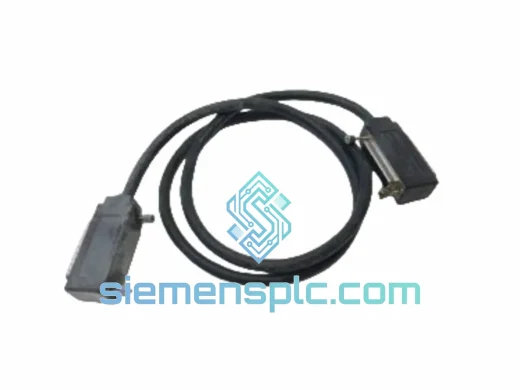
GE IC693CBL312 PLC Expansion Bus Cable
Fanuc
Origin US
PLC Expansion Cable
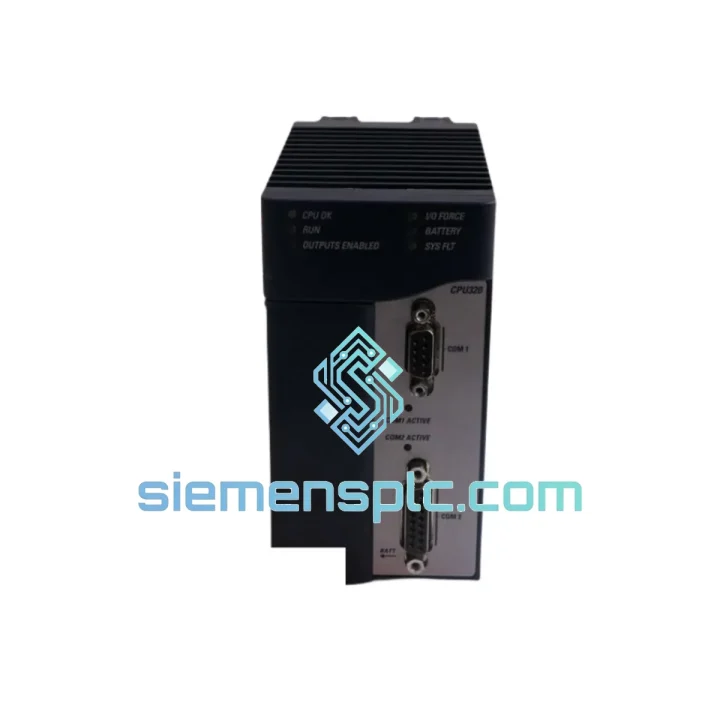
Request verified availability, condition, replacement risk review, packing options and courier lead time for IC695CRU320-EN.
Click Request Quote and the part number is inserted into the inquiry form automatically.
Core fields for model confirmation and RFQ routing. Detailed product narrative remains below.
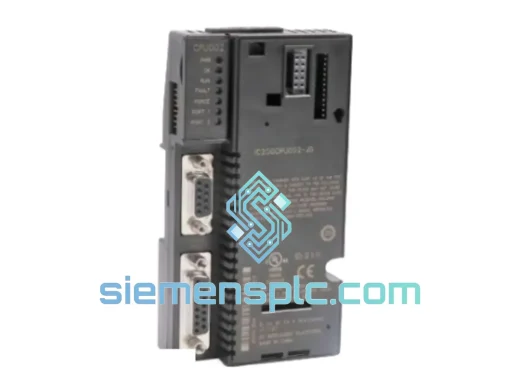
The GE IC695CRU320-EN is a dedicated hot-standby redundancy CPU module engineered for the PACSystems RX3i universal backplane platform. Powered by a 300 MHz Intel Celeron processor with 32 MB of user program memory, this module executes IEC 61131-3 control logic — spanning ladder diagram (LD), function block diagram (FBD), structured text (ST), instruction list (IL), and sequential function chart (SFC) — while concurrently maintaining a live state-synchronization channel to a paired standby CPU. The result is a dual-chassis control topology capable of sub-100 ms bumpless failover, making it applicable to continuous process plants, utility infrastructure, and any application where an unplanned controller restart carries measurable production or safety cost.
Within the control loop, the IC695CRU320-EN occupies the role of primary execution engine and arbitration master. On each scan cycle, the module resolves input data from the IC695 universal backplane bus, executes the user program, updates the output image table, and transmits a compressed state delta to the standby unit over the dedicated redundancy synchronization cable (IC695CBL001). The standby CPU maintains a shadow copy of all output coils, internal registers, and timer/counter accumulator values. When the primary unit detects a watchdog timeout, hardware fault, or sync-link integrity failure, the standby asserts primary status and resumes output driving from the last synchronized state — without re-executing the startup sequence and without generating a spurious output pulse on any channel.
The onboard RJ-45 Ethernet port (10/100 Mbps, auto-negotiating) supports three concurrent protocol stacks: SRTP (Service Request Transport Protocol) for Proficy Machine Edition programming and SCADA integration, Modbus TCP for third-party HMI and historian connectivity, and EGD (Ethernet Global Data) for peer-to-peer data exchange between PACSystems controllers. All three stacks operate as background tasks under the PACSystems runtime kernel’s preemptive scheduler, which assigns them lower priority than the real-time scan task. This architecture ensures that a burst of incoming Modbus TCP requests or an EGD multicast storm cannot extend the logic scan cycle beyond its configured watchdog threshold — a property that single-threaded communication architectures cannot guarantee.
Real-time Stock & RFQ: [email protected] | WhatsApp: +86 18359268345
| Part Number | IC695CRU320-EN |
| Manufacturer | GE Automation & Controls (GE Fanuc) |
| Platform | PACSystems RX3i Universal Backplane |
| Module Function | Hot-Standby Redundancy CPU |
| Processor | 300 MHz Intel Celeron |
| User Program Memory | 32 MB |
| Ethernet Port | RJ-45, 10/100 Mbps auto-negotiating — SRTP / Modbus TCP / EGD |
| Serial Port | RS-232 (programming & HMI) |
| USB Port | Type-B, programming interface |
| Backplane Bus | IC695 Universal Backplane — VME-derived, 64-bit data path |
| Redundancy Sync Link | Dedicated fiber or copper cable via IC695CBL001 |
| Failover Switchover Time | < 100 ms (application-dependent, qualified configurations) |
| IEC 61131-3 Languages | LD, FBD, ST, IL, SFC |
| Supply Voltage | Supplied via IC695 backplane power module (3.3 V / 5 V rails) |
| Operating Temperature | 0 °C to +60 °C |
| Storage Temperature | −40 °C to +85 °C |
| Relative Humidity | 5 % to 95 % non-condensing |
| EMC Compliance | CE (EMC Directive 2014/30/EU), UL 508, cUL |
| RoHS Status | Compliant — EU Directive 2011/65/EU |
| Module Weight | Approx. 2,920 g |
| Warranty | 12 months against manufacturing defects |
The IC695CRU320-EN’s backplane interface is built on a VME-derived 64-bit parallel bus, which provides substantially higher aggregate bandwidth than serial fieldbus alternatives such as PROFIBUS DP or DeviceNet. The bus arbitration logic grants the CPU a fixed, deterministic access window on each scan cycle, preventing I/O modules from stalling the processor during high-density data transfers. This is particularly relevant in configurations with multiple analog input modules, where simultaneous 16-bit sample transfers from several slots would saturate a serial bus but are handled within a single arbitration grant on the parallel backplane.
The redundancy synchronization protocol operates over the IC695CBL001 cable, which supports both copper and fiber variants. On each completed scan cycle, the primary CPU serializes a delta record containing only the changed output image table entries and modified internal register values — not the full memory image. This differential approach bounds the sync-link bandwidth consumption to a value proportional to the rate of state change in the application, rather than to the total memory size. Under steady-state process conditions with low output toggle rates, the sync transmission completes well within the inter-scan idle period, adding negligible latency to the overall scan cycle.
The arbitration circuit that governs primary/standby role assignment is implemented in dedicated hardware logic on the module, independent of the main Celeron processor. This separation is architecturally significant: a software hang or watchdog timeout on the primary CPU does not prevent the arbitration circuit from asserting a role-transfer signal to the standby. The standby unit monitors both the sync-link heartbeat and a separate hardware watchdog signal from the primary; loss of either triggers the transfer sequence. This dual-channel monitoring eliminates the single-point-of-failure that would exist if role arbitration depended solely on the sync-link protocol.
From an EMC standpoint, the module’s internal DC-DC conversion stage employs multi-stage LC filtering on the 3.3 V and 5 V backplane supply rails, attenuating conducted emissions in the 150 kHz–30 MHz band to levels compliant with EN 55011 Class A limits. The processor board is enclosed in a grounded metal shield, and all high-speed signal traces on the backplane connector are routed with controlled impedance (50 Ω ± 10 %) to suppress inter-channel crosstalk. These measures allow the module to operate in close proximity to variable-frequency drives, high-current motor contactors, and welding equipment — all common sources of broadband electromagnetic interference in manufacturing environments.
Each IC695CRU320-EN unit dispatched from siemensplc.com undergoes a structured pre-shipment inspection covering physical housing integrity, connector pin alignment, label authenticity, and firmware version verification against GE factory records. Serial numbers are cross-referenced with manufacturer traceability databases prior to shipment confirmation. Documentation packages — commercial invoice, packing list, and certificate of origin — are prepared as standard for every international order, with ECCN classification records available upon request for customers subject to import licensing requirements in their jurisdiction.
All shipments originate from our warehouse in Xiamen, China, with direct access to DHL Express, FedEx International Priority, and UPS Worldwide Express services. In-stock units typically dispatch within 1–3 business days of order confirmation. For project-volume orders, sea freight consolidation and dedicated freight forwarding arrangements are available with advance coordination. Transit damage claims must be submitted within 7 calendar days of delivery with photographic documentation; replacement units or full refunds are processed per our published returns policy. Technical documentation, firmware release notes, and integration guidance are provided at no additional charge throughout the 12-month warranty period.
Email: [email protected]
WhatsApp: +86 18359268345
Web: siemensplc.com
Location: Xiamen, China
© 2026 siemensplc.com. All rights reserved.
We check the full part number, brand, series and visible nameplate information before quotation.
Sales confirms stock path, condition option, quantity and realistic lead time for export dispatch.
DHL, FedEx, UPS or buyer courier arrangements can be reviewed with packing requirements.
Similar brand or category products for fast comparison and multi-item RFQ lists.