ICS TRIPLEX
RFQ Ready
ICS Triplex T8314C Fibre Optic Communication Module – Trusted Series
Trusted
Origin GB
Fibre Optic Communication Module
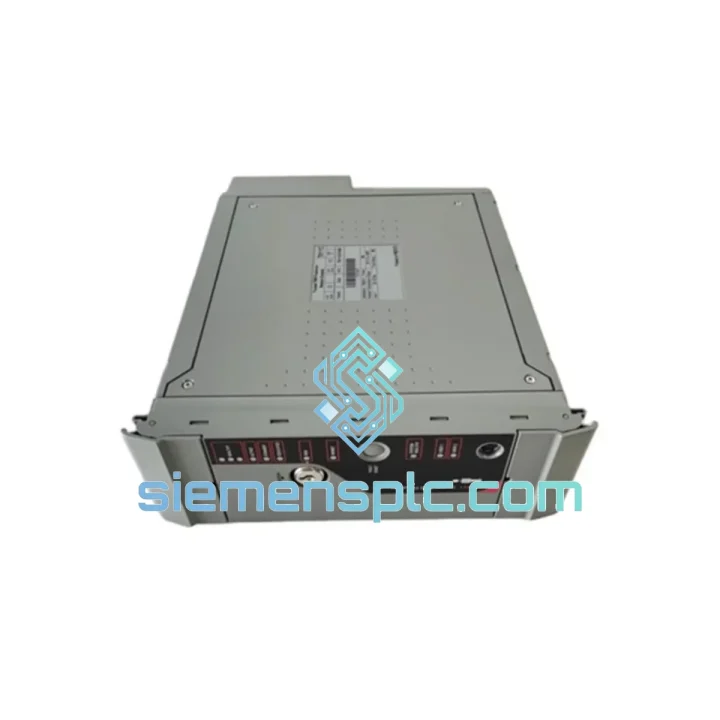
Request verified availability, condition, replacement risk review, packing options and courier lead time for T8153C.
Click Request Quote and the part number is inserted into the inquiry form automatically.
Core fields for model confirmation and RFQ routing. Detailed product narrative remains below.
Within a Trusted Series triple modular redundant (TMR) safety PLC installation, the physical and logical boundary between the primary processor chassis and any remote I/O expansion chassis is governed entirely by the T8153C Expander Interface Adapter. This is not a peripheral communication card in the conventional sense. It is the voted-signal conduit through which all expansion I/O data must pass before it can participate in the TMR arbitration cycle. Its operational integrity is therefore a prerequisite — not a supporting condition — for maintaining IEC 61508 SIL 2 and SIL 3 certification across the full I/O footprint of the installed system.
The T8153C occupies a single slot in the Trusted Series chassis backplane and establishes a point-to-point, time-triggered communication link to a corresponding adapter in the expansion chassis. The link operates on a proprietary, fixed-cycle protocol developed specifically for the Trusted Series architecture. This protocol enforces bounded latency on every data exchange — each scan cycle delivers a complete, integrity-checked frame within a defined time window, with no variable arbitration delay and no reliance on collision-avoidance mechanisms. For safety instrumented systems (SIS) operating under IEC 61511, where the process safety time (PST) budget constrains the maximum allowable response time from field sensor to safety output, this determinism is a hard engineering requirement, not a performance preference.
The module’s role becomes particularly critical in large-scale process installations — LNG liquefaction trains, offshore production platforms, ethylene cracker units, and pipeline compressor stations — where the physical separation between marshalling panels and the main control room makes a single-chassis I/O architecture impractical. The T8153C allows the Trusted Series system to extend its certified safety domain across multiple physically distributed chassis without fragmenting the TMR voting logic or introducing uncertified communication paths. Each expansion chassis connected via a T8153C remains a full participant in the system’s majority-vote arbitration, with its I/O channels contributing to the voted output on the same deterministic schedule as locally connected modules.
Procurement engineers and reliability teams managing spare parts programs for Trusted Series installations should classify the T8153C as a Tier-1 critical spare. A failed expander interface does not degrade the system gracefully in the way that a failed I/O channel might — it severs the entire expansion chassis from the voted signal chain, placing all field instruments connected to that chassis outside the certified safety boundary until the module is replaced. Mean time to repair (MTTR) for this failure mode is therefore a direct input to the system’s overall safety availability calculation.
📩 Real-time Stock & RFQ: [email protected] | WhatsApp: +86 18359268345
| Parameter | Specification |
|---|---|
| Part Number | T8153C |
| Manufacturer | ICS TRIPLEX (Rockwell Automation) |
| Product Series | Trusted Series Safety PLC |
| Functional Role | Inter-chassis expander interface — deterministic TMR communication link |
| Safety Integrity Level | SIL 2 / SIL 3 per IEC 61508 |
| Redundancy Architecture | Triple Modular Redundant (TMR), 2-of-3 majority vote |
| Communication Scheme | Fixed-cycle, time-triggered proprietary backplane protocol |
| Frame Integrity | CRC + SECDED Hamming code (single-bit correction, double-bit detection) |
| Galvanic Isolation | High-speed optocoupler isolation on inter-chassis link |
| Form Factor | Single-slot module, Trusted Series chassis-compatible |
| Operating Temperature | 0 °C to +60 °C |
| Storage Temperature | −40 °C to +85 °C |
| Relative Humidity | 5 % to 95 %, non-condensing |
| EMC Standards | EN 61000-4-2 (ESD), EN 61000-4-4 (EFT/Burst), EN 61000-4-5 (Surge) |
| PCB Construction | Multi-layer with dedicated ground planes; ferrite bead filtering at backplane connector |
| Approximate Weight | 220 g |
| Chassis Compatibility | Trusted Series processor chassis and I/O expansion chassis (all revisions) |
| Warranty | 12 months against functional defects from confirmed shipment date |
The T8153C’s internal design reflects a set of deliberate architectural decisions that distinguish it from general-purpose industrial communication modules. Each decision addresses a specific failure mode relevant to safety-critical inter-chassis communication.
Optocoupler-Based Galvanic Isolation: The inter-chassis data path is broken at the electrical level by high-speed optocouplers rated for the transient voltage differentials common in large process plant installations. In facilities where the processor chassis and expansion chassis are separated by 20–50 meters across different electrical panels, ground potential differences of several volts are routine. Without galvanic isolation, these differentials would appear as common-mode noise on the data lines, producing frame errors that the integrity-checking layer would flag as faults. The T8153C’s isolation barrier eliminates this failure vector entirely, allowing the module to operate reliably in environments where unprotected communication links would generate persistent diagnostic alarms.
Fixed-Cycle Time-Triggered Protocol: The expander link does not use any form of demand-driven or event-triggered communication. Every scan cycle, the T8153C initiates a data exchange at a fixed point in the cycle timeline, regardless of whether the data has changed since the previous cycle. This time-triggered discipline eliminates the latency jitter inherent in arbitration-based protocols (CSMA/CD, token ring, or polling-based Modbus) and ensures that the processor always has a fresh, timestamped snapshot of expansion I/O state at the start of each execution cycle. For HIPPS and ESD applications where the PST budget may be as short as 100–250 ms, this predictability is not optional.
Dual-Layer Frame Integrity — CRC and SECDED Hamming: Each data frame carries two independent integrity mechanisms. The CRC operates across the full frame payload and detects burst errors of any length up to the CRC polynomial’s error-detection capability. The SECDED Hamming code operates at the word level and provides single-bit error correction without requiring a retransmission — the receiving chassis corrects the bit in place and logs the event as a soft error. Double-bit errors at the word level are detected and escalate to a hard fault. This layered approach allows the system to distinguish between transient soft errors (correctable, log-only) and persistent hard faults (module replacement required), enabling condition-based maintenance decisions rather than conservative time-based replacement schedules.
TMR Voting Bus Integration: The T8153C’s output does not feed into a general-purpose data bus. It connects directly to the Trusted Series’ internal TMR voting fabric, where three independent signal paths — each sourced from a separate T8153C in a redundant configuration — are compared on a 2-of-3 majority-vote basis every scan cycle. A single path fault is isolated at the voting layer without interrupting the voted output. The system continues to operate in a degraded-but-safe TMR state, and the fault is surfaced to the diagnostic bus for maintenance action. This behavior is implemented in hardware logic, not in application software, ensuring that the fault response is deterministic and cannot be masked by software errors.
EMC-Hardened PCB Architecture: The module’s printed circuit board uses a six-layer stackup with two dedicated ground planes interleaved between signal layers. This construction reduces the loop area of high-frequency signal traces, lowering both radiated emissions and susceptibility to externally induced interference. LC filter networks and ferrite beads are placed at the chassis backplane connector to suppress conducted transients from the backplane power rails. The combined effect is a module that meets EN 61000-4-2 Level 4 ESD immunity, EN 61000-4-4 Level 3 EFT immunity, and EN 61000-4-5 Level 3 surge immunity without requiring external filtering hardware or special installation precautions.
Each T8153C unit supplied through siemensplc.com is subject to a structured pre-shipment evaluation protocol. Physical inspection covers label authenticity, PCB revision markings, component date codes, and connector condition — screening for counterfeit indicators and handling damage. Functional verification applies chassis power and exercises the expander communication pathway using Trusted Series-compatible test equipment, confirming that the module initializes correctly, establishes a stable link, and reports clean diagnostics before dispatch. Hardware revision and firmware version are recorded and disclosed in the quotation documentation, allowing the buyer to verify compatibility with their installed system configuration prior to purchase commitment.
Packaging follows IPC/JEDEC J-STD-033 guidelines for moisture-sensitive electronic assemblies: anti-static bag, desiccant pack, humidity indicator card, and moisture barrier film, placed inside a rigid foam-lined outer carton rated for IATA air freight handling. Shipments originate from Xiamen, China. Standard transit times to major industrial hubs are 3–5 business days to Europe and North America via DHL Express or FedEx International Priority, and 2–4 business days to Southeast Asia and the Middle East. Same-day dispatch is available for confirmed in-stock units when orders are placed before 14:00 CST. All shipments include a commercial invoice, packing list, and airway bill. A 12-month warranty against functional defects applies from the confirmed shipment date, with replacement or full refund resolution for verified warranty claims.
Email: [email protected]
WhatsApp: +86 18359268345
Web: siemensplc.com
Location: Xiamen, China
© 2026 siemensplc.com. All rights reserved.
We check the full part number, brand, series and visible nameplate information before quotation.
Sales confirms stock path, condition option, quantity and realistic lead time for export dispatch.
DHL, FedEx, UPS or buyer courier arrangements can be reviewed with packing requirements.
Similar brand or category products for fast comparison and multi-item RFQ lists.