Mitsubishi Electric
RFQ Ready
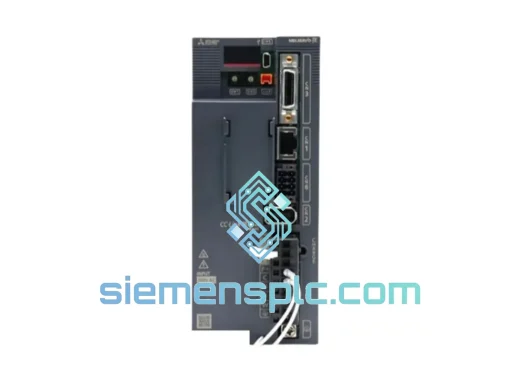
Mitsubishi MR-JE-70C AC Servo Amplifier
MELSERVO-JE CC-Link IE
Origin JP
AC Servo Amplifier
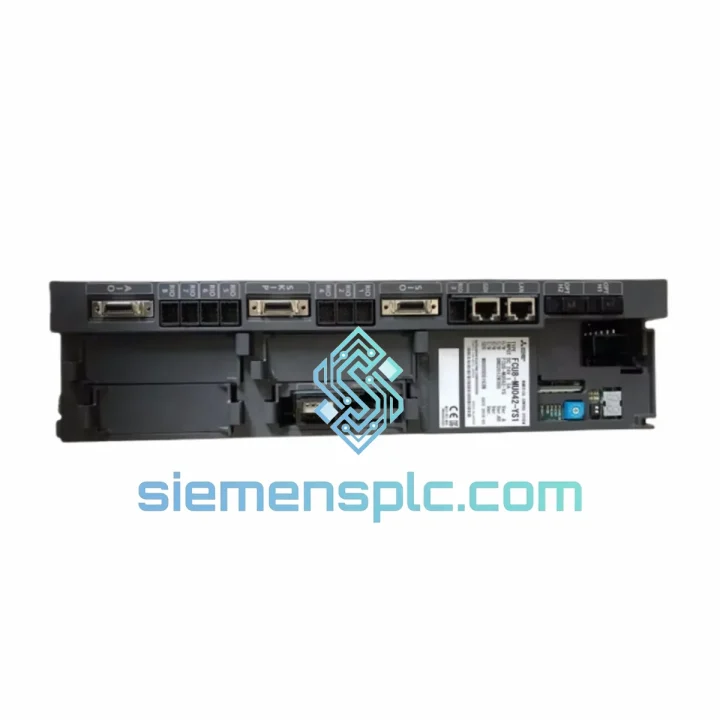
Request verified availability, condition, replacement risk review, packing options and courier lead time for MR3D-CR55.
Click Request Quote and the part number is inserted into the inquiry form automatically.
Core fields for model confirmation and RFQ routing. Detailed product narrative remains below.
The Mitsubishi Electric MR3D-CR55 is a compact, high-resolution AC servo drive belonging to the MR3D series — a product line engineered specifically for multi-axis motion control applications where deterministic torque response, encoder fidelity, and bus-cycle synchronization are non-negotiable. The MR3D-CR55 operates as a slave amplifier node within Mitsubishi’s SSCNET III/H fiber-optic servo network, receiving motion commands from a compatible master controller (e.g., MELSEC iQ-R Motion CPU or CNC C80 series) at a fixed 0.888 ms communication cycle. This architecture eliminates the jitter inherent in conventional RS-485 or analog command interfaces, delivering sub-microsecond command latency across all connected axes simultaneously.
In a closed-loop servo system, the drive’s primary function is to close three nested control loops — current (torque), velocity, and position — at rates that far exceed the mechanical bandwidth of the load. The MR3D-CR55 executes its current control loop at a 62.5 µs cycle, velocity loop at 125 µs, and position loop at 250 µs. These figures are not marketing abstractions; they define the maximum achievable bandwidth of each loop and directly constrain the stiffness and disturbance rejection capability of the overall servo axis. For applications such as direct-drive rotary tables, linear motor stages, or high-speed pick-and-place heads, these loop rates translate into measurable improvements in settling time and contour error.
Real-time Stock & RFQ: [email protected] | WhatsApp: +86 18359268345
| Parameter | Specification |
|---|---|
| Part Number / SKU | MR3D-CR55 |
| Brand | Mitsubishi Electric |
| Series | MR3D (MELSERVO-J5 Compatible) |
| Drive Type | AC Servo Amplifier (Slave Node) |
| Rated Output Current | 5.5 A (continuous); peak current per application profile |
| Input Power Supply | 3-phase / single-phase 200–240 V AC, 50/60 Hz |
| Control Method | Sinusoidal PWM, space vector modulation |
| Encoder Interface | 22-bit absolute encoder (4,194,304 pulses/rev) |
| Communication Bus | SSCNET III/H (optical fiber, 150 Mbps) |
| Communication Cycle | 0.222 ms / 0.444 ms / 0.888 ms (selectable) |
| Current Loop Cycle | 62.5 µs |
| Velocity Loop Cycle | 125 µs |
| Position Loop Cycle | 250 µs |
| Regenerative Braking | Built-in regenerative resistor; external resistor connectable |
| Dynamic Brake | Built-in |
| Protective Functions | Overcurrent, overvoltage, undervoltage, overheat, encoder error, communication timeout |
| Operating Temperature | 0 °C to +55 °C (non-condensing) |
| Storage Temperature | -20 °C to +65 °C |
| Humidity | 5 %RH to 90 %RH (non-condensing) |
| Vibration Resistance | 5.9 m/s² (10–55 Hz) |
| Enclosure Rating | IP20 (panel-mount installation) |
| Approx. Weight | 1,200 g |
| Country of Origin | Japan |
| Compliance | CE (EN 61800-3), UL 508C, RoHS |
| Warranty | 12 months from date of shipment |
SSCNET III/H Optical Bus Architecture. Unlike copper-based fieldbus implementations (EtherCAT, PROFINET), SSCNET III/H uses plastic optical fiber (POF) for inter-node communication. This eliminates ground loop interference entirely — a critical advantage in environments where large servo motors, VFDs, and welding equipment share the same cabinet or cable tray. The fiber medium is immune to common-mode noise up to several kilovolts, and the point-to-point daisy-chain topology means a single node failure does not collapse the entire network segment. The MR3D-CR55 implements hardware-level CRC checking on every received frame; a corrupted packet triggers an immediate fault latch rather than executing a potentially damaging partial command.
22-Bit Absolute Encoder Processing. The drive’s encoder interface accepts feedback from Mitsubishi’s 22-bit multi-turn absolute encoders, providing 4,194,304 counts per revolution. At the hardware level, the encoder data is transmitted serially over a dedicated differential pair and decoded by a dedicated ASIC within the drive — not by the main DSP. This separation ensures that encoder processing latency does not compete with the current control loop execution, maintaining the 62.5 µs current loop cycle even under high-speed multi-axis synchronization loads. The absolute position data is battery-backed within the encoder head itself, eliminating the need for homing routines after power cycling — a significant operational advantage in automated production lines where downtime for re-referencing is unacceptable.
EMC Design and Conducted Emission Suppression. The MR3D-CR55 incorporates an integrated EMC filter on the AC input stage, designed to attenuate conducted emissions in the 150 kHz–30 MHz range to comply with EN 61800-3 Category C2 limits. The PWM switching frequency is set above 10 kHz, pushing the fundamental switching harmonic outside the audible range and reducing the amplitude of lower-order harmonics that couple most efficiently into adjacent signal wiring. Internal PCB layout follows a split-ground plane strategy: the power stage ground and the control logic ground are connected at a single star point, preventing high-frequency switching currents from circulating through the signal ground reference.
Regenerative Energy Management. During deceleration, the MR3D-CR55 routes regenerative energy back to the DC bus. An internal chopper circuit monitors DC bus voltage; when it exceeds a threshold (typically 400 V DC for a 200 V AC input system), the chopper activates and dissipates excess energy through the built-in regenerative resistor. For applications with high inertia loads or frequent deceleration cycles, an external regenerative resistor can be connected to the dedicated terminals, increasing the drive’s continuous regenerative power handling capacity without requiring a separate braking unit.
Every Mitsubishi Electric MR3D-CR55 unit supplied by siemensplc.com is sourced through verified industrial supply channels and carries original Mitsubishi Electric labeling, serial number, and factory packaging. Units are not relabeled, repackaged, or modified in any way. The 12-month warranty covers manufacturing defects and is supported by our in-house technical team based in Xiamen, China.
Pre-shipment inspection covers: label and serial number integrity verification, housing and connector completeness check, power-on functional verification where test fixtures are available, and anti-static packaging with shock-absorbing foam inserts. Export documentation — including commercial invoice, packing list, and certificate of origin — is prepared for every international shipment.
Logistics from our Xiamen warehouse to major global destinations: DHL Express (Europe, North America: 3–5 business days), FedEx International Priority (Middle East, Southeast Asia: 2–4 business days), SF Express International (Asia-Pacific: 1–3 business days). HS Code 8537.10 applies to this product category; customs declaration support and export licensing guidance are provided upon request. For orders of 3 or more units, dedicated logistics coordination and consolidated shipping are available.
Email: [email protected]
WhatsApp: +86 18359268345
Web: siemensplc.com
Location: Xiamen, China
© 2026 siemensplc.com. All rights reserved.
We check the full part number, brand, series and visible nameplate information before quotation.
Sales confirms stock path, condition option, quantity and realistic lead time for export dispatch.
DHL, FedEx, UPS or buyer courier arrangements can be reviewed with packing requirements.
Similar brand or category products for fast comparison and multi-item RFQ lists.