NVIDIA
In Stock OK
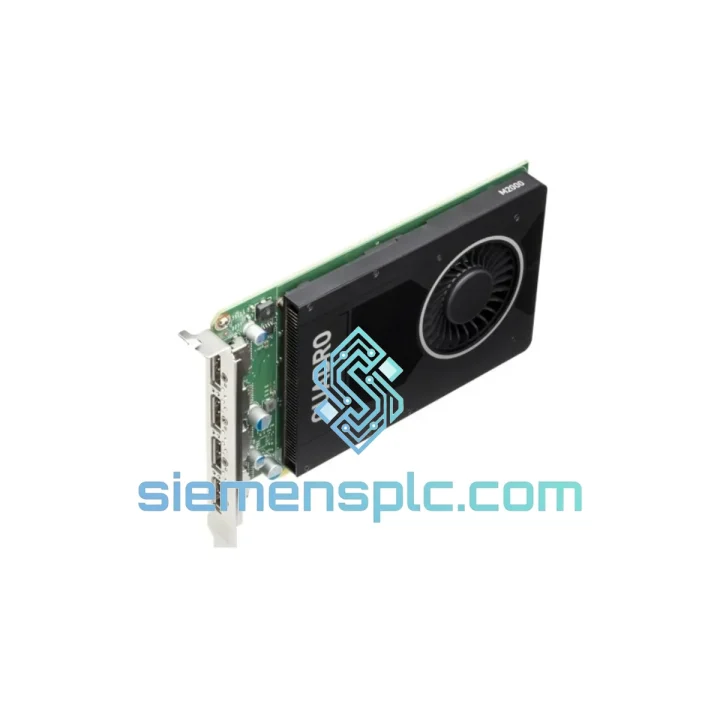
NVIDIA Quadro M2000 Professional GPU – Maxwell Series
Request verified availability, condition, replacement risk review, packing options and courier lead time for M2000.
BrandNVIDIA
Part NumberM2000
ConditionAvailability Check
Lead TimeRFQ Confirmation
DocumentsDatasheet / photos by RFQ
ShippingExport packing available
Auto-filled RFQ
M2000
Click Request Quote and the part number is inserted into the inquiry form automatically.
- Reply by email: [email protected]
- WhatsApp / Tel: +86 18359268345
- Mon-Sat 9:00-18:00 GMT+8
Procurement Data
Key Product Information
Core fields for model confirmation and RFQ routing. Detailed product narrative remains below.
- Brand
- NVIDIA
- Primary Part Number
- M2000
- Product Type
- Professional Workstation GPU
- Product Family
- Other series
- Country of Origin
- Not specified
- Catalog Category
- HMI Panels
- Operating Temp.
- 0 °C to 80 °C (ambient)
- Warranty
- 12 months from date of dispatch
- Compliance
- RoHS 2, CE, FCC Class B, UL
Model confirmed for inquiry
M2000
Send quantity, destination and urgency. The RFQ form keeps this part number attached.
Request Quote
Product Overview
NVIDIA Quadro M2000 4GB GDDR5 – Deterministic Rendering Engine for Industrial Visualization and Engineering Workstations
The Quadro M2000 occupies a well-defined position in the professional GPU hierarchy: a single-slot, bus-powered accelerator built on NVIDIA’s Maxwell (GM206) silicon, delivering 768 shader processors, 4 GB of ECC-protected GDDR5 memory on a 128-bit bus, and a validated ISV certification matrix that spans the dominant CAD, CAE, and industrial automation software ecosystems. In control-room and HMI deployments, where display continuity and driver stability are non-negotiable, the M2000’s architecture provides a measurable reliability advantage over consumer-grade alternatives.
The card’s 75 W thermal design power is fully satisfied by the PCIe ×16 slot without any auxiliary power connector. This characteristic is not incidental — it directly enables integration into certified medical, industrial, and compact workstation chassis where power-delivery constraints and EMC compliance requirements prohibit auxiliary cabling. The single-slot form factor further extends compatibility to multi-card workstation configurations and space-constrained rack-mount systems used in process control environments.
From a memory subsystem perspective, the 4 GB GDDR5 frame buffer operates at an effective 106.6 GB/s bandwidth. ECC (Error-Correcting Code) memory is toggle-selectable via NVIDIA Control Panel or nvidia-smi; when active, single-bit errors are corrected in hardware without software intervention, and double-bit errors are flagged for system-level handling. For long-duration FEA/CFD solves in ANSYS Mechanical or Siemens NX, this protection layer eliminates the class of silent data corruption that can invalidate multi-hour simulation runs.
The display subsystem provides four independent DisplayPort 1.2 outputs, each capable of driving a 5120 × 3200 resolution at 60 Hz. In SCADA and DCS operator console deployments, this allows a single M2000 to populate a four-screen workstation — process overview, trend historian, alarm management, and P&ID detail — without a secondary GPU or active display splitter. The DisplayPort 1.2 standard also supports Multi-Stream Transport (MST), enabling daisy-chained monitor configurations where physical cabling density is a constraint.
Real-time Stock & RFQ: [email protected] | WhatsApp: +86 18359268345
Technical Parameters
| Parameter | Specification |
|---|---|
| Model / SKU | NVIDIA Quadro M2000 / M2000 |
| GPU Architecture | Maxwell (GM206) |
| CUDA Cores | 768 |
| Frame Buffer | 4 GB GDDR5 ECC |
| Memory Bandwidth | 106.6 GB/s |
| Memory Interface Width | 128-bit |
| Display Outputs | 4× DisplayPort 1.2 |
| Max Simultaneous Displays | 4 |
| Max Resolution per Display | 5120 × 3200 @ 60 Hz |
| PCIe Interface | PCIe 3.0 ×16 |
| Thermal Design Power (TDP) | 75 W (bus-powered, no aux connector) |
| Form Factor | Single-slot, low-profile bracket included |
| API Support | OpenGL 4.5, DirectX 12, Vulkan 1.0, CUDA 8.0, OpenCL 2.0 |
| ISV Certifications | Autodesk, Dassault Systèmes, PTC, Siemens PLM, ANSYS |
| Operating Temperature | 0 °C to 80 °C (ambient) |
| Storage Temperature | -20 °C to 95 °C |
| Compliance | RoHS 2, CE, FCC Class B, UL |
| Card Weight | 323 g |
| Warranty | 12 months from date of dispatch |
Hardware Logical Analysis
The GM206 die implements NVIDIA’s second-generation Maxwell shader multiprocessor (SMM) architecture. Each SMM block contains 128 CUDA cores partitioned into four 32-wide warp schedulers, each with a dedicated instruction buffer and register file. The M2000’s six active SMMs yield 768 total CUDA cores operating at a base clock of 1050 MHz with a GPU Boost ceiling of 1163 MHz — a 10.8% headroom that the thermal management subsystem can sustain within the 75 W envelope under typical professional workloads.
The memory controller implements a 128-bit GDDR5 interface across four 32-bit channels. GDDR5 operates at an effective 6.6 Gbps per pin, producing the 106.6 GB/s aggregate bandwidth. The ECC implementation uses a standard SECDED (Single Error Correct, Double Error Detect) Hamming code applied at the memory controller level, adding approximately 12.5% overhead to raw memory capacity — reducing the usable frame buffer to approximately 3.5 GB when ECC is enabled. This is a hardware-level operation; no CPU cycles are consumed in the correction path.
EMC performance is addressed through the card’s PCB stackup and component placement. The GM206 package uses a flip-chip BGA with an integrated heat spreader, reducing radiated emissions from the die. The GDDR5 memory devices are placed in a symmetric layout around the GPU to equalize trace lengths and minimize differential skew on the memory bus — a factor that directly affects signal integrity at 6.6 Gbps data rates. The card’s single-slot cooler uses a blower-style fan that exhausts heated air through the bracket aperture, preventing recirculation within the chassis and maintaining predictable thermal behavior in rack-mount enclosures with restricted airflow.
The DisplayPort 1.2 output stage supports both SST (Single-Stream Transport) and MST (Multi-Stream Transport) modes. In MST mode, a single DP 1.2 port can drive multiple displays through a compatible hub, with the GPU’s display engine managing the packetized stream allocation. The four independent display engines on the M2000 each contain a dedicated pixel pipeline, allowing four completely independent refresh cycles — a requirement for SCADA systems where each monitor may operate at a different refresh rate or resolution.
System Integration Benefits
- Deterministic display output: Four independent display engines eliminate frame-sync contention between monitors, ensuring each screen updates on its own refresh cycle without tearing or latency coupling — critical for alarm management displays that must update within defined scan intervals.
- Zero auxiliary power dependency: Bus-powered operation at 75 W removes the need for PSU auxiliary connectors, simplifying integration into certified industrial workstations and reducing potential failure points in the power delivery chain.
- ECC memory integrity: Hardware SECDED correction operates transparently below the OS and application layers, protecting simulation state, texture data, and framebuffer contents from single-bit upsets without software overhead or application modification.
- ISV driver certification: NVIDIA’s Quadro driver branch undergoes ISV co-validation with Autodesk, Dassault, Siemens PLM, PTC, and ANSYS before release. This eliminates the class of rendering artifacts and application crashes that arise from driver-application incompatibilities in consumer GPU driver branches.
- Single-slot form factor: Preserves adjacent PCIe slots for additional I/O cards — network adapters, serial communication cards, or data acquisition boards — in workstations that serve dual roles as visualization and data acquisition nodes.
- Low-profile bracket compatibility: Enables deployment in 1U and 2U rack-mount workstations used in control room and edge computing environments where full-height cards cannot be accommodated.
- OpenGL 4.5 compliance: The full OpenGL 4.5 feature set, including compute shaders, tessellation, and geometry shaders, is available through NVIDIA’s Quadro driver — ensuring compatibility with industrial visualization software that relies on advanced OpenGL extensions for 3D process model rendering.
- Thermal predictability: The blower cooler’s exhaust-to-bracket design produces a consistent thermal profile under sustained load, allowing system integrators to calculate chassis airflow budgets with a defined heat source location rather than a diffuse convection pattern.
- CUDA 8.0 compute capability: Enables GPU-accelerated preprocessing in simulation tools that offload mesh generation, matrix assembly, or post-processing to CUDA kernels — reducing CPU-bound bottlenecks in FEA and CFD workflows.
- Vulkan 1.0 support: Provides a low-overhead graphics API path for next-generation industrial visualization applications that require explicit GPU resource management and reduced driver latency.
Quality Assurance & Global Logistics
Each NVIDIA Quadro M2000 unit dispatched from our Xiamen, China facility passes a structured pre-shipment verification protocol. Physical inspection covers PCB surface condition, BGA solder joint integrity (visual and thermal), and GDDR5 module seating. Functional verification uses GPU-Z to confirm GPU die identification, VBIOS version string, and memory configuration against NVIDIA’s published specifications for the M2000 SKU. A minimum two-hour burn-in under FurMark stress load validates thermal management performance and clock stability within the GPU Boost envelope. All four DisplayPort outputs are tested under active signal load. ECC functionality is verified via nvidia-smi --query-gpu=ecc.mode.current and a controlled memory stress pass.
Units are sourced exclusively from verified enterprise decommission channels and authorized distribution partners. Grey-market and counterfeit supply chains are excluded by supplier qualification procedures that include documentation chain-of-custody verification. Anti-static packaging with humidity indicator cards and corner-protection foam inserts is standard for all shipments.
International logistics from Xiamen are executed via DHL Express, FedEx International Priority, and SF Express international services, with typical transit times of 3–7 business days to major industrial hubs in Europe, North America, Southeast Asia, and the Middle East. Full export documentation — commercial invoice, packing list, and certificate of origin — is provided for customs clearance. HS code classification and export licensing support are available on request for controlled-destination shipments.
Contact Information
Email: [email protected]
WhatsApp: +86 18359268345
Web: siemensplc.com
Location: Xiamen, China
© 2026 siemensplc.com. All rights reserved.
Ready to quote
[email protected]
Send This Part Number to Sales
RFQ workflow
Quality workflow ->
Confirmation Process
01Model confirmation
We check the full part number, brand, series and visible nameplate information before quotation.
02Availability reply
Sales confirms stock path, condition option, quantity and realistic lead time for export dispatch.
03Packing & courier
DHL, FedEx, UPS or buyer courier arrangements can be reviewed with packing requirements.
Continue sourcing
Browse full catalog ->
Related Automation Parts
Similar brand or category products for fast comparison and multi-item RFQ lists.
Siemens
RFQ Ready
Siemens 6AV7240-0HC07-0PA0 Industrial Panel PC Motherboard – SIMATIC IPC477D
SIMATIC
Origin DE
Industrial Panel PC Motherboard