Schneider Electric
RFQ Ready
Schneider Electric 170ADO35000 Discrete Output Module – Modicon Quantum
Modicon Quantum
Origin FR
Discrete Output Module
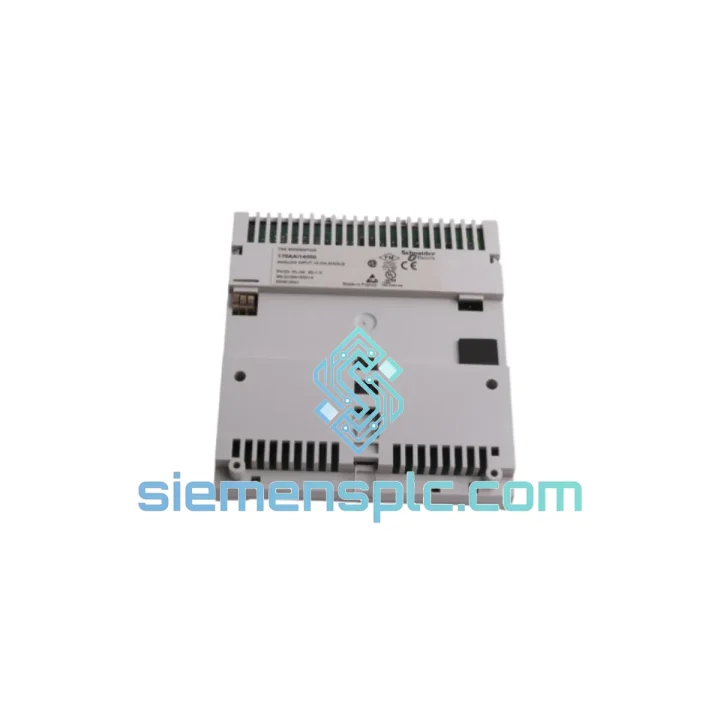
Request verified availability, condition, replacement risk review, packing options and courier lead time for 170AAO92100.
Click Request Quote and the part number is inserted into the inquiry form automatically.
Core fields for model confirmation and RFQ routing. Detailed product narrative remains below.
The 170AAO92100 is a four-channel analog output module designed for installation within Schneider Electric’s Modicon Quantum I/O backplane infrastructure. Its primary function in a control loop is to translate digitally computed setpoints — generated by the Quantum CPU across the backplane bus — into conditioned, field-ready analog signals that drive final control elements: proportional control valves, variable-frequency drives, electro-pneumatic positioners, and current-to-pressure transducers. Without a stable, low-drift analog output stage, the closed-loop integrity of any PID-regulated process degrades; the 170AAO92100 is the hardware layer that preserves that integrity under continuous industrial duty.
Each of the four output channels is independently configurable for either 4–20 mA current-loop operation or voltage output modes (0–10 V, ±10 V), selectable via software parameterization in EcoStruxure Control Expert (formerly Unity Pro). The 12-bit digital-to-analog conversion stage provides 4,096 discrete output steps across the full engineering range, yielding a resolution of approximately 4 µA per step in current mode — sufficient for tight proportional valve positioning in pressure-critical applications such as gas injection systems or hydraulic servo circuits.
Real-time Stock & RFQ: [email protected] | WhatsApp: +86 18359268345
| Parameter | Specification |
|---|---|
| Part Number / SKU | 170AAO92100 |
| Brand | Schneider Electric |
| Series | Modicon Quantum |
| Module Category | Analog Output Module |
| Number of Output Channels | 4 (independently configurable) |
| Output Signal — Current Mode | 4–20 mA (active source) |
| Output Signal — Voltage Mode | 0–10 V DC / ±10 V DC |
| D/A Converter Resolution | 12-bit (4,096 steps) |
| Current Output Load Impedance | ≤ 600 Ω |
| Voltage Output Load Impedance | ≥ 1 kΩ |
| Output Accuracy (at 25°C) | ±0.1% of full scale |
| Temperature Drift | ≤ 100 ppm/°C |
| Settling Time (to 0.1% FS) | ≤ 1 ms per channel |
| Channel-to-Bus Isolation | Optical isolation, 500 V AC (1 min) |
| Backplane Interface | Modicon Quantum I/O bus (parallel) |
| Operating Temperature | 0°C to +60°C |
| Storage Temperature | −40°C to +85°C |
| Relative Humidity | 5% to 95%, non-condensing |
| Vibration Resistance | IEC 60068-2-6: 10–150 Hz, 1 g |
| Shock Resistance | IEC 60068-2-27: 15 g, 11 ms |
| EMC Immunity | IEC 61000-4-2/3/4/5/6 compliant |
| Certifications | CE, UL 508, cUL, CSA |
| Form Factor | Single-slot Quantum I/O module |
| Module Weight | Approx. 220 g |
| Country of Origin | France |
| Warranty | 12 months from date of shipment |
Backplane Bus Interface and Scan Cycle Coupling
The 170AAO92100 communicates with the Quantum CPU via the parallel Quantum I/O bus, which operates at a fixed backplane clock rate synchronized to the CPU scan cycle. Output register writes from the CPU are latched into the module’s internal holding registers at each I/O scan boundary. The D/A conversion stage then updates all four output channels simultaneously from these latched values, ensuring that multi-channel output transitions are phase-coherent — a critical requirement in coordinated multi-axis drive applications where differential timing between channels would introduce torque ripple or positional error.
Optical Isolation Architecture
The channel-to-bus isolation barrier is implemented using high-speed optocouplers positioned between the digital logic domain (backplane side) and the analog output stage (field side). This galvanic separation — rated at 500 V AC for one minute — prevents ground loop currents from the field wiring from coupling noise into the backplane data bus. In installations where field devices share a common ground with heavy motor drives or welding equipment, this isolation layer is the primary defense against common-mode interference that would otherwise corrupt the 12-bit DAC output and manifest as process instability.
Current Source Output Topology
In 4–20 mA mode, each channel operates as an active current source rather than a voltage-to-resistor approximation. The output stage employs a feedback-regulated transconductance amplifier that maintains constant current delivery regardless of load impedance variations within the specified 0–600 Ω range. This topology is inherently immune to resistive voltage drops across long field cable runs — a fundamental advantage in plant-wide installations where field device wiring may span hundreds of meters. The 4 mA live-zero convention also provides a built-in wire-break detection mechanism: a field reading of 0 mA unambiguously indicates a broken loop rather than a valid zero-percent setpoint.
EMC Design and Conducted Emission Suppression
The module’s PCB layout incorporates dedicated ground planes that separate the analog output traces from the digital logic circuitry, minimizing capacitive coupling between the high-frequency backplane clock signals and the sensitive DAC output nodes. Ferrite bead filters on the field terminal connections attenuate high-frequency conducted emissions from the field wiring before they reach the DAC output stage. The module meets IEC 61000-4-4 (electrical fast transient/burst) immunity at 2 kV on signal lines, which is the standard test level for equipment installed in industrial control panels adjacent to contactor-heavy motor control centers.
Thermal Management and Derating
The module’s power dissipation is dominated by the output driver stage, which must maintain a regulated current or voltage across varying load impedances. The thermal design uses the aluminum backplane rail as a passive heat spreader, conducting junction heat away from the output driver ICs without requiring forced-air cooling. At the maximum operating temperature of 60°C, the module operates within its full specification envelope without output accuracy derating — a design margin that accommodates the elevated ambient temperatures common in sealed electrical enclosures during summer operation in tropical or desert climates.
Every 170AAO92100 unit supplied by siemensplc.com is sourced as genuine Schneider Electric original equipment. Prior to dispatch, each module undergoes a structured verification protocol: manufacturer date-code and label authentication against Schneider Electric’s published genuine-product identifiers; visual inspection of connector pins, PCB conformal coating, and housing integrity; and functional bench verification in a Quantum rack environment confirming correct backplane enumeration and analog output channel response across the full engineering range.
Shipments originate from our warehouse in Xiamen, China — a major international logistics hub with direct access to DHL Express, FedEx International Priority, and UPS Worldwide Express services. Standard express transit times are 3–5 business days to Europe and North America, 2–4 business days to Southeast Asia and the Middle East, and 1–2 business days to Hong Kong, Taiwan, and South Korea. All shipments include full tracking, commercial invoice, and packing list documentation. Export classification and customs documentation are prepared in accordance with the destination country’s import requirements. The 12-month warranty covers functional defects attributable to manufacturing; each unit ships with a condition report and, where available, original Schneider Electric packaging and documentation.
Email: [email protected]
WhatsApp: +86 18359268345
Web: siemensplc.com
Location: Xiamen, China
© 2026 siemensplc.com. All rights reserved.
We check the full part number, brand, series and visible nameplate information before quotation.
Sales confirms stock path, condition option, quantity and realistic lead time for export dispatch.
DHL, FedEx, UPS or buyer courier arrangements can be reviewed with packing requirements.
Similar brand or category products for fast comparison and multi-item RFQ lists.