SICK
RFQ Ready
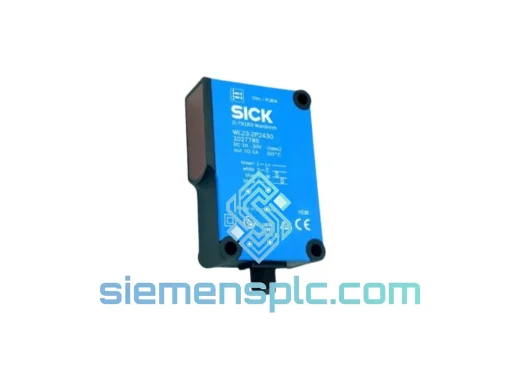
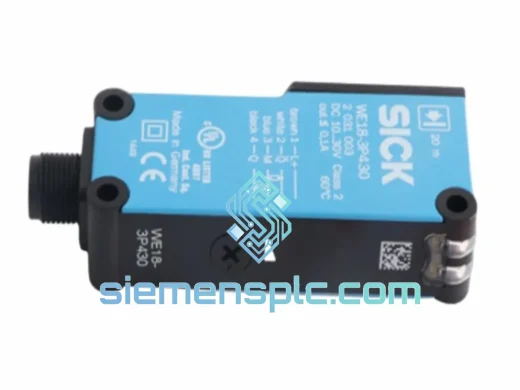
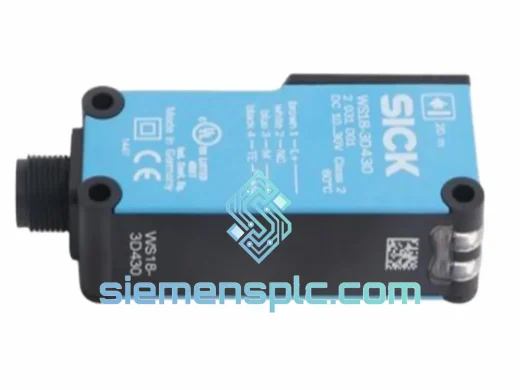
SICK WS18-3D430 Photoelectric Sensor
W18 Series Photoelectric
Origin DE
Photoelectric Sensor
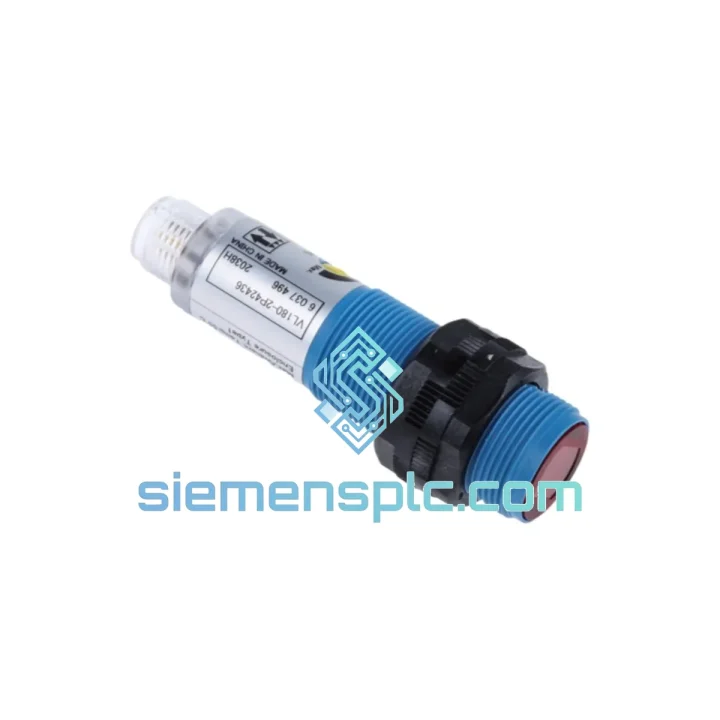
Request verified availability, condition, replacement risk review, packing options and courier lead time for VL180-2P42436.
Click Request Quote and the part number is inserted into the inquiry form automatically.
Core fields for model confirmation and RFQ routing. Detailed product narrative remains below.
The SICK VL180-2P42436 is a compact diffuse-reflection photoelectric sensor from SICK AG’s VL180 Series, engineered for deterministic object detection in industrial automation environments where sensing reliability directly governs process throughput and machine availability. Unlike retro-reflective or through-beam configurations that require precise optical alignment between emitter and receiver, the VL180-2P42436 operates on an energetic diffuse principle: the emitter and receiver share a single housing, and detection is triggered by the intensity of light reflected back from the target surface. This architecture eliminates the need for a separate reflector or receiver unit, reducing installation footprint and mechanical alignment overhead — a measurable advantage in high-density machine layouts where mounting real estate is constrained.
Within the control loop hierarchy, this sensor functions as a discrete binary input source. Its PNP transistor output delivers a sourcing signal to the connected PLC digital input card when a target enters the configured sensing window. The output switching logic is compatible with IEC 61131-2 Type 1 and Type 3 digital input specifications, making it directly interoperable with Siemens S7-1200/S7-1500 SM 1221 input modules, Rockwell CompactLogix 1769-IQ16 cards, and Mitsubishi MELSEC iQ-R RX40C7 input units without intermediate signal conditioning. The sensor’s 10–30 V DC operating range accommodates both 12 V and 24 V DC bus architectures, which are the two dominant supply voltages in contemporary machine control panels.
Real-time Stock & RFQ: [email protected] | WhatsApp: +86 18359268345
| Parameter | Value |
|---|---|
| Part Number / SKU | VL180-2P42436 |
| Manufacturer | SICK AG (Germany) |
| Series | VL180 |
| Detection Mode | Diffuse Reflection (Energetic) |
| Output Type | PNP (Sourcing), NO/NC selectable |
| Operating Voltage (Vs) | 10 – 30 V DC (SELV/PELV) |
| No-Load Supply Current (I₀) | ≤ 35 mA |
| Output Current (Imax) | 100 mA continuous |
| Voltage Drop (Vd) | ≤ 2.5 V at Imax |
| Short-Circuit Protection | Yes (pulsed) |
| Reverse Polarity Protection | Yes |
| Light Source | Infrared LED (modulated) |
| Connection Type | 2-pin M8 connector |
| Housing Material | Thermoplastic (PBT) |
| Enclosure Rating | IP67 (IEC 60529) |
| Ambient Temperature (Operation) | -40 °C to +60 °C |
| Ambient Temperature (Storage) | -40 °C to +70 °C |
| EMC Compliance | EN 60947-5-2, CE marked |
| Standards | IEC 60947-5-2, UL 508 |
| Weight (unit) | Approx. 15 g |
| Warranty | 12 months against manufacturing defects |
The VL180-2P42436 employs a modulated infrared LED emitter operating at a fixed carrier frequency. This modulation scheme is the primary mechanism by which the sensor discriminates between its own emitted signal and ambient light interference — including fluorescent lamp flicker (typically 100–120 Hz) and direct sunlight. The receiver’s bandpass filter and synchronous demodulation circuit are tuned to the emitter’s carrier frequency, so only signals at that specific frequency trigger the output stage. This architecture provides a measured ambient light immunity of up to 5,000 lux under incandescent illumination and up to 40,000 lux under sunlight, per SICK’s published VL180 Series datasheet parameters.
The output transistor stage is a PNP open-collector configuration with an integrated flyback diode, which suppresses inductive transients generated when switching inductive loads such as relay coils or solenoid valves. The short-circuit protection circuit operates in a pulsed mode: upon detecting an output-to-ground fault, the driver stage cycles on and off at a low duty cycle, limiting power dissipation in the output transistor and preventing thermal runaway. This self-protecting behavior allows the sensor to survive wiring faults without permanent damage — a significant advantage in field environments where cable insulation degradation is a maintenance reality.
The housing is constructed from PBT (polybutylene terephthalate) thermoplastic, which offers a glass transition temperature well above the sensor’s rated operating range and exhibits low moisture absorption (approximately 0.06% at equilibrium), maintaining dimensional stability and lens alignment accuracy across the full -40 °C to +60 °C operating envelope. The IP67 rating is achieved through a dual-seal design: a face seal on the optical window and a radial seal on the M8 connector interface, both tested to 30-minute immersion at 1 m depth per IEC 60529 methodology.
The 2-pin M8 connector interface simplifies field wiring to two conductors: supply positive (Vs) and output/supply negative. This minimalist pinout reduces connector mating errors in high-volume machine assembly and lowers the per-sensor wiring cost in multi-sensor installations. The M8 connector’s IP67 rating is maintained only when mated with a compatible IP67-rated cordset — a specification detail that system integrators must verify during cable selection.
Every SICK VL180-2P42436 unit supplied by siemensplc.com is sourced from verified, traceable supply channels. SICK AG manufactures its sensor product lines under ISO 9001-certified quality management systems, with production facilities subject to rigorous process control and outgoing inspection protocols. Units supplied through siemensplc.com are accompanied by original SICK packaging, manufacturer labeling, and batch traceability documentation upon request.
Our operations are based in Xiamen, China — a major international trade hub with direct access to Xiamen Gaoqi International Airport and Xiamen Port, two of China’s primary export gateways for industrial components. This geographic position enables us to offer competitive transit times to destinations across Southeast Asia (2–5 business days via air freight), Europe (3–7 business days via DHL/FedEx express), the Middle East (3–6 business days), and North America (4–8 business days). For high-volume orders, sea freight consolidation from Xiamen Port provides a cost-effective alternative with predictable transit schedules.
All export shipments are processed with complete commercial documentation: commercial invoice, packing list, certificate of origin (Form E for ASEAN, EUR.1 for EU where applicable), and shipper’s export declaration. Customs HS code classification for photoelectric sensors (typically HS 8536.50 or 8543.70 depending on destination country tariff schedule) is handled by our logistics team to minimize customs clearance delays. Anti-static and shock-resistant packaging is applied to all electronic component shipments to protect optical and electronic assemblies during international transit.
A 12-month warranty against manufacturing defects is provided on all new units. Warranty claims are processed through our Xiamen operations center, with replacement units dispatched upon fault confirmation. Our technical team — with direct experience in SICK sensor product lines — provides pre-sale application engineering support and post-delivery commissioning assistance via email and WhatsApp.
Email: [email protected]
WhatsApp: +86 18359268345
Web: siemensplc.com
Location: Xiamen, China
© 2026 siemensplc.com. All rights reserved.
We check the full part number, brand, series and visible nameplate information before quotation.
Sales confirms stock path, condition option, quantity and realistic lead time for export dispatch.
DHL, FedEx, UPS or buyer courier arrangements can be reviewed with packing requirements.
Similar brand or category products for fast comparison and multi-item RFQ lists.