Siemens
RFQ Ready
Siemens 6ES7321-1BL00-0AA0 Digital Input Module
SIMATIC
Origin DE
PLC Digital Input Module
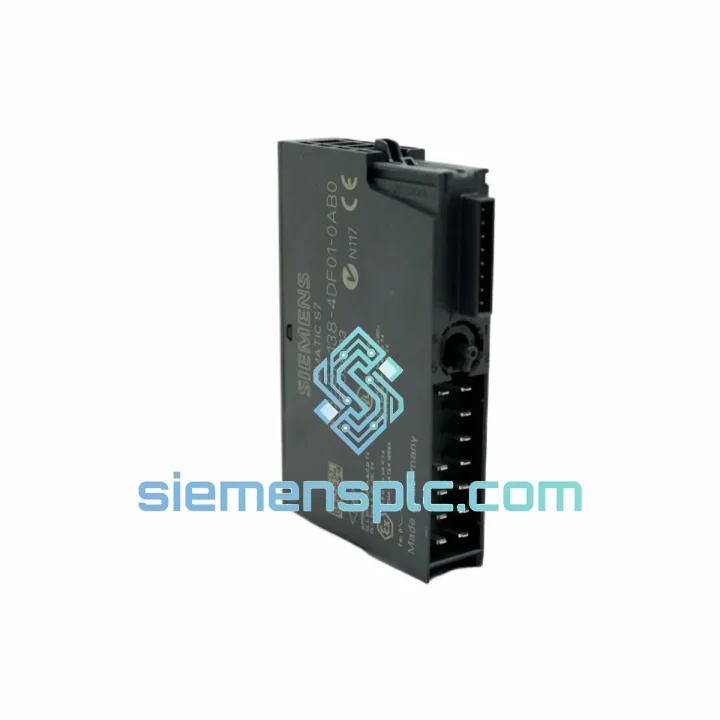
Request verified availability, condition, replacement risk review, packing options and courier lead time for 6ES7138-4DF01-0AB0.
Click Request Quote and the part number is inserted into the inquiry form automatically.
Core fields for model confirmation and RFQ routing. Detailed product narrative remains below.
The 6ES7138-4DF01-0AB0 is a dedicated serial interface electronic module (EM) within the Siemens SIMATIC ET 200S modular distributed I/O family. Its primary function is to extend the ET 200S station with a point-to-point serial communication channel, enabling the SIMATIC S7 controller to exchange data with third-party field devices, drives, barcode readers, weighing terminals, and legacy instrumentation that operate over RS-232, RS-422, or RS-485 physical layers. Unlike fieldbus-based I/O modules that rely on cyclic process image exchange, this module handles asynchronous, character-framed serial data streams — a fundamentally different data-flow model that demands dedicated buffering, baud-rate generation, and protocol-layer handling at the module level rather than at the CPU.
Within a running ET 200S station, the 6ES7138-4DF01-0AB0 occupies a standard electronic module slot on a TM-E terminal module (order ref. 6ES7193-4CA40-0AA0 or equivalent). The terminal module provides the backplane bus connection and the field-side terminal block simultaneously, so no additional wiring adapters are required. The module draws its 24 V DC supply from the adjacent power module and communicates with the ET 200S interface module (IM 151 series) via the internal ET 200S backplane bus at a fixed internal clock rate. The IM then forwards the serial payload data to the S7 CPU over PROFIBUS DP or PROFINET, depending on the IM variant installed.
Real-time stock inquiry and RFQ: [email protected] | WhatsApp: +86 18359268345
| Parameter | Value |
|---|---|
| Order Number (MLFB) | 6ES7138-4DF01-0AB0 |
| Product Family | SIMATIC ET 200S |
| Module Category | Electronic Module — Serial Interface |
| Serial Standards Supported | RS-232 (point-to-point), RS-422 (full-duplex, 4-wire), RS-485 (half-duplex, 2-wire bus) |
| Baud Rate Range | 300 baud to 115.2 kbaud (configurable) |
| Data Frame Format | 5–8 data bits, 1–2 stop bits, parity: none / even / odd |
| Transmission Mode | Full-duplex (RS-232 / RS-422) or half-duplex (RS-485) |
| Max. Cable Length — RS-232 | 15 m (per EIA-232 standard) |
| Max. Cable Length — RS-485 | 1,200 m at 9.6 kbaud; 100 m at 115.2 kbaud |
| Supply Voltage | 24 V DC (via ET 200S power module) |
| Current Consumption (backplane bus) | ≤ 100 mA at 5 V DC (internal bus) |
| Operating Temperature | 0 °C to +60 °C |
| Storage Temperature | −40 °C to +70 °C |
| Relative Humidity | 10 % to 95 %, non-condensing |
| Degree of Protection | IP20 (module body) |
| Mounting | Snap-on to TM-E terminal module on DIN rail |
| Dimensions (W × H × D) | 15 mm × 81 mm × 52 mm (approx.) |
| Weight | Approx. 100 g |
| Certifications | CE, UL, cUL, ATEX (zone 2, with appropriate IM), GL, FM |
| Engineering Software | SIMATIC STEP 7 V5.5 SP4+, TIA Portal V13 SP1 and above |
| Warranty | 12 months from date of shipment (siemensplc.com guarantee) |
Backplane Bus Interface and Data Buffering: The 6ES7138-4DF01-0AB0 connects to the ET 200S internal backplane bus through a proprietary parallel interface embedded in the terminal module. The module contains an onboard UART (Universal Asynchronous Receiver-Transmitter) with a dedicated transmit and receive FIFO buffer. This buffering architecture decouples the asynchronous serial data stream from the synchronous backplane bus cycle, preventing character loss during bus arbitration latency. The FIFO depth is sufficient to absorb inter-character gaps introduced by the IM’s polling cycle without requiring the CPU to service every byte interrupt individually.
Baud Rate Generation: An internal crystal-controlled oscillator provides the baud rate clock, ensuring frequency accuracy within ±0.5 % across the full operating temperature range. This tolerance is well within the ±2 % window required by EIA-485 for reliable multi-drop bus operation at 115.2 kbaud. The baud rate is set via the STEP 7 / TIA Portal hardware configuration and stored in the module’s non-volatile parameter memory, so the module restores its communication settings autonomously after a power cycle without requiring a re-download from the CPU.
RS-485 Driver and Termination Logic: For RS-485 half-duplex operation, the module integrates a differential line driver/receiver with automatic transmit-enable control. The driver switches from receive to transmit mode within the inter-character gap, eliminating the need for external direction-control logic or RTS/CTS handshaking. The module supports bus termination resistor activation via software parameter, removing the need for external termination networks at the module end of the bus segment. The differential output voltage is ≥ 1.5 V into a 54 Ω load, compliant with EIA-485 minimum driver output requirements.
EMC Design: The module’s PCB layout routes the serial signal lines with controlled impedance traces and places decoupling capacitors at the line driver supply pins to suppress high-frequency switching transients. The terminal module’s field-side connector provides galvanic isolation between the backplane bus ground and the serial signal ground through an optocoupler barrier rated at 500 V AC isolation voltage. This isolation prevents ground loop currents — a common source of data corruption in industrial environments where field devices and control cabinets share different ground potentials — from reaching the backplane bus and corrupting the process image.
Diagnostic Register Architecture: The module maintains a set of status and error registers accessible via the ET 200S diagnostic mechanism. These registers report framing errors (stop bit not detected), parity errors, overrun errors (FIFO overflow), and break conditions on the serial line. The IM aggregates these diagnostic bits into the standard ET 200S diagnostic frame and forwards them to the CPU, where they appear as module-level diagnostics in the STEP 7 / TIA Portal diagnostic buffer. This allows the PLC program to detect serial communication faults without polling the module directly, reducing CPU scan time overhead.
Every 6ES7138-4DF01-0AB0 unit dispatched from our Xiamen, China facility is sourced exclusively from Siemens AG’s authorized distribution chain. Each module undergoes a four-stage verification process before shipment:
1. Authenticity Inspection: Label typography, holographic security features, date code format, and PCB marking are cross-referenced against Siemens AG’s current genuine-product reference database. Modules that fail any single check criterion are quarantined and returned to the supplier.
2. Electrical Pre-Test: Modules are powered via a calibrated 24 V DC bench supply and connected to an ET 200S test station. The backplane bus communication, UART loopback function, and diagnostic register readback are verified using STEP 7 hardware diagnostics. Pass criteria require zero framing errors and correct module identification response within 500 ms of power application.
3. ESD-Safe Packaging: Verified modules are placed in anti-static bags (surface resistance < 10¹¹ Ω per IEC 61340-5-1), sealed, and placed in rigid cardboard boxes with foam inserts sized to the module’s 15 mm × 81 mm × 52 mm envelope. Moisture-indicator cards are included for shipments to high-humidity destinations.
4. Export Documentation: Each shipment includes a commercial invoice, packing list, and certificate of conformity. HS code 8537.10 is applied for customs classification. For customers requiring it, a Siemens AG factory test certificate or third-party inspection report can be arranged prior to dispatch.
Logistics partners include DHL Express, FedEx International Priority, and UPS Worldwide Express. Standard transit times from Xiamen to major industrial hubs: Europe 3–5 business days, North America 4–6 business days, Southeast Asia 2–3 business days, Middle East 4–7 business days. Tracking numbers are issued within 24 hours of dispatch. For urgent plant-down situations, same-day dispatch is available for orders confirmed before 14:00 CST.
Email: [email protected]
WhatsApp: +86 18359268345
Web: siemensplc.com
Location: Xiamen, China
© 2026 siemensplc.com. All rights reserved.
We check the full part number, brand, series and visible nameplate information before quotation.
Sales confirms stock path, condition option, quantity and realistic lead time for export dispatch.
DHL, FedEx, UPS or buyer courier arrangements can be reviewed with packing requirements.
Similar brand or category products for fast comparison and multi-item RFQ lists.