Siemens
RFQ Ready
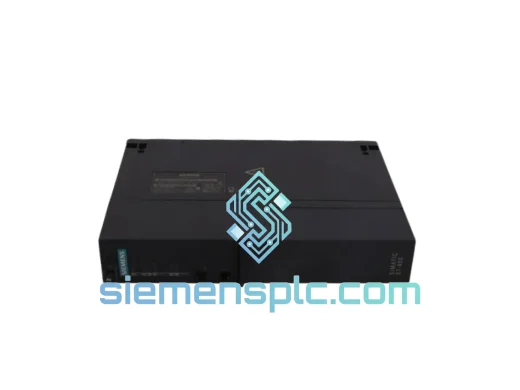
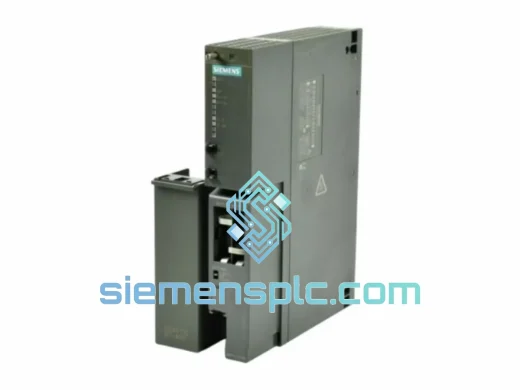
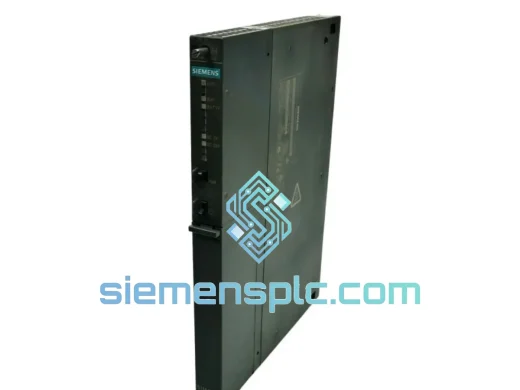
Siemens 6ES7405-0DA02-0AA0 PLC Power Supply – PS405 Series
SIMATIC S7-400
Origin DE
PLC Power Supply
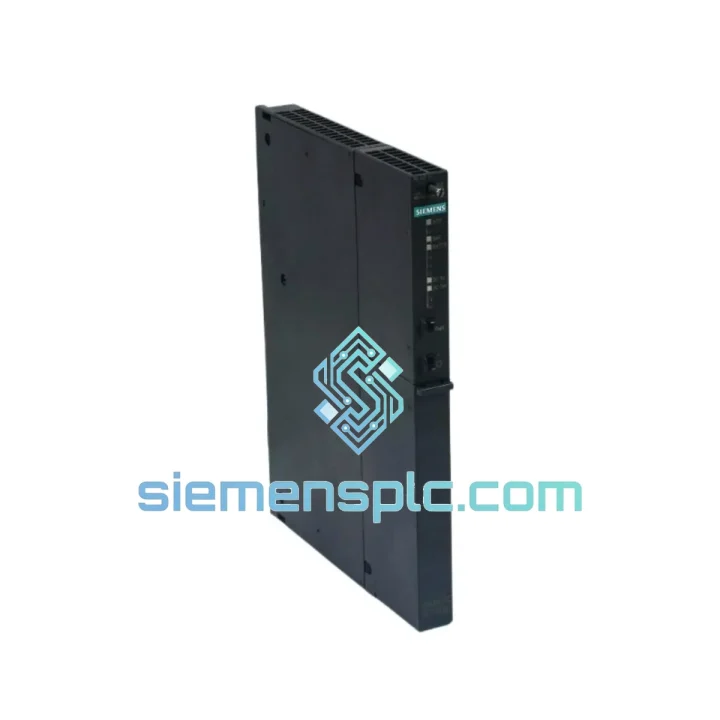
Request verified availability, condition, replacement risk review, packing options and courier lead time for 6ES7407-0DA01-0AA0.
Click Request Quote and the part number is inserted into the inquiry form automatically.
Core fields for model confirmation and RFQ routing. Detailed product narrative remains below.
Within the SIMATIC S7-400 platform, the power supply module occupies a structurally non-negotiable position: it is the sole source of regulated 5 VDC bus energy for every CPU instruction cycle, every I/O module scan, and every inter-rack communication transaction. The 6ES7407-0DA01-0AA0 — designated PS407 4A within Siemens’ S7-400 power supply family — fulfils this role through a wide-range AC input design that accepts 85 to 264 VAC at 47 to 63 Hz, converting mains power to a tightly regulated 5 VDC / 4 A backplane rail and a 24 VDC / 0.5 A auxiliary output for field-side instrumentation. Output regulation on the 5 V rail is held within ±2% of nominal under all specified load and temperature conditions, a tolerance that keeps every downstream module within its defined supply window without margin erosion.
The PS407 4A is the entry-capacity member of the PS407 AC-input series. Its 4 A bus current ceiling makes it the technically correct selection for racks carrying a single CPU and up to six standard digital or analog signal modules, where aggregate 5 V consumption under worst-case thermal loading remains below 3.5 A. It is mechanically and electrically distinct from the PS405 DC-input series and is not field-interchangeable with those modules. Installation is restricted to Slot 1 of S7-400 UR1, UR2, ER1, and ER2 racks.
📩 Real-time Stock & RFQ: [email protected] | WhatsApp: +86 18359268345
| Parameter | Specification |
|---|---|
| Siemens Order Number | 6ES7407-0DA01-0AA0 |
| Module Designation | PS407 4A |
| Platform | SIMATIC S7-400 |
| AC Input Voltage Range | 85–264 VAC, wide-range auto-select |
| AC Input Frequency | 47–63 Hz |
| 5 VDC Bus Output Current | 4 A continuous, ±2% regulation |
| 24 VDC Auxiliary Output | 0.5 A |
| Power Dissipation (full load) | ≈ 20 W |
| Inrush Current Limiting | Integrated soft-start; peak inrush ≤ 20 A |
| Output Short-Circuit Protection | Electronic fold-back with auto-restart |
| Input-to-Output Isolation | Reinforced; ≥ 3 kVAC dielectric withstand (1 min) |
| Rack Slot Assignment | Slot 1 only (UR1, UR2, ER1, ER2) |
| Module Dimensions (W × H × D) | 50 × 290 × 210 mm |
| Approximate Weight | 0.9 kg |
| Operating Temperature | 0 °C to +60 °C |
| Storage Temperature | −40 °C to +70 °C |
| Relative Humidity | 10–95%, non-condensing (IEC 60068-2-3) |
| Vibration Resistance | 10–58 Hz, 0.075 mm amplitude (IEC 60068-2-6) |
| Shock Resistance | 15 g / 11 ms half-sine (IEC 60068-2-27) |
| Degree of Protection | IP20 (EN 60529) |
| EMC Emissions Standard | EN 55011 Class A |
| EMC Immunity Standards | IEC 61000-4-2 / -4-3 / -4-4 / -4-5 / -4-6 / -4-8 / -4-11 |
| Certifications | CE (LVD 2014/35/EU, EMC 2014/30/EU), UL 508, cUL, FM Class I Div 2, ATEX Zone 2, RoHS |
| Country of Origin | Germany |
| Warranty | 12 months from dispatch date |
The internal conversion architecture of the 6ES7407-0DA01-0AA0 is structured as a three-stage cascade, each stage addressing a distinct electrical engineering constraint imposed by the S7-400 backplane’s sensitivity to supply noise and transient response.
Stage 1 — Active Power Factor Correction (PFC): The front-end PFC circuit operates as a boost converter, shaping the input current waveform to track the AC voltage sinusoid and maintain a power factor above 0.95 across the full 85–264 VAC input range. The intermediate DC bus is regulated to approximately 390 VDC, independent of input voltage. This pre-regulation stage is the mechanism that enables the wide-range auto-select capability: the downstream converter sees a stable high-voltage DC bus regardless of whether the facility supply is 120 V or 230 V. From a plant electrical perspective, the PFC stage also limits total harmonic distortion (THD) on the input current to below 10%, reducing harmonic loading on shared distribution transformers in installations where multiple switching power supplies operate from a common panel.
Stage 2 — LLC Resonant DC-DC Converter: The isolated DC-DC stage uses an LLC series-resonant topology. At nominal load, the switching frequency is tuned to the resonant frequency of the LLC tank circuit, achieving zero-voltage switching (ZVS) on the primary-side MOSFETs and zero-current switching (ZCS) on the secondary-side rectifier diodes. The practical consequence is that switching losses are reduced to near-zero at the design operating point, and the electromagnetic interference generated by switching transitions is substantially lower than in equivalent hard-switched PWM designs. The transformer’s reinforced insulation system provides a creepage distance and clearance geometry compliant with IEC 60664-1 for Pollution Degree 2 — relevant in panel environments where conductive particulate accumulation is a long-term maintenance consideration. The secondary output is rectified and filtered to approximately 5.5 VDC before entering the post-regulation stage.
Stage 3 — Linear Post-Regulator and Bus Supervisor: A linear regulator on the 5 V output suppresses residual switching ripple from the LLC stage to below 50 mV peak-to-peak. This is not redundant with the LLC’s inherent low-noise characteristic — it addresses load-step transient response. When a CPU transitions from STOP to RUN mode, or when a batch of output modules simultaneously switch their field loads, the current demand on the 5 V rail changes within microseconds. The linear stage absorbs this transient without the output voltage dipping below 4.75 V, the lower boundary of the S7-400 module supply specification. A dedicated voltage supervisor monitors the 5 V rail continuously; deviation beyond ±5% of nominal triggers a diagnostic assertion on the S7-400 P-bus within 10 ms, which the CPU logs to its diagnostic buffer as a power supply fault event — enabling condition-based maintenance before a fault escalates to an unplanned shutdown.
EMC Shielding Architecture: The input filter stage combines a common-mode choke, X-capacitors across line and neutral, and Y-capacitors from line and neutral to chassis ground. This filter topology attenuates both differential-mode noise (generated by the PFC switching) and common-mode noise (coupled through transformer interwinding capacitance). The module’s die-cast aluminium front frame is bonded to the rack chassis ground rail, forming a continuous Faraday enclosure around the internal switching stages. This construction approach is consistent with the EN 55011 Class A conducted and radiated emissions limits and the IEC 61000-4-3 radiated immunity requirement of 10 V/m at 80 MHz to 1 GHz.
Thermal Management: An internally controlled fan draws cooling air upward through the module body, aligned with the S7-400 rack’s defined bottom-to-top airflow direction. Fan speed is modulated by a thermistor-based controller — at 50% load and 25 °C ambient, the fan operates at approximately 60% of maximum speed, extending bearing service life. The primary heat-generating components — the PFC inductor, LLC transformer, and output rectifier assembly — are mounted on an aluminium heat spreader that conducts thermal energy directly into the airstream, avoiding thermal coupling to the backplane connector assembly and preserving connector contact resistance over the module’s operational lifespan.
All 6ES7407-0DA01-0AA0 units dispatched from our Xiamen, China operations centre are sourced through documented supply channels and pass a structured multi-stage incoming inspection before packaging and dispatch.
Inspection Protocol:
Packaging Standard: Units are packed in anti-static foam-lined cartons meeting IEC 60068-2-32 free-fall transport requirements. Each shipment includes the original Siemens product documentation set, an inspection test record, and a packing list with individual serial number traceability.
Logistics from Xiamen, China: Xiamen operates as a designated free-trade port with direct air freight access to major industrial distribution hubs across Asia-Pacific, Europe, the Middle East, and the Americas. Standard international express shipments via DHL, FedEx, or UPS reach most destinations within 3 to 7 business days from dispatch. Orders confirmed before 14:00 CST qualify for same-day dispatch processing. Full export documentation — commercial invoice, packing list, and certificate of origin — is prepared to the destination country’s customs requirements to minimise clearance delays at the point of entry.
Warranty Terms: 12 months from dispatch date, covering manufacturing defects and electrical failure under specified operating conditions. Confirmed warranty claims are processed with a target replacement dispatch within 5 business days of fault diagnosis completion.
📧 Email: [email protected]
📱 WhatsApp: +86 18359268345
🌐 Web: siemensplc.com
📍 Location: Xiamen, China
© 2026 siemensplc.com. All rights reserved.
We check the full part number, brand, series and visible nameplate information before quotation.
Sales confirms stock path, condition option, quantity and realistic lead time for export dispatch.
DHL, FedEx, UPS or buyer courier arrangements can be reviewed with packing requirements.
Similar brand or category products for fast comparison and multi-item RFQ lists.