Allen-Bradley
RFQ Ready
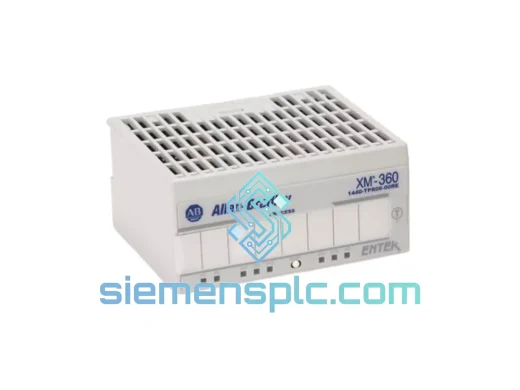
Allen-Bradley 1440-TPR06-00RE Absolute Position Transducer
Rockwell Automation
Origin US
Absolute Position Transducer
Request verified availability, condition, replacement risk review, packing options and courier lead time for MD20A.
Click Request Quote and the part number is inserted into the inquiry form automatically.
Core fields for model confirmation and RFQ routing. Detailed product narrative remains below.
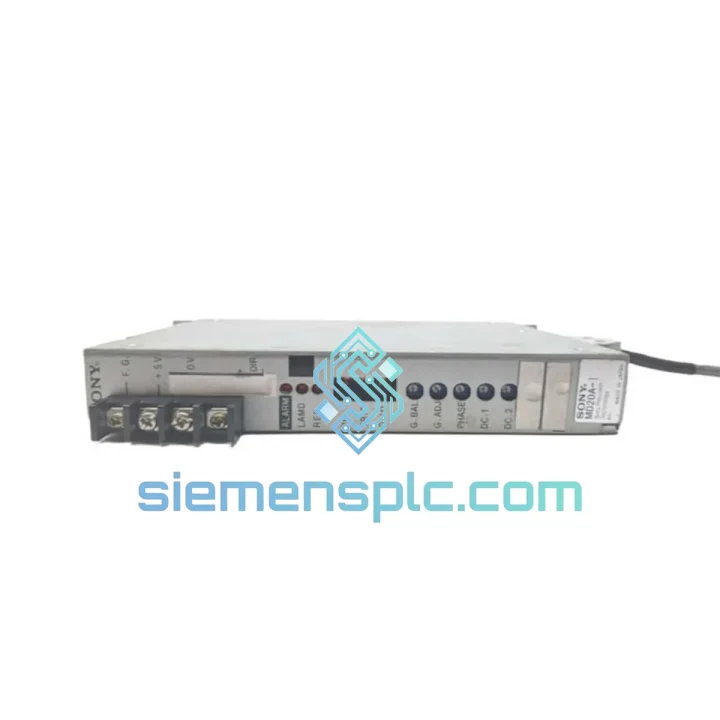
The SONY MD20A is a dedicated position detection module engineered for high-accuracy closed-loop servo and motion control systems. Operating as the feedback backbone between a linear or rotary encoder and the host servo drive, the MD20A conditions raw encoder signals—interpolating, digitizing, and transmitting position data with sub-micron repeatability. Its architecture is purpose-built for environments where positional drift, signal latency, or noise-induced miscounts are operationally unacceptable: semiconductor wafer stages, precision CNC machining centers, automated optical inspection platforms, and multi-axis robotic cells.
Unlike generic signal conditioners, the MD20A integrates directly with SONY’s proprietary encoder interface protocol, enabling deterministic position reporting at update rates that keep pace with high-dynamic servo loops. The module accepts differential sinusoidal encoder signals (1 Vpp), applies hardware-level interpolation to achieve fine position resolution, and outputs a clean digital position word to the controller backplane. This eliminates the interpolation burden from the CPU and reduces jitter in the position feedback path—a measurable advantage in applications requiring nanometer-class repeatability.
Real-time Stock & RFQ: [email protected] | WhatsApp: +86 18359268345
| Manufacturer | SONY Corporation (Industrial Division) |
| Model / SKU | MD20A |
| Module Category | Position Detection Module (Encoder Signal Processor) |
| Input Signal Type | Differential sinusoidal encoder, 1 Vpp (A/B quadrature + reference mark) |
| Interpolation Factor | Up to ×20 hardware interpolation (model-dependent configuration) |
| Output Interface | Parallel digital position word / serial synchronous to host controller |
| Position Update Rate | ≤ 1 ms cycle time (synchronized to servo drive sampling clock) |
| Operating Voltage | +5 VDC ± 5% (supplied via backplane connector) |
| Power Consumption | ≤ 2.5 W typical at full operation |
| Operating Temperature | 0 °C to +55 °C (storage: −20 °C to +70 °C) |
| Humidity | 20% to 80% RH, non-condensing |
| EMC Compliance | CE Mark; EN 61000-4-2 (ESD), EN 61000-4-4 (EFT), EN 61000-4-6 (conducted RF) |
| Mechanical Form Factor | Single-slot plug-in card; backplane edge connector |
| Weight | Approx. 2,140 g (module + packaging) |
| Connector | D-sub 15-pin (encoder input); backplane 64-pin (system bus) |
| Warranty | 12 months from date of shipment (new units) |
| Country of Origin | Japan |
The MD20A’s internal signal chain begins at a differential line receiver stage, where the incoming 1 Vpp sinusoidal A/B signals from the encoder head are amplified and offset-corrected before entering the interpolation ASIC. The differential topology provides common-mode rejection of up to 7 V, which is critical in machine tool cabinets where servo drive switching transients can couple onto encoder cable shields at frequencies between 10 kHz and 1 MHz.
The interpolation ASIC performs arctangent-based subdivision of the sinusoidal signal pair, converting each analog period into a configurable number of digital increments. This hardware interpolation—executed in dedicated silicon rather than firmware—eliminates the latency variability that software-based interpolation introduces, keeping position data phase-coherent with the servo drive’s current loop at all operating speeds.
On the EMC front, the module’s PCB layout employs a split ground plane strategy: the analog encoder input section and the digital backplane interface section are separated by a ferrite bead barrier, preventing high-frequency digital switching noise from contaminating the analog signal path. Decoupling capacitors are placed within 2 mm of each IC power pin, and the backplane connector pins are filtered with common-mode chokes rated to 100 MHz. This design approach allows the MD20A to maintain position count integrity even when installed adjacent to high-current servo amplifier modules in a shared rack enclosure.
The reference mark detection circuit operates on a dedicated hardware comparator, independent of the main interpolation path. This ensures that the zero-reference pulse—used for homing routines and absolute position initialization—is captured with a latency of less than 500 ns, regardless of the current interpolation processing load. The captured reference position is latched into a hardware register and held until the host controller acknowledges receipt, preventing reference mark loss during high-speed homing traversals.
Every SONY MD20A unit supplied by siemensplc.com is sourced through verified channels: authorized SONY industrial distributors, documented OEM overstock, and certified refurbishers with traceable chain-of-custody records. Each unit undergoes a structured incoming inspection protocol before dispatch:
Logistics are managed from our warehouse in Xiamen, China. In-stock units ship within 1–3 business days via DHL Express, FedEx International Priority, or UPS Worldwide Expedited—your choice. All shipments are packed in ESD-safe anti-static bags, cushioned in foam-lined boxes, and double-boxed for international transit. Export documentation (commercial invoice, packing list, HS code declaration) is prepared in-house for smooth customs clearance. Sea freight consolidation is available for bulk orders exceeding 10 units. Delivery to major industrial hubs in Europe, North America, Southeast Asia, and the Middle East typically completes within 3–7 business days from dispatch.
Email: [email protected]
WhatsApp: +86 18359268345
Web: siemensplc.com
Location: Xiamen, China
© 2026 siemensplc.com. All rights reserved.
We check the full part number, brand, series and visible nameplate information before quotation.
Sales confirms stock path, condition option, quantity and realistic lead time for export dispatch.
DHL, FedEx, UPS or buyer courier arrangements can be reviewed with packing requirements.
Similar brand or category products for fast comparison and multi-item RFQ lists.