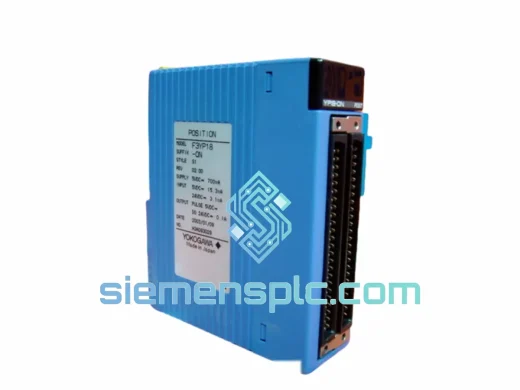
Product Overview
YOKOGAWA ET5*C Thermocouple Signal Conditioner: Stop the Bleed — Get Back Online Fast
Every minute your process line sits idle, you’re burning money. A failed signal conditioner in a thermocouple loop doesn’t just kill one measurement — it can cascade into a full DCS alarm storm, force a manual override, and drag your entire production cell offline. The YOKOGAWA ET5*C is the exact module you need to restore loop integrity and get your plant back to rated output. We stock it. We ship it today. From Xiamen to your site — DHL or FedEx, door to door.
URGENT REQUIREMENT? Contact: [email protected] | WhatsApp: +86 18359268345
Quick Technical Datasheet
| Parameter |
Specification |
| Manufacturer |
YOKOGAWA Electric Corporation |
| Part Number |
ET5*C |
| Series |
ET Series |
| Function |
Signal Conditioner — Thermocouple (T/C) Input |
| Input Type |
Thermocouple: J, K, T, E, R, S, B (suffix-dependent) |
| Output Signal |
4–20 mA / 1–5 V DC (isolated, model-dependent) |
| Isolation |
3-way galvanic isolation: Input / Output / Power |
| Supply Voltage |
24 V DC (±10%) |
| Accuracy |
±0.1% of span (typical) |
| Operating Temperature |
0 °C to +55 °C |
| Storage Temperature |
−25 °C to +70 °C |
| Mounting |
35 mm DIN rail |
| Protection Class |
IP20 |
| Compliance |
CE, RoHS, ISO 9001 |
| Weight |
Approx. 100 g |
| Availability |
✅ Ready to Ship — Xiamen Stock |
Troubleshooting & Replacement Tips
Pulled from real field experience. Before you crack open the cabinet, run through this checklist:
Common failure signatures on the ET5*C:
-
Output frozen at 4 mA or 20 mA: Almost always an input open-circuit (broken T/C wire or corroded terminal) or a failed input amplifier stage. Swap the T/C first — if output recovers, the conditioner is fine. If not, the ET5*C itself is the culprit.
-
Output drifting ±2–5% with no process change: Internal reference drift, usually accelerated by sustained operation above 50 °C. Check cabinet ventilation before fitting the replacement — you’ll burn through the new one too.
-
Intermittent signal drop (output bouncing between valid range and 0 mA): Suspect the DIN rail power bus connection or the module’s internal DC/DC converter. Reseat the module first; if the fault persists, replace.
-
DCS showing “Bad PV” with no hardware alarm: Check the 3-way isolation barrier — a ground loop introduced by a cable fault can saturate the isolation stage without triggering a discrete alarm.
Replacement procedure — step by step:
-
Isolate the loop. Place the DCS channel in manual mode and note the last good PV value. Do not rely on the faulty reading.
-
Verify the exact suffix. The asterisk (*) in ET5*C represents the output range and T/C type variant code. Pull the nameplate off the failed unit and match it exactly. Fitting the wrong suffix will give you a live output with a calibrated-wrong span — the worst kind of fault because it looks healthy.
-
Check DIP/rotary switch settings on the failed unit before removal. Photograph them. The ET Series uses onboard switches to configure T/C type, output range, and burnout direction. The replacement ships in factory default — you must replicate the original switch positions before installation.
-
Disconnect field wiring in order: output first, then input T/C leads, then power. Label every terminal. The ET5*C uses screw-clamp terminals — torque to 0.5 N·m, not finger-tight.
-
Seat the replacement on the DIN rail and reconnect in reverse order: power → T/C input → output. Apply 24 V DC and allow 5 minutes warm-up before returning the DCS channel to auto.
-
Verify output against a known reference. Use a calibrator on the T/C input terminals and confirm the output tracks correctly across the full span before handing back to operations.
-
Firmware note: The ET5*C is a hardware-configured module — no firmware upload required. If your site uses a YOKOGAWA CENTUM VP or CS 3000 DCS, no I/O database change is needed provided the replacement carries the same suffix code.
Reliability in Harsh Conditions
Process plants don’t give signal conditioners an easy life. The ET5*C is built to handle the punishment that kills lesser components:
-
Vibration: Designed to IEC 60068-2-6 sinusoidal vibration profiles. The DIN rail clip uses a positive-locking mechanism — the module will not walk off the rail under sustained mechanical vibration from compressors or pumps mounted nearby.
-
Thermal cycling: The internal components are rated for continuous operation at 55 °C ambient. In practice, we’ve seen these modules run reliably in poorly ventilated marshalling cabinets where measured internal temperatures exceed 45 °C for years without failure.
-
Humidity and condensation: IP20 enclosure with conformal-coated PCB (model-dependent). For high-humidity environments — coastal plants, paper mills, food processing — confirm the conformal coat option at time of order.
-
EMI/RFI immunity: 3-way galvanic isolation provides inherent common-mode rejection. The module meets IEC 61000-4 series immunity requirements, making it suitable for installation in cabinets alongside variable-frequency drives and high-current contactors.
-
Power supply transients: Internal TVS protection on the 24 V DC supply rail. Short-duration spikes from relay switching will not damage the module.
Bottom line: this is not a consumer-grade component. It is engineered for continuous, unattended operation in environments where failure has real financial and safety consequences.
Global Express Logistics
Our warehouse is in Xiamen, China — one of the country’s primary export hubs with direct access to DHL, FedEx, and UPS international gateways. Here’s how your order moves:
-
Order confirmed before 14:00 CST: Same-day dispatch. Tracking number issued within 2 hours of pickup.
-
DHL Express Worldwide: Xiamen → Europe: 3–5 business days. Xiamen → North America: 4–6 business days. Xiamen → Middle East / Southeast Asia: 2–4 business days.
-
FedEx International Priority: Available for time-critical shipments. Door-to-door with proactive exception management.
-
Export documentation: Commercial invoice, packing list, and certificate of origin prepared for every shipment. FORM E (ASEAN) and EUR.1 available upon request. HS Code: 9032.89.
-
Customs clearance: We pre-declare all shipments with accurate commodity descriptions to minimize customs hold risk. For countries with strict import controls on industrial electronics, contact us before ordering — we can advise on documentation requirements.
-
Bulk orders: For 5+ units or project-scale quantities, we can consolidate with other YOKOGAWA components and arrange sea freight or air cargo on a CIF basis.
We understand that when you’re calling us, your plant is already down. Speed is not a selling point — it’s the only thing that matters. We treat every order as urgent until told otherwise.
Contact Information
📧 Email: [email protected]
📱 WhatsApp: +86 18359268345
🌐 Web: siemensplc.com
© 2026 siemensplc.com. All rights reserved.