
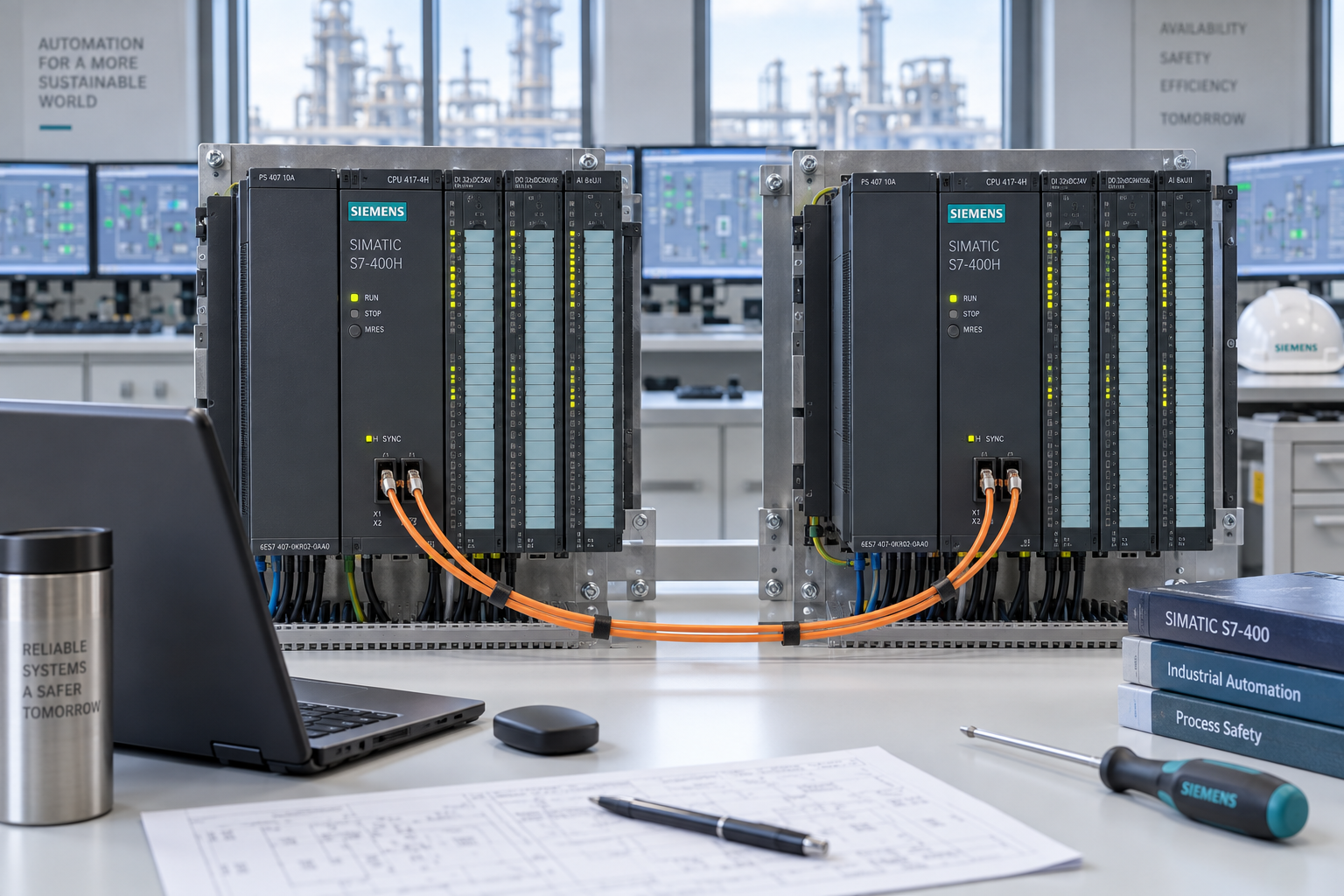
Redundancy changes the way a maintenance team should think about a legacy PLC. When one S7-400H CPU is active and the other is on standby, the plant may appear protected even though the synchronization path, backup CPU or diagnostic record has been neglected. A migration program can be the long-term answer, but it does not remove the need to keep the existing redundant system dependable during the planning period.
The recent industrial focus on lifecycle services, digital engineering and modernization makes this a practical issue for many plants. The question is not whether a new platform is attractive. It is whether the current safety and process functions can remain stable until the migration is engineered, tested and approved.
Define what redundancy actually covers
Begin with the system architecture. Record both CPU identities, rack positions, communication interfaces, synchronization cables, power supplies, remote I/O stations and the active/standby state. Identify which functions are truly bumpless and which still require operator action after a failover. Capture the normal diagnostic LEDs, event history and the time required for a controlled switchover.
Review the application backup and hardware configuration together. A project file without the hardware catalog, network parameters or documented retentive-data behavior is not a recovery package. Store the approved version with a date, owner and checksum. Photograph the rack and fiber routing so a replacement can be installed without guessing.
Protect the CPU and synchronization path
In an H system, a CPU replacement is only successful when the redundant pair can re-establish the expected state. Check power quality, rack contacts, communication modules and the synchronization path before declaring a processor failure. Inspect fiber connectors for contamination, sharp bends and strain. Confirm that the link diagnostics agree at both ends.
The Siemens CPU 417-4H processor should be matched to the installed hardware revision, application, memory arrangement and redundancy role. The spare must be evaluated with the commissioning procedure, not only by whether it powers up. Record how the site will load the project, establish the standby state and confirm the failover test.
The Siemens S7-400H fiber synchronization cable is equally important. A visually intact cable can still have a connector or attenuation problem. Keep the exact cable type, routing, bend-radius requirement and test method in the spare record.
Use migration planning to improve today’s spares
A migration plan should not be a reason to stop maintaining the existing system. It should make the current spare decision more intelligent. Identify the functions that will migrate first, the hardware that must remain until the cutover and the parts whose lead time could threaten the schedule. Do not consume the last tested CPU or synchronization link on a non-critical test without updating the risk register.
For each critical cabinet, create a bridge plan: minimum tested spare, recovery spare, configuration backup, temporary test method and planned migration milestone. If a new platform is already selected, document how the old system will be isolated and how the new system will be validated. The bridge plan helps procurement avoid buying quantities that will become stranded while still protecting production.
Test a replacement without creating a new outage
Bench testing should confirm power-up, diagnostics, communications and the ability to load the approved project or a controlled test project. For a redundant pair, test the synchronization and failover method in a safe environment where possible. Record what was not tested. A spare with a missing memory component, unknown firmware or unverified communication path should be labeled as a recovery candidate, not as outage-ready.
During the live replacement, use a permit and rollback plan. Freeze unrelated changes. Confirm the active CPU, isolate the correct rack and verify the standby state before the handover. After installation, check process values, alarms, remote I/O, historian data and the expected redundancy diagnostics. Have operations sign off before closing the work order.
Keep a short post-swap review in the lifecycle file. Record the failed symptom, the root cause confidence, the spare used, the test evidence and the next migration decision. This turns a one-time recovery into better information for the next outage and reduces the chance that the plant consumes its last bridge spare without noticing.
Questions maintenance teams usually ask
Does a migration project mean we can stop holding S7-400H spares?
No. Until the new system is commissioned and accepted, the existing H system remains a production dependency. The spare level can change, but it should be based on migration milestones and risk.
Is a CPU spare enough for an H system?
Not always. The synchronization path, power, rack contacts, memory and communication interfaces can also prevent a successful failover.
How should a synchronization cable be tested?
Inspect connectors and routing, verify continuity or approved optical test results, and confirm that the installed pair reports the expected synchronization state.
What belongs in a bridge spare plan?
Include tested hardware, backups, configuration ownership, recovery steps, temporary test arrangements, migration milestones and the point at which each spare can be retired.
Keep the bridge under control
S7-400H maintenance is not a choice between blind replacement and immediate modernization. A controlled bridge protects the plant while the engineering team does the harder work of migration. The most useful spare record connects the CPU, synchronization path, application backup and failover test.
For S7-400H CPU or synchronization-spare planning, send the rack photographs, part numbers, current diagnostics and migration timing to SiemensPLC. We can help verify the matching hardware and prepare a quotation that supports the bridge plan.
© 2026 SiemensPLC. All rights reserved. Official Website: https://siemensplc.com Inquiry: [email protected] | WhatsApp/Tel: +86 18359293191