ABB
RFQ Ready
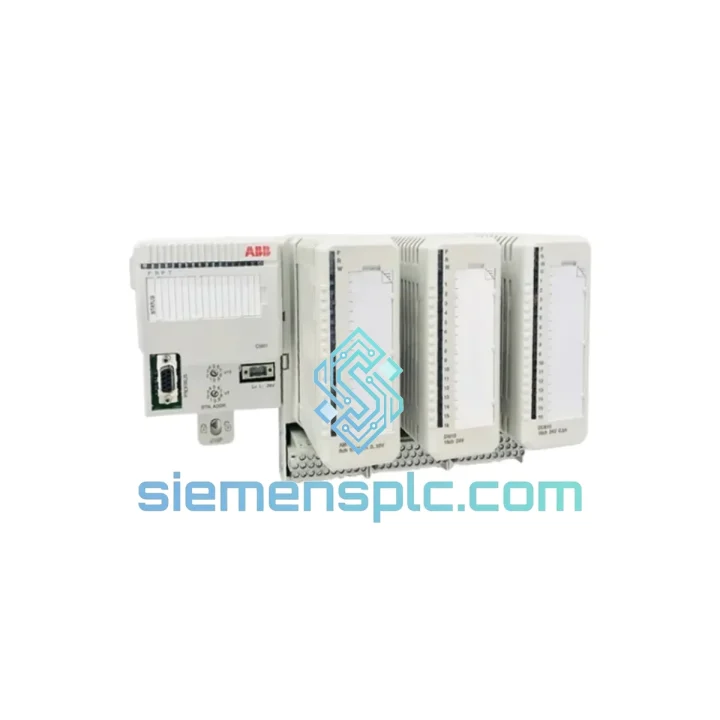
ABB HAC807B102 Analog Input Termination Unit – AC800M Series
AC800M
Origin SE
Analog Input Termination Unit
Request verified availability, condition, replacement risk review, packing options and courier lead time for TU890.
Click Request Quote and the part number is inserted into the inquiry form automatically.
Core fields for model confirmation and RFQ routing. Detailed product narrative remains below.
The ABB TU890 is a passive module termination unit (MTU) engineered as the structured field-wiring interface between ABB S800 I/O modules and process instrumentation cabling. Within an AC800M-based distributed control architecture, the TU890 occupies the termination layer of the I/O subsystem — the physical boundary where field signals transition from unshielded or shielded multi-core cables into the deterministic signal paths consumed by the controller’s I/O bus. Its role is not incidental; the integrity of every analog measurement and discrete command passing through an S800 rack depends on the mechanical and electrical quality of this termination point.
Unlike generic DIN-rail terminal blocks, the TU890 is designed with a keyed mechanical interface that accepts S800 I/O modules directly, establishing both the electrical connection and the physical retention of the module in a single mating action. This architecture eliminates the intermediate wiring harness that would otherwise be required between a generic terminal block and the module’s connector, reducing the number of resistance junctions in the signal path and improving long-term contact reliability in thermally cycled environments.
Real-time Stock & RFQ: [email protected] | WhatsApp: +86 18359268345
| Part Number | TU890 |
| Manufacturer | ABB Ltd. |
| Product Series | S800 I/O / AC800M |
| Function | Module Termination Unit (MTU) — passive field-wiring interface for S800 I/O modules |
| Mounting Standard | 35 mm DIN rail (EN 60715) |
| Field Terminal Type | Screw-clamp, cage-clamp compatible |
| Max. Conductor Cross-Section | 2.5 mm² (AWG 14) solid or stranded |
| Compatible I/O Modules | Full ABB S800 I/O range: AI810, AI820, AO810V2, DI810, DI811, DO810, DO814, and variants |
| Operating Temperature | 0 °C to +60 °C |
| Storage Temperature | −40 °C to +70 °C |
| Relative Humidity | 5–95 % RH, non-condensing (IEC 60068-2-78) |
| Degree of Protection | IP20 (IEC 60529), panel-mounted |
| Vibration Resistance | IEC 60068-2-6: 10–150 Hz, 1 g |
| Shock Resistance | IEC 60068-2-27: 15 g, 11 ms half-sine |
| Weight | Approx. 200 g |
| Certifications | CE, UL, cUL, RoHS compliant |
| Reference Document | ABB Datasheet 3BSE020924R1 |
| Warranty | 12 months from date of shipment |
The TU890’s hardware design reflects ABB’s approach to minimizing field-induced failure modes at the termination layer. Several architectural decisions are worth examining from an engineering standpoint:
Passive Signal Architecture: The TU890 contains no active electronics — no signal conditioning, no bus transceivers, no power regulation. This is a deliberate design choice. By keeping the termination unit passive, ABB ensures that the MTU itself introduces zero failure modes into the signal chain beyond contact resistance and mechanical wear. Mean time between failures (MTBF) for passive termination hardware in controlled panel environments routinely exceeds 20 years under IEC 61709 stress models.
Keyed Module Interface: The mechanical keying between the TU890 and S800 I/O modules prevents incorrect module insertion — a critical safeguard in multi-module racks where AI, AO, DI, and DO modules may be physically adjacent. Incorrect module seating in an unkeyed system can result in signal cross-connection or, in worst cases, voltage application to current-input circuits. The TU890’s keying geometry eliminates this failure mode at the hardware level without requiring software interlocks.
EMC Design Considerations: The screw-clamp terminal arrangement on the TU890 supports cable shield termination directly at the field terminal, allowing shield grounding at the panel entry point per IEC 61000-5-2 recommendations. Proper shield termination at the MTU level is the primary defense against common-mode noise injection into analog input channels — particularly relevant in environments with variable-frequency drives, high-current switchgear, or RF-emitting equipment in proximity to the control cabinet.
Hot-Swap Module Replacement: Because field wiring terminates to the TU890 rather than directly to the I/O module, the S800 module can be extracted and replaced without disturbing field connections. This hot-swap capability is not merely a convenience feature — in continuous process industries, it is a maintenance architecture requirement. The TU890 enables module replacement within a planned maintenance window without requiring loop isolation, field cable disconnection, or re-termination verification, all of which introduce re-commissioning risk.
Thermal Cycling Tolerance: Screw-clamp terminals on the TU890 maintain consistent contact force across the operating temperature range (0–60 °C). In contrast, spring-clamp designs can exhibit contact force variation with thermal cycling, particularly with aluminum conductors. The screw-clamp design is the preferred choice for high-vibration or thermally dynamic environments such as compressor buildings, turbine halls, and marine engine rooms.
Every ABB TU890 unit supplied through siemensplc.com is sourced as genuine ABB original hardware. Our procurement network draws from authorized ABB distribution channels, decommissioned plant inventories with full traceability documentation, and verified secondary-market sources subject to incoming inspection protocols.
Incoming Inspection Process: Each unit undergoes visual inspection for label authenticity (ABB part number, date code, country of origin markings), connector and terminal condition assessment, housing integrity check, and where applicable, functional verification against a reference S800 I/O module.
Packaging & Preservation: Units are packed in anti-static bags with desiccant sachets, placed in foam-lined cartons rated for international air and sea freight. Packaging meets ISTA 2A transit testing standards for fragile industrial electronics.
Logistics from Xiamen, China: Our warehouse and logistics operations are based in Xiamen, Fujian Province — a major international trade hub with direct access to Xiamen Gaoqi International Airport and Xiamen Port. Standard international shipments are dispatched via DHL Express, FedEx International Priority, or UPS Worldwide Expedited, with typical transit times of 3–7 business days to Europe, North America, Southeast Asia, and the Middle East. Sea freight consolidation is available for large-volume orders. All shipments include commercial invoice, packing list, and HS code documentation (HS: 8537.10) to support customs clearance in destination countries.
Warranty: 12 months from date of shipment. Defective units are replaced or credited subject to inspection. RMA process is initiated within 24 hours of defect notification.
Email: [email protected]
WhatsApp: +86 18359268345
Web: siemensplc.com
Location: Xiamen, China
© 2026 siemensplc.com. All rights reserved.
We check the full part number, brand, series and visible nameplate information before quotation.
Sales confirms stock path, condition option, quantity and realistic lead time for export dispatch.
DHL, FedEx, UPS or buyer courier arrangements can be reviewed with packing requirements.
Similar brand or category products for fast comparison and multi-item RFQ lists.