Allen-Bradley
RFQ Ready
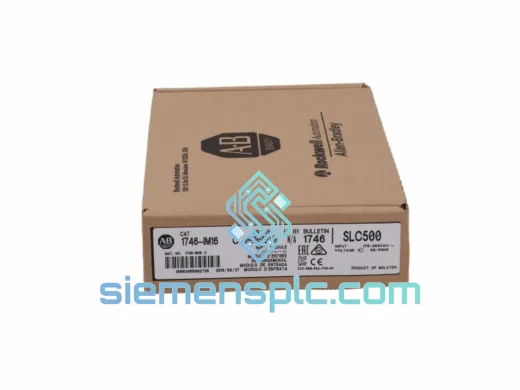
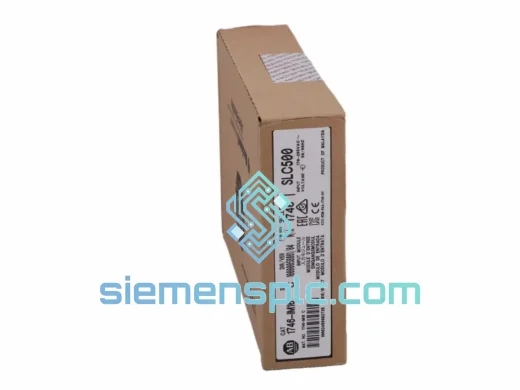
Allen-Bradley DIM16 Discrete Input Module
SLC 500
Origin US
Discrete Input Module
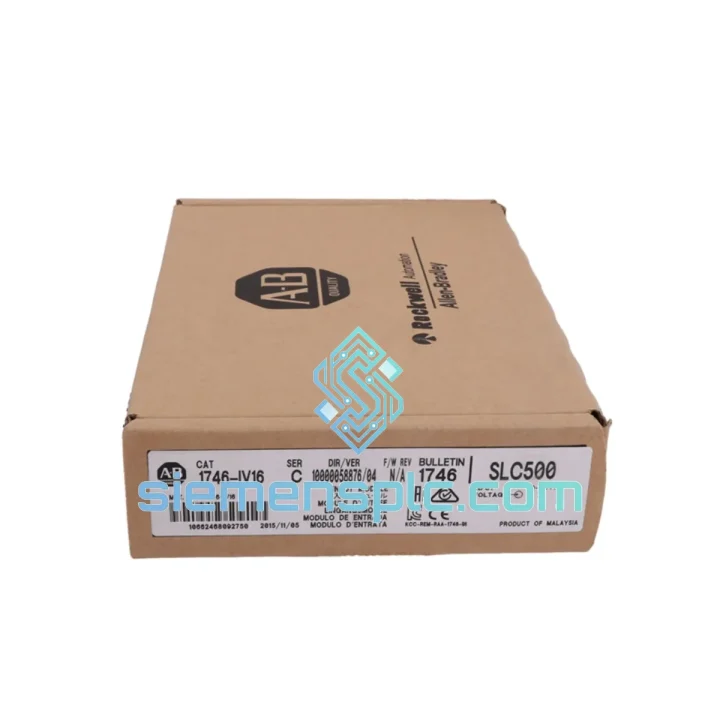
Request verified availability, condition, replacement risk review, packing options and courier lead time for 1746-IV16.
Click Request Quote and the part number is inserted into the inquiry form automatically.
Core fields for model confirmation and RFQ routing. Detailed product narrative remains below.
The 1746-IV16 occupies a single slot in any SLC 500 modular or fixed chassis and delivers 16 independently monitored 24VDC sourcing discrete input channels to the processor’s input image table. Its role in the control loop is unambiguous: it is the boundary layer between the physical plant — proximity sensors, limit switches, push-buttons, relay dry contacts — and the deterministic scan cycle of the SLC 5/01 through 5/05 processor. Every rung of ladder logic that reads a field device status depends on the accuracy and noise immunity of this module. Signal corruption at this layer propagates directly into false permissives, missed interlocks, and erroneous E-stop conditions. The 1746-IV16 addresses this with a 1500V AC optical isolation barrier, a 1ms hardware input filter, and per-point LED status indicators that allow field-level fault isolation without connecting a programming terminal.
The module’s 16 input points are organized into two groups of 8, each with an isolated common terminal. This dual-group architecture allows two independent 24VDC field power sources to feed the module simultaneously — a practical requirement in safety-segmented panels where E-stop circuits and standard I/O circuits must share a single chassis slot without sharing a common return path. Input current draw is 6mA per point at 24VDC nominal, keeping the aggregate backplane 5VDC draw at 50mA — a figure that allows a fully populated 1746-A13 chassis to remain within the 1746-P2 power supply’s 4A budget even with mixed analog and discrete I/O configurations.
In automotive body welding cells, the module operates adjacent to medium-frequency inverter welding equipment generating transient voltages exceeding 600V peak on field wiring. The 1500V isolation rating and the hardware input filter suppress these transients before they reach the backplane, maintaining the integrity of weld-gun home-position and clamp-confirmation signals that feed safety interlock rungs. In food and beverage packaging lines running at 200–600 units per minute, the 1ms filter time is short enough to capture high-speed photoeye pulses without missing events, while still rejecting contact-bounce artifacts from mechanical limit switches. In pharmaceutical batch processing environments, the module’s deterministic hardware filtering eliminates the scan-cycle jitter that software-filtered inputs introduce — a requirement for 21 CFR Part 11 compliant event timestamping in FactoryTalk Historian.
The removable terminal block (RTB) wiring interface accepts 22–14 AWG conductors and separates from the module body without disturbing field wiring, reducing replacement time during maintenance windows to under three minutes. Hardware slot keying prevents incorrect module insertion during chassis reconfiguration — a critical safeguard in multi-module racks where a 24VDC input module and a 120VAC input module may occupy adjacent slots. The module is UL Listed, CE Marked, CSA Certified, and RCM Marked, satisfying the certification matrix required for installations across North America, the European Union, and the Asia-Pacific region.
Real-time Stock & RFQ: [email protected] | WhatsApp: +86 18359268345
| Catalog Number | 1746-IV16 |
| Platform | SLC 500 (Fixed & Modular Chassis) |
| Number of Input Points | 16 (2 groups of 8, isolated commons) |
| Input Signal Type | Sourcing (PNP field device compatible) |
| Nominal Input Voltage | 24V DC |
| Input Voltage Range | 10–30V DC |
| ON-State Voltage Threshold | ≥ 10V DC |
| OFF-State Voltage Threshold | ≤ 5V DC |
| Input Current per Point (ON) | 6 mA @ 24V DC |
| Hardware Input Filter Time | 1 ms |
| Field-to-Backplane Isolation | 1500V AC |
| Backplane Current Draw | 50 mA @ 5V DC |
| Operating Temperature | 0°C to +60°C (32°F to 140°F) |
| Storage Temperature | -40°C to +85°C |
| Relative Humidity | 5–95% non-condensing |
| Status Indicators | 16 × per-point green LED |
| Wiring Interface | Removable Terminal Block (RTB), 22–14 AWG |
| Slot Keying | Hardware keyed (prevents wrong-slot insertion) |
| Approximate Weight | 400 g |
| Certifications | UL Listed, CE Marked, CSA Certified, RCM |
| Warranty | 12 months from date of shipment |
Optical Isolation Architecture: Each of the 16 input channels passes through a dedicated optocoupler. The LED side of the optocoupler is driven by the field device’s 24VDC sourcing output through a current-limiting resistor network that maintains 6mA forward current across the full 10–30VDC input range. The phototransistor side drives the backplane logic directly. This discrete-per-channel isolation topology means a field wiring fault — including a dead short to chassis ground — on any single input point cannot propagate to adjacent channels or to the backplane 5VDC rail. The 1500V AC withstand rating between field terminals and backplane is validated per IEC 61131-2 Section 6.4 dielectric strength requirements.
Input Filter and Debounce Logic: The 1ms hardware RC filter on each input channel is implemented at the analog front end, before the optocoupler. This placement is deliberate: it attenuates high-frequency transients — including those generated by inductive load switching, variable-frequency drive PWM carrier frequencies (typically 2–16 kHz), and weld inverter arc-initiation spikes — before they can forward-bias the optocoupler LED and generate false ON transitions. Contact bounce from mechanical limit switches, which typically produces 0.5–5ms of chatter, is fully suppressed. The filter does not introduce scan-cycle dependency; its time constant is fixed in hardware and independent of the SLC processor’s scan time.
Dual-Group Common Architecture: The 16 inputs are divided into two groups of 8 (Group A: inputs 0–7; Group B: inputs 8–15), each with an independent common terminal. The two commons are isolated from each other on the module’s internal PCB. This allows the installer to connect Group A to a 24VDC safety-rated power supply feeding E-stop and interlock circuits, and Group B to a standard 24VDC I/O supply feeding process sensors — within a single chassis slot, without cross-contamination of the two power domains. This architecture directly supports IEC 62061 and ISO 13849 safety circuit segregation requirements without requiring a second chassis slot.
EMC Design and Backplane Interface: The module’s PCB layout routes field-side traces and backplane-side traces on separate copper layers with a ground plane between them, providing additional high-frequency isolation beyond the optocoupler’s rated withstand voltage. The backplane connector interface conforms to the SLC 500 parallel backplane specification: the module presents its 16 input bits to the processor’s input image table at word address I:s.0 (where s is the slot number), with bits 0–15 mapping directly to input points 0–15. No configuration is required in RSLogix 500 beyond assigning the slot — the module is auto-detected by the SLC processor during the I/O configuration scan.
Every 1746-IV16 unit shipped from our Xiamen, China facility undergoes a structured four-stage inspection protocol before release. Stage one covers physical and visual examination: housing integrity, terminal block condition, label legibility, series letter verification, and hardware keying confirmation against Allen-Bradley factory specifications. Stage two is functional bench testing: each of the 16 input points is activated with a calibrated 24VDC test signal, LED indicator response is verified, and backplane communication is confirmed using a live SLC 500 test rack running RSLogix 500. Stage three is isolation testing: field-to-backplane isolation resistance is measured at 500VDC DC hipot; the minimum acceptable result is 100MΩ per IEC 61131-2 requirements. Stage four is revision and firmware documentation: the series letter and hardware revision are recorded and cross-referenced against the Rockwell Automation product compatibility matrix to confirm the unit is suitable for the customer’s target SLC processor firmware version.
Documentation available upon request includes: per-point functional test report, six-face product photographs, series and revision label close-up, certificate of conformance, and Rockwell Automation product lifecycle status confirmation. All units are shipped with 12-month warranty coverage from the date of shipment.
Logistics from Xiamen operate via DHL Express, FedEx International Priority, and UPS Worldwide Expedited for time-critical orders. Standard transit times are 3–5 business days to North America and Western Europe, 2–4 business days to Southeast Asia and the Middle East, and 1–2 business days to Hong Kong, Taiwan, and South Korea. Sea freight consolidation is available for orders exceeding 20kg. Full export documentation — commercial invoice, packing list, certificate of origin, and HS code 8538.90 classification — is included with every shipment. Import duty pre-calculation assistance is available for EU DAP/DDP terms upon request.
Email: [email protected]
WhatsApp: +86 18359268345
Web: siemensplc.com
Location: Xiamen, China
© 2026 siemensplc.com. All rights reserved.
We check the full part number, brand, series and visible nameplate information before quotation.
Sales confirms stock path, condition option, quantity and realistic lead time for export dispatch.
DHL, FedEx, UPS or buyer courier arrangements can be reviewed with packing requirements.
Similar brand or category products for fast comparison and multi-item RFQ lists.