Allen-Bradley
RFQ Ready
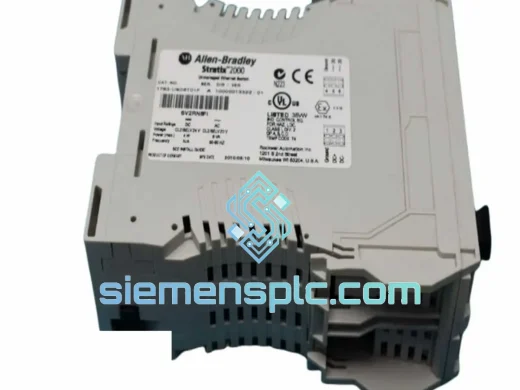
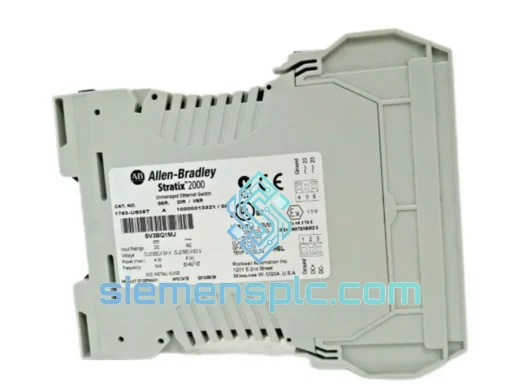
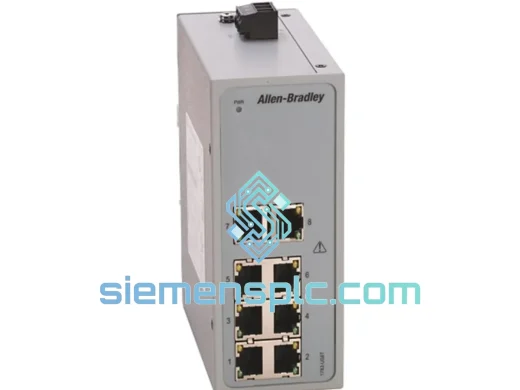
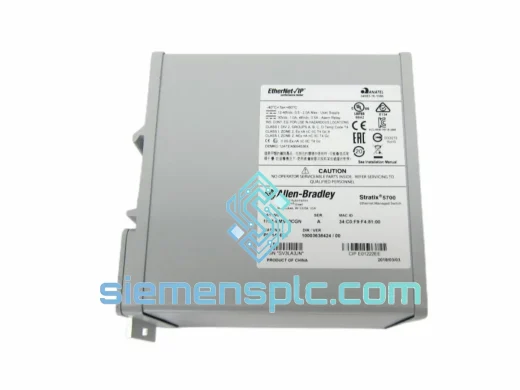
Allen-Bradley 1783-BMS10CGN Industrial Ethernet Switch – Stratix 2000
Stratix
Origin US
Industrial Ethernet Switch
Request verified availability, condition, replacement risk review, packing options and courier lead time for 1783-BMS20CGL.
Click Request Quote and the part number is inserted into the inquiry form automatically.
Core fields for model confirmation and RFQ routing. Detailed product narrative remains below.
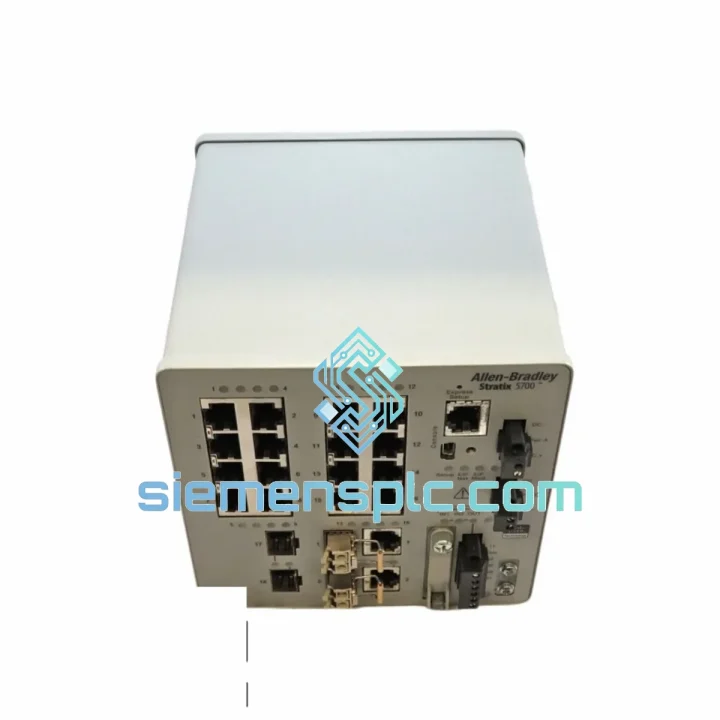
The Allen-Bradley 1783-BMS20CGL is a Layer 2 managed industrial Ethernet switch belonging to the Stratix 5700 platform — a product line co-developed by Rockwell Automation and Cisco Systems on a hardened IOS firmware base. Within a control loop architecture, this switch functions as the primary network convergence point between field-level I/O devices, motion controllers, and supervisory systems. Its 20-port configuration — 16 × 10/100BASE-TX copper ports plus 4 × 100BASE-FX fiber uplinks (LC duplex) — allows simultaneous copper-based device connections at the cell level while maintaining fiber-based ring or star uplinks to the plant backbone, eliminating the need for a separate media converter layer.
In EtherNet/IP architectures governed by CIP (Common Industrial Protocol), the switch’s hardware-level IEEE 1588 v2 Precision Time Protocol (PTP) implementation is architecturally significant. Unlike software-based timestamping, which introduces jitter proportional to CPU load, the 1783-BMS20CGL performs ingress and egress timestamping at the ASIC level. This yields synchronization accuracy in the sub-microsecond range — a prerequisite for coordinated multi-axis motion control systems where inter-drive timing tolerances are measured in tens of microseconds. The switch operates as a PTP Boundary Clock, absorbing grandmaster timing from an upstream source and redistributing it to downstream CIP Motion devices without accumulating cascaded jitter.
The Resilient Ethernet Protocol (REP) implementation provides ring-topology redundancy with a documented failover time of under 50 milliseconds — a figure that falls within the acceptable recovery window for most continuous process control applications. REP operates at Layer 2 without requiring spanning tree convergence delays, making it preferable to RSTP in latency-sensitive environments. The switch supports both REP and RSTP simultaneously, allowing mixed-topology deployments during phased network migrations.
Real-time Stock & RFQ: [email protected] | WhatsApp: +86 18359268345
| Parameter | Specification |
|---|---|
| Part Number | 1783-BMS20CGL |
| Brand | Allen-Bradley (Rockwell Automation) |
| Series | Stratix 5700 |
| Switch Architecture | Layer 2 Managed |
| Total Ports | 20 |
| Copper Ports | 16 × 10/100BASE-TX (RJ-45, auto-MDI/MDIX) |
| Fiber Uplink Ports | 4 × 100BASE-FX (LC duplex, multimode) |
| Switching Fabric | 4.8 Gbps non-blocking |
| Forwarding Rate | 3.57 Mpps |
| MAC Address Table | 8,000 entries |
| VLAN Support | IEEE 802.1Q, up to 255 active VLANs |
| QoS | IEEE 802.1p (CoS), DiffServ (DSCP), 4 egress queues per port |
| Redundancy Protocols | REP (Resilient Ethernet Protocol), RSTP (IEEE 802.1w), STP (IEEE 802.1d) |
| Time Synchronization | IEEE 1588 v2 PTP (hardware timestamping), Boundary Clock mode |
| IGMP Snooping | v1 / v2 / v3 |
| Multicast Groups | Up to 255 |
| Security | IEEE 802.1X port authentication, ACLs, port security, DHCP snooping |
| Management | SNMP v1/v2c/v3, Telnet, SSH v2, HTTP/HTTPS, RMON |
| Input Voltage | 18–30 VDC (nominal 24 VDC) |
| Power Consumption | ≤ 30 W (fully loaded) |
| Operating Temperature | 0 °C to +60 °C |
| Storage Temperature | -40 °C to +85 °C |
| Relative Humidity | 5% to 95% non-condensing |
| Enclosure Rating | IP30 |
| Mounting | DIN-rail (EN 50022 35 mm) |
| Dimensions (W×H×D) | Approx. 45 × 130 × 110 mm |
| Weight | Approx. 1.7 kg |
| Firmware Base | Cisco IOS (Rockwell-customized, AOP-enabled) |
| Certifications | UL 508, CE, cUL, FCC Class A, ATEX Zone 2 / Class I Div 2 |
| Warranty | 12 months (siemensplc.com) |
ASIC-Level Packet Processing and Store-and-Forward Architecture: The 1783-BMS20CGL employs a store-and-forward switching mechanism at the ASIC layer. Each incoming frame is fully received and its CRC verified before forwarding — a design choice that eliminates corrupted frame propagation across the control network. In industrial environments where a single malformed EtherNet/IP packet can trigger a controller fault, this error containment behavior is operationally significant. The non-blocking 4.8 Gbps switching fabric ensures that even under simultaneous full-duplex traffic on all 20 ports, no internal congestion occurs.
EMC Design and Conducted Noise Immunity: The switch’s power input stage incorporates transient voltage suppression (TVS) diodes and common-mode chokes rated to withstand IEC 61000-4-4 electrical fast transient (EFT) bursts at 2 kV and IEC 61000-4-5 surge immunity at 1 kV line-to-line. The chassis ground connection via DIN-rail clip provides a low-impedance path for capacitively coupled high-frequency noise, reducing susceptibility to variable-frequency drive (VFD) switching harmonics — a common interference source in motor control panels. The fiber uplink ports provide galvanic isolation between network segments, breaking ground loops that would otherwise introduce common-mode noise into copper-connected devices.
IGMP Snooping and Multicast Traffic Management: EtherNet/IP implicit messaging (Class 1 connections) relies on UDP multicast for I/O data distribution. Without IGMP snooping, multicast frames flood all ports, consuming bandwidth on devices that are not subscribers. The 1783-BMS20CGL’s IGMP v3 snooping engine maintains a per-port group membership table, forwarding multicast streams only to ports with active listeners. This is particularly relevant in motion control cells where multiple drives subscribe to a single controller’s output assembly — the switch ensures each drive receives only its addressed data without saturating unrelated ports.
QoS Queue Architecture: Each port implements four weighted round-robin (WRR) egress queues. CIP Sync PTP event messages are mapped to the highest-priority queue (queue 4) via DSCP EF (Expedited Forwarding, DSCP 46) or CoS 7 markings, ensuring timestamping frames are never delayed behind bulk data traffic. Implicit I/O messages are typically mapped to queue 3, while explicit messaging (Class 3 CIP) occupies queue 2. This hierarchical queuing structure maintains deterministic latency for time-critical traffic even when the network is under load from HMI data polling or historian uploads.
Every Allen-Bradley 1783-BMS20CGL unit supplied by siemensplc.com is sourced as genuine Rockwell Automation product. Units undergo a structured pre-shipment verification process: physical label inspection against Rockwell’s published part number format, firmware version confirmation via console boot log, and a 30-minute powered functional test covering port link negotiation, VLAN configuration write/read, and SNMP reachability. Serial numbers are logged and cross-referenced with available Rockwell product databases prior to dispatch.
Packaging follows ESD-safe protocols: anti-static poly bags, foam-lined cartons, and moisture-barrier desiccant packs for sea freight shipments. All units are shipped from our warehouse in Xiamen, China — a logistics hub with direct access to DHL Express, FedEx International Priority, and UPS Worldwide Expedited services. Standard air freight transit times are 3–5 business days to Europe, 4–6 days to North America, and 2–3 days to Southeast Asia. For urgent plant-down situations, same-day dispatch is available for in-stock units when orders are confirmed before 14:00 CST. Bulk orders exceeding 10 units can be consolidated for sea freight via Xiamen Port, with full export documentation including commercial invoice, packing list, and certificate of origin.
A 12-month warranty covers all shipped units against manufacturing defects and functional failure under normal operating conditions. Warranty claims are processed within 5 business days of receipt of the returned unit. Extended warranty and on-site technical support contracts are available upon request.
Email: [email protected]
WhatsApp: +86 18359268345
Web: siemensplc.com
Location: Xiamen, China
© 2026 siemensplc.com. All rights reserved.
We check the full part number, brand, series and visible nameplate information before quotation.
Sales confirms stock path, condition option, quantity and realistic lead time for export dispatch.
DHL, FedEx, UPS or buyer courier arrangements can be reviewed with packing requirements.
Similar brand or category products for fast comparison and multi-item RFQ lists.