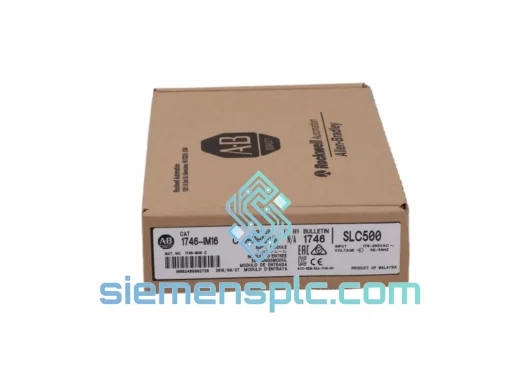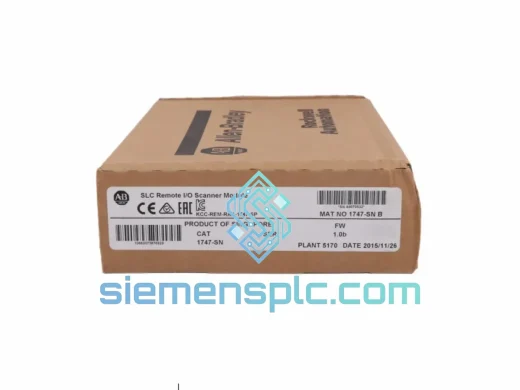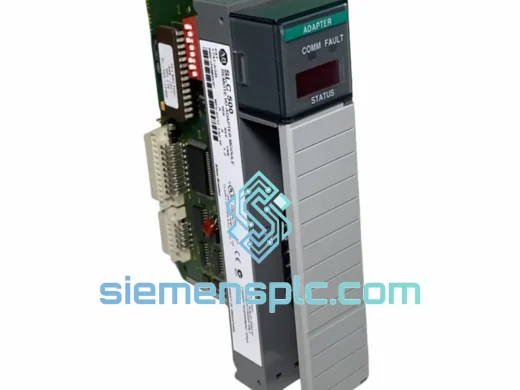
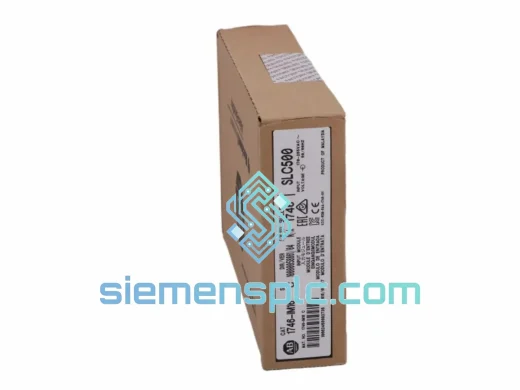
Allen-Bradley
RFQ Ready
Allen-Bradley DIM16 Discrete Input Module
SLC 500
Origin US
Discrete Input Module
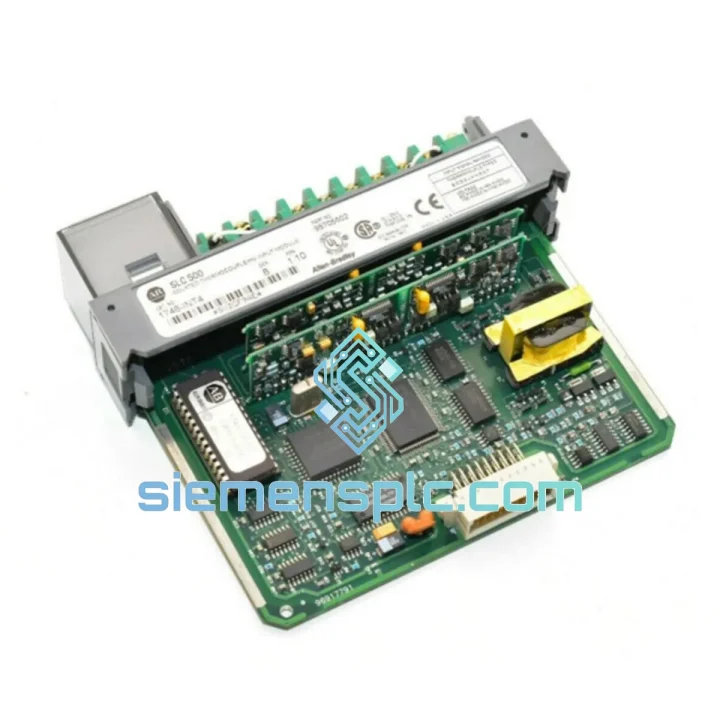
Request verified availability, condition, replacement risk review, packing options and courier lead time for 1746-INT4.
Click Request Quote and the part number is inserted into the inquiry form automatically.
Core fields for model confirmation and RFQ routing. Detailed product narrative remains below.
The Allen-Bradley 1746-INT4 is a dedicated thermocouple signal acquisition module engineered for the SLC 500 programmable controller platform. Occupying a single I/O slot in any standard SLC 500 chassis, it converts millivolt-level thermocouple signals from four independent channels into 16-bit integer data words accessible directly by the SLC processor via the backplane. Its role in a control loop is unambiguous: it is the thermal boundary between the physical process and the digital control domain, and the fidelity of that boundary determines the accuracy of every temperature-dependent control decision downstream.
Unlike general-purpose analog input modules that require external signal conditioners or transmitters, the 1746-INT4 integrates cold junction compensation, linearization, and open-wire detection on-board. This consolidation reduces panel footprint, eliminates inter-device wiring errors, and shortens commissioning time on temperature-critical installations.
Real-time Stock & RFQ: [email protected] | WhatsApp: +86 18359268345
| Parameter | Specification |
|---|---|
| Part Number | 1746-INT4 |
| Platform | Allen-Bradley SLC 500 |
| Number of Input Channels | 4 (individually isolated) |
| Supported Thermocouple Types | J, K, E, T, R, S, B, N |
| Input Voltage Range | −12 mV to +78 mV (type-dependent) |
| Resolution | 16-bit (0.1 °C / 0.1 °F selectable) |
| Measurement Accuracy | ±1 °C typical (type and range dependent) |
| Cold Junction Compensation | Automatic, internal thermistor-based |
| Input Impedance | >1 MΩ per channel |
| Channel-to-Channel Isolation | Yes — optical isolation barrier per channel |
| Channel-to-Backplane Isolation | Yes |
| Open-Wire Detection | Yes — flags in data file word |
| Backplane Current Draw (5 VDC) | 150 mA |
| Backplane Current Draw (24 VDC) | 0 mA (no 24 V backplane draw) |
| Operating Temperature | 0 °C to +60 °C (32 °F to 140 °F) |
| Storage Temperature | −40 °C to +85 °C |
| Relative Humidity | 5% to 95% non-condensing |
| Channel Scan / Update Rate | ~160–320 ms (all 4 channels, filter-dependent) |
| Module Weight | Approx. 400 g |
| Certifications | UL 508, CE (EMC + LVD), CSA C22.2 No.142, RoHS |
| Warranty | 12 months against manufacturing defects |
The 1746-INT4 is built around a differential input front-end with a common-mode rejection ratio (CMRR) exceeding 120 dB at 50/60 Hz. This specification is not incidental — in industrial environments where thermocouple leads run parallel to power cables, motor drives, and inductive loads, common-mode noise induced on the signal pair can easily reach hundreds of millivolts. The module’s front-end rejects this noise before it reaches the analog-to-digital conversion stage, preserving measurement integrity without requiring shielded conduit on every thermocouple run.
Each of the four channels is galvanically isolated from the others and from the SLC backplane using an optical isolation barrier. The isolation voltage rating ensures that ground potential differences between sensor mounting points — a common occurrence in large furnaces, boilers, and multi-zone kilns — do not create ground loop currents that would otherwise introduce a DC offset error into the measurement. This per-channel isolation architecture is a deliberate hardware design choice that distinguishes the 1746-INT4 from lower-cost modules that share a common ground reference across all channels.
Cold junction compensation is performed by an on-board thermistor mounted at the terminal block. The thermistor continuously measures the ambient temperature at the point where the thermocouple wire terminates, and the module’s signal processor applies the appropriate Seebeck coefficient correction in real time. This eliminates the need for isothermal terminal blocks or external reference junction compensation circuits, reducing both BOM cost and wiring complexity.
The linearization algorithm is implemented in firmware and covers all eight supported thermocouple types (J, K, E, T, R, S, B, N) per IEC 60584 reference tables. The output data word presented to the SLC processor is already a linearized temperature value in engineering units — the ladder logic program does not need to perform any polynomial correction, which reduces scan time overhead and simplifies program validation.
EMC hardening is achieved through a combination of hardware filtering on the input lines, a low-pass anti-aliasing filter ahead of the ADC, and the optical isolation barriers that break conducted interference paths. The module meets the immunity requirements of IEC 61000-4-2 (ESD), IEC 61000-4-4 (EFT/Burst), and IEC 61000-4-6 (conducted RF), making it suitable for installation in cabinets adjacent to variable-frequency drives and contactors without additional shielding measures.
Every 1746-INT4 unit dispatched from our Xiamen, China facility is sourced from verified supply channels and subjected to a structured pre-shipment inspection protocol. Visual examination covers connector pin condition, label authenticity against OEM reference markings, housing integrity, and the absence of rework indicators. Where bench test infrastructure is available, modules are powered and channel response is verified against known reference inputs prior to packaging.
Traceability documentation — including sourcing chain records and batch references — is maintained for each unit and can be provided upon request to support regulated procurement processes in pharmaceutical, aerospace, and defense supply chains.
Packaging follows ESD-safe handling standards: anti-static bags, foam-lined cartons with corner protection, and moisture-barrier sealing for ocean freight shipments. Commercial invoices, packing lists, and certificates of conformance are prepared to facilitate customs clearance in all major import jurisdictions including the EU, USA, Australia, and Southeast Asia.
Logistics from Xiamen port connects to DHL Express, FedEx International Priority, and UPS Worldwide Expedited services, with typical transit times of 3–5 business days to Europe and North America. For volume orders, sea freight consolidation via Xiamen port is available with full container load (FCL) and less-than-container load (LCL) options. All shipments include tracking numbers issued at the time of dispatch.
A 12-month warranty covers manufacturing defects in materials and workmanship. Warranty claims are processed with replacement dispatch within 5 business days of confirmed fault verification. Units under warranty claim are returned to our Xiamen facility for inspection; return shipping costs are covered for confirmed warranty cases.
Email: [email protected]
WhatsApp: +86 18359268345
Web: siemensplc.com
Location: Xiamen, China
© 2026 siemensplc.com. All rights reserved.
We check the full part number, brand, series and visible nameplate information before quotation.
Sales confirms stock path, condition option, quantity and realistic lead time for export dispatch.
DHL, FedEx, UPS or buyer courier arrangements can be reviewed with packing requirements.
Similar brand or category products for fast comparison and multi-item RFQ lists.