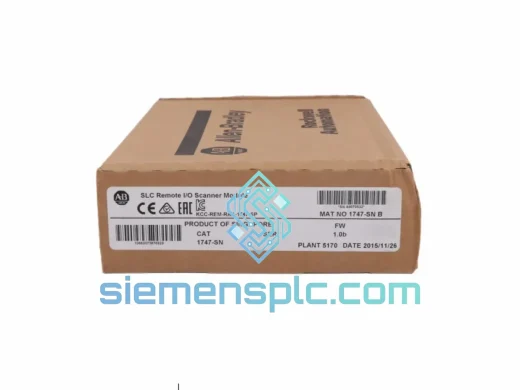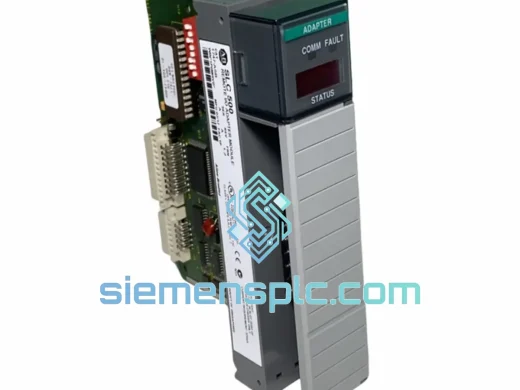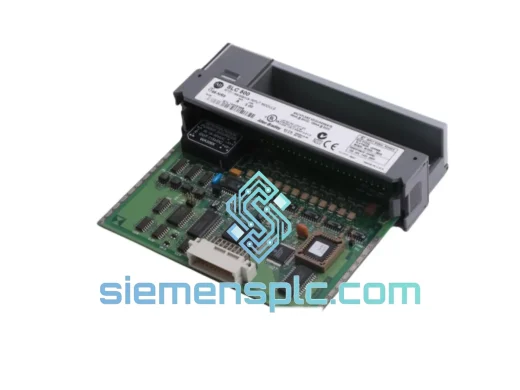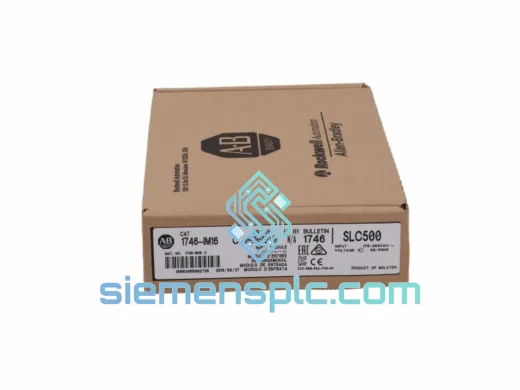
Allen-Bradley
RFQ Ready
Allen-Bradley AIM16 PLC Input Module – SLC 500 Series
SLC 500
Origin US
PLC Input Module
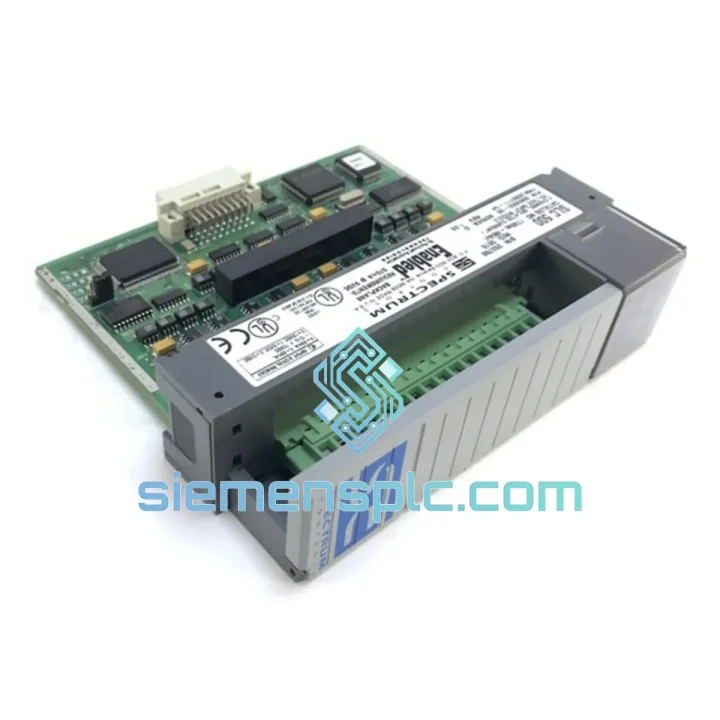
Request verified availability, condition, replacement risk review, packing options and courier lead time for 1746SC-INI4VI.
Click Request Quote and the part number is inserted into the inquiry form automatically.
Core fields for model confirmation and RFQ routing. Detailed product narrative remains below.
The 1746SC-INI4VI occupies a structurally distinct position within the SLC 500 analog I/O family. Unlike standard non-isolated modules that share a common analog reference plane, this module implements per-channel galvanic isolation — each of its four input channels maintains an independent isolation barrier rated to withstand channel-to-channel and channel-to-backplane voltage differentials. This architecture directly addresses one of the most persistent failure modes in industrial analog signal acquisition: ground potential differences between field instruments and the control chassis.
In a typical process plant, 4–20 mA transmitters installed on pressure vessels, heat exchangers, or pipeline segments are grounded at their physical location. When those ground potentials differ from the PLC chassis ground by even a few volts, non-isolated input modules introduce common-mode error currents that corrupt ADC readings and, over time, degrade input circuitry. The 1746SC-INI4VI eliminates this failure vector entirely. Each channel’s isolation barrier — implemented via optocoupler or transformer-coupled front-end circuitry — blocks DC and low-frequency common-mode voltages while passing the differential signal of interest to the 16-bit ADC stage.
The module accepts both current (4–20 mA) and voltage (0–10 VDC, ±10 VDC) inputs on a per-channel basis, configurable via RSLogix 500 channel configuration words. This dual-mode capability allows a single module slot to serve mixed sensor populations — a pressure transmitter on channel 0 (current mode), a potentiometer feedback on channel 1 (voltage mode) — without requiring separate module types or additional chassis slots.
📩 Real-time Stock & RFQ: [email protected] | WhatsApp: +86 18359268345
| Manufacturer | Allen-Bradley (Rockwell Automation) |
| Part Number | 1746SC-INI4VI |
| Platform | SLC 500 |
| Module Classification | Isolated Analog Input |
| Number of Input Channels | 4 (individually isolated) |
| Input Modes | Current: 4–20 mA; Voltage: 0–10 VDC, ±10 VDC (per channel) |
| ADC Resolution | 16-bit |
| Input Impedance (Voltage Mode) | > 1 MΩ |
| Input Impedance (Current Mode) | 250 Ω (burden resistor) |
| Channel-to-Channel Isolation | Yes — galvanic, full DC isolation |
| Channel-to-Backplane Isolation | Yes |
| Backplane Current Consumption | 250 mA @ 5 VDC |
| Operating Temperature | 0 °C to +60 °C |
| Storage Temperature | −40 °C to +85 °C |
| Relative Humidity | 5% to 95% non-condensing |
| Chassis Slot Requirement | 1 slot (SLC 500 I/O chassis) |
| Compatible Chassis | 1746-A4, 1746-A7, 1746-A10, 1746-A13 |
| Compatible Processors | SLC 5/01, 5/02, 5/03, 5/04, 5/05 |
| Programming Software | RSLogix 500 (v7.0+) |
| Certifications | UL, cUL, CE (EMC Directive 2014/30/EU) |
| Country of Origin | United States |
| Warranty | 12 months from date of shipment |
The 1746SC-INI4VI’s signal chain begins at the field terminal block, where each channel’s input pair feeds into a dedicated front-end conditioning stage. In current mode, the 250 Ω precision burden resistor converts the 4–20 mA loop current into a 1–5 VDC differential voltage before the isolation stage. In voltage mode, a high-impedance differential amplifier buffers the input directly. Both paths then pass through the isolation barrier — a transformer-coupled or optocoupler-based stage depending on revision — which provides the galvanic break between field wiring and the module’s digital processing domain.
Post-isolation, the conditioned signal enters a 16-bit successive-approximation register (SAR) ADC. At 16-bit resolution, the module resolves the 4–20 mA span into 65,536 discrete counts, yielding a theoretical resolution of approximately 0.244 µA per count — sufficient for high-precision process variables such as differential pressure across an orifice plate or pH electrode output. The ADC output is latched into the SLC 500 input image table at each I/O scan cycle, with the processor reading the scaled integer value directly from the input file (I:x.y format).
EMC performance is addressed at the hardware level through several design measures. The module’s PCB layout isolates analog and digital ground planes, with the isolation barrier forming the physical boundary between domains. Ferrite beads on the backplane interface lines suppress high-frequency noise injected from adjacent digital modules. The terminal block wiring accepts shielded twisted-pair cable, and the module’s input circuitry is designed to reject common-mode noise up to the isolation voltage rating — a critical parameter in environments with variable-frequency drives (VFDs) or large motor starters operating in proximity to the control panel.
The module does not implement onboard signal filtering beyond the ADC’s inherent anti-aliasing characteristics, which means the engineer retains full control over digital filtering strategy within RSLogix 500 — whether a simple moving average, first-order IIR filter, or deadband logic applied in ladder code. This design philosophy preserves determinism: the module delivers raw, high-resolution data to the processor, and the control program applies application-specific signal conditioning without hardware-imposed latency.
Every 1746SC-INI4VI unit supplied through siemensplc.com is sourced from verified industrial distribution channels and undergoes a structured pre-shipment inspection protocol. Physical authenticity checks include label verification, date code cross-referencing against manufacturer production records, and housing condition assessment against OEM reference standards. Where feasible, functional bench testing confirms power-on behavior and signal-path continuity prior to packaging.
Units are dispatched from our Xiamen, China operations center using anti-static, moisture-barrier packaging compliant with JEDEC J-STD-033 handling guidelines. Standard international shipments are fulfilled via DHL Express, FedEx International Priority, or UPS Worldwide Expedited, with typical transit times of 3–7 business days to major industrial hubs in Europe, North America, Southeast Asia, and the Middle East. Expedited same-day dispatch is available for in-stock units on orders confirmed before 14:00 CST.
Export documentation — including commercial invoice, packing list, certificate of origin, and material safety data where applicable — is prepared for each shipment. DAP (Delivered At Place) Incoterms are standard; DDP (Delivered Duty Paid) arrangements are available for select destinations upon request. Bulk procurement orders of 5 or more units qualify for volume pricing and dedicated account management.
All units are covered by a 12-month warranty from the date of shipment. In the event of a confirmed functional failure under normal operating conditions within the warranty period, siemensplc.com will arrange replacement or credit at its discretion, with no return shipping cost to the buyer for verified warranty claims.
📧 Email: [email protected]
📱 WhatsApp: +86 18359268345
🌐 Web: siemensplc.com
📍 Location: Xiamen, China
© 2026 siemensplc.com. All trademarks and part numbers are the property of their respective manufacturers. We supply genuine OEM components sourced through verified industrial channels.
We check the full part number, brand, series and visible nameplate information before quotation.
Sales confirms stock path, condition option, quantity and realistic lead time for export dispatch.
DHL, FedEx, UPS or buyer courier arrangements can be reviewed with packing requirements.
Similar brand or category products for fast comparison and multi-item RFQ lists.