Allen-Bradley
RFQ Ready
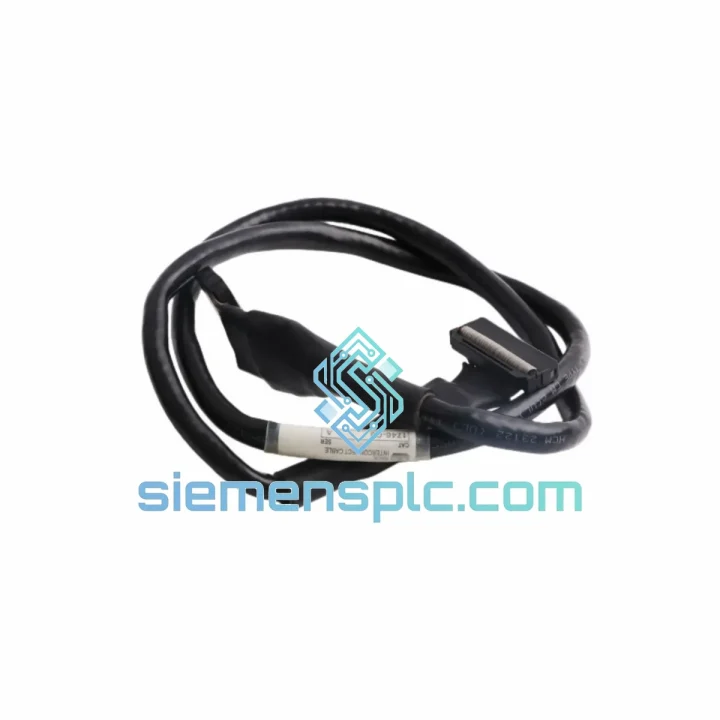
Allen-Bradley 1786-RG6F ControlNet Coaxial Cable – 1786 Series
1786 Series
Origin US
Industrial Network Cable
Request verified availability, condition, replacement risk review, packing options and courier lead time for 1786-CP.
Click Request Quote and the part number is inserted into the inquiry form automatically.
Core fields for model confirmation and RFQ routing. Detailed product narrative remains below.
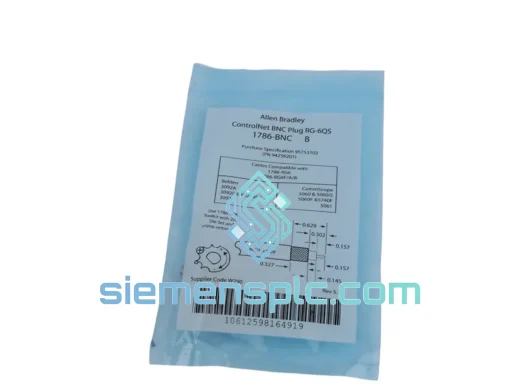
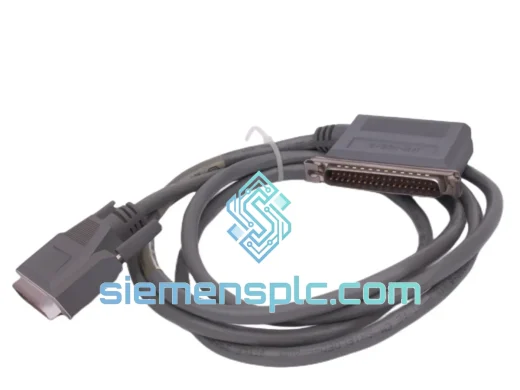
The Allen-Bradley 1786-CP is a dedicated Network Access Cable (NAC) engineered to bridge a programming terminal’s RS-232 serial port to the BNC tap interface of a ControlNet coaxial segment. Within a ControlNet topology, every node — whether a 1756-CNB bridge module, a PLC-5/40C controller, or a 1788-CNC scanner — communicates over a dual-redundant RG-6 coaxial bus governed by the CTDMA (Concurrent Time Domain Multiple Access) MAC protocol. The 1786-CP provides the physical-layer handshake that allows RSLinx Classic or RSNetWorx for ControlNet to enumerate, configure, and diagnose that bus from a standard laptop or workstation without requiring a dedicated ControlNet interface card.
Unlike generic serial cables, the 1786-CP incorporates internal signal conditioning circuitry that adapts the RS-232 voltage levels (±12 V swing) to the 75 Ω impedance environment of the ControlNet coaxial segment. The cable’s BNC connector mates directly to any 1786-series tap — including the 1786-TPS (single-port) and 1786-TPYR (Y-style) variants — without disturbing the live network. This non-intrusive access is critical in continuous-process environments where network downtime carries direct production cost.
In practice, the 1786-CP is the first physical tool a commissioning engineer reaches for when establishing initial RSNetWorx connectivity, verifying node addresses, or performing post-maintenance diagnostics on an existing ControlNet segment. Its compact form factor and passive BNC interface mean it can remain semi-permanently attached to a maintenance tap on the trunk cable, ready for periodic health checks without any network reconfiguration.
Real-time Stock & RFQ: [email protected] | WhatsApp: +86 18359268345
| Parameter | Specification |
|---|---|
| Manufacturer | Allen-Bradley / Rockwell Automation |
| Part Number (SKU) | 1786-CP |
| Product Series | 1786 ControlNet |
| Function | ControlNet Network Access Cable (NAC) |
| Host Interface | DB-9 RS-232 (DTE, male) |
| Network Interface | BNC (75 Ω, coaxial) |
| Compatible Network Standard | ControlNet (IEC 61158 Type 2 / IEEE 802.4 coaxial) |
| Signal Adaptation | RS-232 (±12 V) to 75 Ω coaxial physical layer |
| Compatible Taps | 1786-TPS, 1786-TPYR, 1786-TPYRS |
| Compatible Software | RSLinx Classic, RSLinx Enterprise, RSNetWorx for ControlNet |
| Cable Jacket | PVC, flexible, industrial-grade |
| Approximate Weight | 160 g |
| Country of Origin | United States (Rockwell Automation) |
| Condition | Genuine OEM, new / surplus-new |
| Warranty | 12 months from date of shipment |
The ControlNet physical layer operates on a dual-redundant RG-6 coaxial bus at a nominal data rate of 5 Mbit/s. Each node on the network connects via a passive tap that capacitively couples to the trunk cable, preserving the 75 Ω characteristic impedance of the segment. The 1786-CP’s BNC connector is designed to mate with these taps without introducing measurable impedance discontinuity — a critical requirement given that reflections on a ControlNet trunk degrade the signal-to-noise margin for all nodes on that segment, not just the node nearest the fault.
Internally, the 1786-CP contains a level-shifting and impedance-matching circuit that translates the RS-232 asynchronous serial stream from the host PC into the differential signaling format expected by the ControlNet physical layer. This circuit is powered parasitically from the RS-232 RTS/DTR lines, eliminating the need for an external power supply — a practical advantage in field commissioning scenarios where AC outlets may not be accessible at the tap location.
From an EMC standpoint, the cable’s coaxial construction provides inherent shielding against radiated interference. The outer braid, bonded to the BNC shell, creates a continuous Faraday enclosure around the inner conductor from the tap interface to the point where the cable transitions to the RS-232 segment. This shielding architecture is particularly relevant in heavy industrial environments — motor drive rooms, arc welding cells, high-voltage switchgear panels — where radiated EMI levels routinely exceed 10 V/m in the 30 MHz–1 GHz band.
The RS-232 segment of the cable uses a shielded twisted-pair construction with the shield terminated at the DB-9 shell, providing a second layer of EMC protection on the host-side interface. The overall cable assembly is rated for the industrial temperature range and uses a flexible PVC jacket that maintains pliability at low ambient temperatures, reducing connector stress during repeated plug/unplug cycles in maintenance workflows.
Every 1786-CP unit supplied through siemensplc.com is sourced from verified industrial distribution channels and undergoes a structured pre-shipment inspection covering physical authenticity markers (label typography, connector plating, cable jacket markings), continuity and shielding integrity testing, and cross-referencing of date codes against known Rockwell Automation production batches. Units that do not pass all inspection criteria are quarantined and not offered for sale.
All shipments originate from our warehouse in Xiamen, China — a major export hub with direct access to DHL Express, FedEx International Priority, UPS Worldwide Express, and EMS international postal services. In-stock units typically ship within 1–3 business days of order confirmation. For time-critical requirements, same-day dispatch is available for orders confirmed before 14:00 CST. Export documentation — commercial invoice, packing list, and certificate of origin — is prepared for every shipment. Certificates of conformance and inspection records are available upon request for B2B buyers with traceability requirements.
A 12-month warranty covers all units against manufacturing defects and functional failure under normal operating conditions. Warranty claims are processed within 5 business days of receipt of the returned unit, with replacement dispatch or credit note issued accordingly.
Email: [email protected]
WhatsApp: +86 18359268345
Web: siemensplc.com
Location: Xiamen, China
© 2026 siemensplc.com. All rights reserved.
We check the full part number, brand, series and visible nameplate information before quotation.
Sales confirms stock path, condition option, quantity and realistic lead time for export dispatch.
DHL, FedEx, UPS or buyer courier arrangements can be reviewed with packing requirements.
Similar brand or category products for fast comparison and multi-item RFQ lists.