
Siemens
In Stock OK
Siemens 6ES7414-1XG02-0AB0 PLC CPU Module – SIMATIC S7-400
Request verified availability, condition, replacement risk review, packing options and courier lead time for 6ES7414-1XG02-0AB0.
BrandSiemens
Part Number6ES7414-1XG02-0AB0
ConditionAvailability Check
Lead TimeRFQ Confirmation
DocumentsDatasheet / photos by RFQ
ShippingExport packing available
Auto-filled RFQ
6ES7414-1XG02-0AB0
Click Request Quote and the part number is inserted into the inquiry form automatically.
- Reply by email: [email protected]
- WhatsApp / Tel: +86 18359268345
- Mon-Sat 9:00-18:00 GMT+8
Procurement Data
Key Product Information
Core fields for model confirmation and RFQ routing. Detailed product narrative remains below.
- Brand
- Siemens
- Primary Part Number
- 6ES7414-1XG02-0AB0
- Product Type
- PLC CPU Module
- Series / Family
- SIMATIC S7-400
- Country of Origin
- DE
- Catalog Category
- PLCs & Controllers
- Operating Temp.
- 0 °C to +60 °C
- Warranty
- 12 months from dispatch date
Model confirmed for inquiry
6ES7414-1XG02-0AB0
Send quantity, destination and urgency. The RFQ form keeps this part number attached.
Request Quote
Product Overview
Siemens 6ES7414-1XG02-0AB0 CPU 414-1: Backplane Bus Master and Program Execution Controller for SIMATIC S7-400
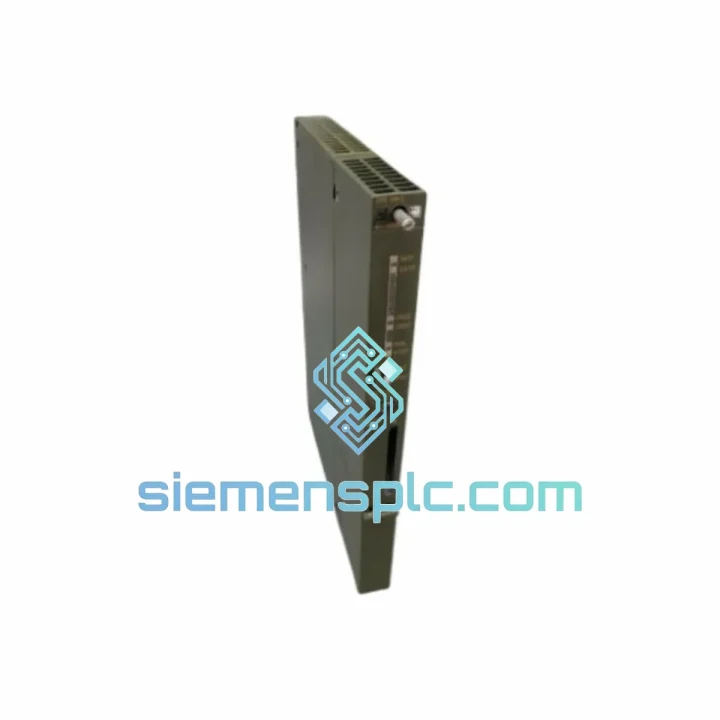
The 6ES7414-1XG02-0AB0 is the CPU 414-1 variant within the Siemens SIMATIC S7-400 mid-range controller family. Its primary function in a control loop is deterministic program execution: it arbitrates all data traffic on the S7-400 P-bus (peripheral bus) and C-bus (communication bus), executes the user program in a defined scan cycle, and maintains consistent process-image update timing regardless of I/O load. In a closed-loop control architecture — for example, a cascade PID loop governing a distillation column — the CPU’s ability to hold scan-cycle jitter below 1 ms is what separates stable setpoint tracking from oscillation-induced product loss.
The CPU 414-1 occupies the second tier of the S7-400 performance hierarchy, positioned above the 412 series and below the 416/417 high-end processors. This placement makes it the rational selection for plants requiring more than 64 KB of work memory and more than one MPI node, but not yet demanding the multi-DP-master capability of the 416. Typical deployment scenarios include medium-complexity batch reactors, multi-axis conveyor coordination, and power-plant auxiliary systems where a single CPU must manage 512 to 2048 I/O points across one central rack and up to six expansion racks.
Real-time Stock & RFQ: [email protected] | WhatsApp: +86 18359268345
Technical Parameters
| Parameter | Value |
|---|---|
| Part Number | 6ES7414-1XG02-0AB0 |
| Series Designation | CPU 414-1 |
| Product Family | SIMATIC S7-400 |
| Work Memory (RAM) | 512 KB (expandable via memory card) |
| Load Memory | Up to 8 MB via Flash memory card |
| Bit Operation Execution Time | 0.1 µs (typical) |
| Word Operation Execution Time | 0.2 µs (typical) |
| Floating-Point Operation | 0.3 µs (typical) |
| I/O Address Range | 8 KB inputs / 8 KB outputs |
| Process Image Size | 2 KB inputs / 2 KB outputs (default partition) |
| MPI Interface | Integrated, 187.5 kbps – 12 Mbps |
| MPI Nodes (max) | 32 |
| Timers / Counters | 2048 / 2048 |
| Data Blocks | Up to 8191 DBs |
| Nesting Depth | 16 levels per OB |
| Supply Voltage | DC 5 V via S7-400 backplane bus |
| Current Consumption (5 V bus) | 1.5 A (max) |
| Operating Temperature | 0 °C to +60 °C |
| Storage Temperature | -40 °C to +70 °C |
| Relative Humidity | 10 % to 95 %, non-condensing |
| Degree of Protection | IP 20 |
| Dimensions (W × H × D) | 25 mm × 290 mm × 219 mm |
| Weight | approx. 900 g |
| Programming Language | LAD, FBD, STL, SCL, CFC (via STEP 7) |
| Firmware Version | XG02 |
| Warranty | 12 months from dispatch date |
Hardware Logical Analysis
The 6ES7414-1XG02-0AB0 implements a dual-bus architecture that physically separates I/O data traffic from inter-module communication. The P-bus (peripheral bus) operates as a synchronous parallel backplane at 48 MHz, transferring process-image data between the CPU and I/O modules in a time-multiplexed slot scheme. This design prevents a high-density analog module — for example, a 16-channel 4–20 mA input card performing 16-bit conversions — from introducing latency into the digital I/O scan, because each module type occupies a dedicated bus slot window.
The C-bus (communication bus) runs as a serial differential link at up to 12 Mbps and handles inter-CPU communication, IM (interface module) traffic to expansion racks, and CP (communication processor) data exchange. The physical separation of P-bus and C-bus means that a burst of PROFIBUS DP traffic through a CP 443-5 does not degrade the determinism of the process-image update cycle — a critical property in safety-adjacent applications where scan-cycle overrun must be detected and handled by OB80.
EMC hardening on the CPU 414-1 is implemented at three levels. First, the PCB uses a six-layer stackup with dedicated ground planes between signal layers, reducing radiated emissions and improving immunity to conducted interference per EN 61000-4-4 (EFT/Burst, 2 kV). Second, all external interface signals — MPI, memory card slot, and mode selector — pass through transient-voltage suppression (TVS) arrays rated at ±1 kV surge per IEC 61000-4-5. Third, the module housing is a die-cast aluminum frame that provides a Faraday shield with measured shielding effectiveness exceeding 40 dB at 100 MHz, verified against EN 55011 Class A limits.
The watchdog timer architecture uses a hardware-independent oscillator circuit separate from the main CPU clock. If the user program fails to service the watchdog within the configured monitoring time (configurable from 10 ms to 6553 s in STEP 7 HW Config), the watchdog asserts a STOP transition via a dedicated hardware line that bypasses the main processor — ensuring the rack enters a defined safe state even if the CPU core itself has locked up. This is not a software watchdog; it is a discrete logic circuit on the module’s supervisory controller.
Retentive memory is implemented using a battery-backed SRAM region of 256 KB within the work memory space. The battery circuit uses a gold-cap supercapacitor as a primary buffer (hold time: approximately 30 minutes at 25 °C) and an optional external lithium battery (6ES7971-0BA00) for extended retention beyond 30 days. The retentive/non-retentive boundary is configurable per data block in STEP 7, allowing engineers to minimize battery-dependent data to only those variables — setpoints, recipe parameters, counters — that must survive a power cycle.
System Integration Benefits
- Deterministic OB1 Cycle Execution: The CPU 414-1 guarantees a minimum cycle time floor configurable down to 1 ms, with hardware-enforced cycle monitoring via OB80. Control loops that require fixed-interval execution — PID, ratio control, feedforward compensation — can be assigned to time-interrupt OBs (OB30–OB38) with periods from 5 ms to 60 s, independent of the OB1 scan load.
- Transparent Diagnostic Architecture: The module populates the S7-400 diagnostic buffer with timestamped entries for every module fault, rack fault, and CPU state transition. Each entry carries a 10 ms-resolution timestamp derived from the CPU’s internal real-time clock, enabling post-event analysis without external data loggers.
- Process-Image Partitioning: Engineers can define up to 15 process-image partitions (PIPs) in addition to the default OB1 image. Each PIP can be assigned to a specific OB, allowing high-priority I/O — for example, emergency shutdown inputs — to be updated at 5 ms intervals while standard I/O updates at the OB1 cycle rate. This eliminates the need for direct peripheral access (P-access) in most applications, simplifying program structure.
- Consistent MPI Network Behavior: The integrated MPI port supports token-ring arbitration with up to 32 nodes. The CPU acts as the network master, issuing token passes at a configurable gap factor. This ensures that HMI polling — typically 500 ms update cycles — does not interfere with programming device access or peer CPU data exchange.
- Structured Fault Handling via OB Hierarchy: The CPU 414-1 supports the full S7-400 OB hierarchy: OB82 (I/O point fault), OB83 (module removal/insertion), OB84 (CPU hardware fault), OB85 (program execution error), OB86 (rack failure), and OB87 (communication error). Each OB receives a start information structure containing the fault address, fault class, and event identifier, enabling the user program to implement fault-specific responses rather than a generic STOP.
- Memory Card Hot-Swap for Program Updates: The Flash memory card slot supports program transfer without a programming device. A new program can be loaded onto a memory card offline, inserted into the CPU, and activated via a MRES (memory reset) sequence — a procedure that takes under 60 seconds and requires no laptop or network connection on the plant floor.
- Consistent Behavior Across Firmware Revisions: The XG02 firmware revision maintains backward compatibility with STEP 7 V5.4 SP5 and later, including TIA Portal V13 SP2 via the legacy S7-400 device library. Existing project files compiled for earlier XG-series firmware revisions load and execute without modification, protecting engineering investment in established control programs.
- Rack-Level Redundancy Preparation: While the CPU 414-1 itself does not implement H-system redundancy (that requires the 414-4H or 417-4H), its diagnostic transparency and structured OB fault handling make it straightforward to implement application-level redundancy — for example, a hot-standby logic block that monitors a secondary CPU via MPI and executes a controlled switchover sequence within the user program.
Quality Assurance & Global Logistics
Every 6ES7414-1XG02-0AB0 unit dispatched from our Xiamen, China facility undergoes a documented four-stage inspection protocol. Stage one is origin verification: the module’s serial number is cross-referenced against Siemens’ published serial number format rules (plant code, year/week of manufacture, sequence number) to confirm it falls within a valid production window for the XG02 firmware revision. Stage two is physical authentication: housing mold lines, label print quality, hologram placement, and connector pin geometry are compared against a reference unit. Counterfeit S7-400 CPUs typically fail at the hologram or the backplane connector pin pitch — both are checked under 10× magnification.
Stage three is electrical bench verification: the module is installed in a test rack with a known-good PS 407 power supply and a UR2 rack, powered up, and interrogated via STEP 7 online diagnostics. The diagnostic buffer is read to confirm no pre-existing fault entries, the firmware version string is verified as XG02, and a minimal test program is downloaded and executed to confirm OB1 cycling. Stage four is packaging: the module is placed in a static-dissipative bag (surface resistivity 10⁵–10¹¹ Ω/sq per IEC 61340-5-1), sealed with a humidity indicator card, and placed in a foam-lined export carton rated for 1.2 m drop per ISTA 2A.
Logistics from Xiamen port to major industrial hubs: Frankfurt (4–6 days air freight), Houston (5–7 days air freight), Singapore (2–3 days air freight), Dubai (3–5 days air freight). Sea freight options are available for multi-unit orders where lead time permits. All shipments include a commercial invoice, packing list, and certificate of origin. For customers requiring FORM E (ASEAN-China FTA) or EUR.1 movement certificates, please specify at the time of order. Export classification: HS 8537.10 (boards, panels, consoles for electric control). No export license required for standard commercial destinations.
The 12-month warranty covers manufacturing defects and premature component failure under normal operating conditions as defined in Siemens manual 6ES7414-1XG02-0AB0 A5E00077686. Warranty claims are processed within 5 business days of receipt of the returned module. Replacement units are dispatched from Xiamen stock; no cross-shipment delays. Warranty does not cover damage from incorrect supply voltage, ESD mishandling, or physical impact — all of which are detectable during the return inspection and documented in the claim report.
Contact Information
Email: [email protected]
WhatsApp: +86 18359268345
Web: siemensplc.com
Location: Xiamen, China
© 2026 siemensplc.com. All rights reserved.
Ready to quote
[email protected]
Send This Part Number to Sales
RFQ workflow
Quality workflow ->
Confirmation Process
01Model confirmation
We check the full part number, brand, series and visible nameplate information before quotation.
02Availability reply
Sales confirms stock path, condition option, quantity and realistic lead time for export dispatch.
03Packing & courier
DHL, FedEx, UPS or buyer courier arrangements can be reviewed with packing requirements.
Continue sourcing
Browse full catalog ->
Related Automation Parts
Similar brand or category products for fast comparison and multi-item RFQ lists.
Siemens
RFQ Ready
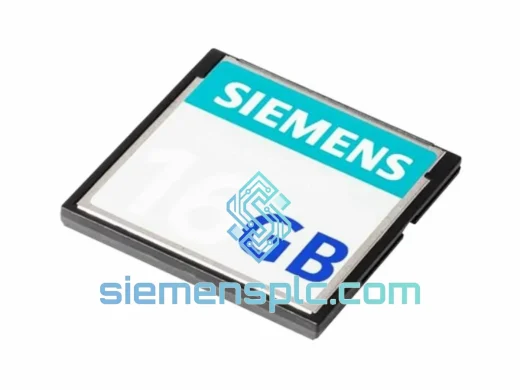
Siemens 6ES7648-2BF02-0XG0 Compact Flash Card
SIMATIC S7-400
Origin DE
Industrial Memory Card