Yokogawa
RFQ Ready
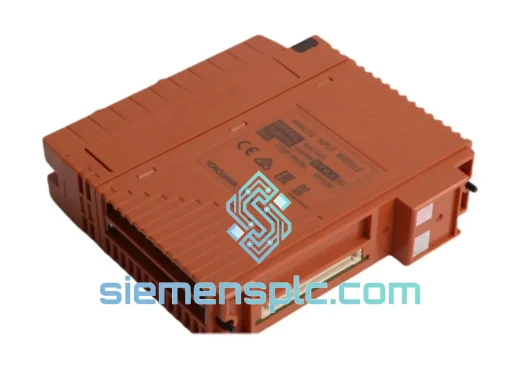
Yokogawa SAI143-H63/PRP S3 DCS Analog Input Module
CENTUM VP
Origin JP
DCS Analog Input Module
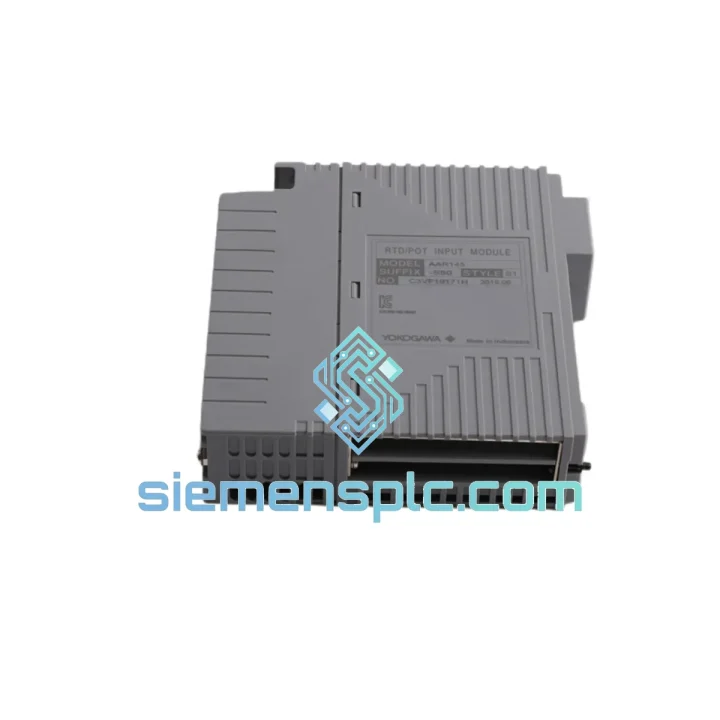
Request verified availability, condition, replacement risk review, packing options and courier lead time for AAR145-S50.
Click Request Quote and the part number is inserted into the inquiry form automatically.
Core fields for model confirmation and RFQ routing. Detailed product narrative remains below.
The AAR145-S50 S1 occupies a well-defined role within YOKOGAWA’s CENTUM VP and CS 3000 distributed control architectures: it serves as the primary analog front-end for resistance-based temperature and position sensing, converting low-level RTD and potentiometer signals into digitized process values that the Field Control Station (FCS) uses for closed-loop regulation. Unlike voltage or current input modules, RTD acquisition demands a fundamentally different signal conditioning chain — one that must manage excitation current sourcing, lead-wire compensation, and linearization across multiple sensor standards simultaneously. The AAR145-S50 S1 addresses each of these requirements within a single, rack-mounted module footprint.
In a typical CENTUM VP installation, the FCS executes control function blocks at a defined scan cycle. The accuracy and latency of the analog input stage directly determine the quality of the process variable (PV) fed into PID or advanced control blocks. Any drift, noise, or conversion error at the I/O layer propagates directly into the control output, making the selection and maintenance of the input module a first-order engineering concern — not a procurement afterthought.
Real-time Stock & RFQ: [email protected] | WhatsApp: +86 18359268345
| Part Number | AAR145-S50 S1 |
| Manufacturer | YOKOGAWA Electric Corporation |
| Module Classification | Multi-channel RTD / Potentiometer Analog Input Module |
| Compatible Platform | CENTUM VP, CENTUM CS 3000 (FCS / FCU rack) |
| Supported Input Types | Pt100, Pt1000, JPt100, Cu10, Ni100, Potentiometer (POT) |
| Measurement Accuracy | ±0.1°C typical (Pt100, at 25°C ambient) — refer to YOKOGAWA GS for full error budget |
| Lead-Wire Compensation | 3-wire and 4-wire RTD configurations supported |
| Channel Isolation | Channel-to-channel and channel-to-backplane isolation |
| Backplane Interface | CENTUM VP internal I/O bus (proprietary high-speed serial) |
| Power Source | Supplied via DCS rack backplane (no external PSU required) |
| Operating Temperature | 0°C to 55°C |
| Storage Temperature | -25°C to 70°C |
| Relative Humidity | 5% to 95% RH (non-condensing) |
| Module Weight | Approx. 260 g |
| Suffix Designation | S50 = 50 Hz power frequency filter; S1 = standard specification |
| Compliance | CE, RoHS; manufactured under ISO 9001 QMS |
| Country of Origin | Japan |
| Warranty | 12 months from date of shipment (siemensplc.com guarantee) |
| Lead Time | In-stock: 1–3 business days; sourced/allocated: 7–15 business days |
Excitation Current Architecture
RTD measurement requires a stable, low-noise excitation current to be passed through the sensor element. The AAR145-S50 S1 generates this excitation internally using a precision current source referenced to a stable voltage reference. The excitation magnitude is selected to balance measurement sensitivity against self-heating error — a critical trade-off in Pt100 applications where sensor self-heating can introduce systematic offsets exceeding 0.1°C in low-flow or stagnant process conditions. The module’s internal current source maintains excitation stability across the full operating temperature range, preventing drift-induced measurement error during ambient temperature excursions inside the control cabinet.
Lead-Wire Resistance Compensation
The S50 suffix designates a 50 Hz power frequency rejection filter, which is significant in European and Asian plant environments where 50 Hz interference from power cabling is the dominant noise source. The module’s analog front-end applies a synchronous rejection filter tuned to 50 Hz, achieving high normal-mode rejection at the power line frequency. This is implemented at the ADC integration stage rather than as a passive RC filter, which means the rejection ratio remains stable regardless of source impedance variation — a common failure mode in passive filter designs when sensor cable lengths vary across field installations.
Channel-to-Channel Isolation Mechanism
Each input channel on the AAR145-S50 S1 is galvanically isolated from adjacent channels and from the backplane bus. This isolation is implemented using transformer-coupled or optocoupler-based barriers at the signal path boundary. The practical consequence is that a ground fault or high common-mode voltage event on one sensor loop cannot propagate to adjacent channels or corrupt the backplane communication. In multi-loop temperature monitoring applications — such as a heat exchanger with 8 RTD points on a single module — this isolation architecture prevents a single wiring fault from taking down the entire measurement group.
Backplane Bus Protocol and Scan Latency
The module communicates with the FCS processor over YOKOGAWA’s internal I/O bus, which operates as a deterministic, time-division multiplexed serial link. The FCS assigns each I/O module a fixed time slot within the scan cycle, ensuring that the PV update latency is bounded and predictable. For the AAR145-S50 S1, the conversion time per channel is governed by the ADC integration period (which is inversely related to the 50 Hz rejection filter bandwidth). The module presents fully converted, linearized engineering-unit values to the FCS — the linearization for each RTD type (Pt100, JPt100, Ni100, etc.) is performed within the module’s onboard firmware, offloading this computation from the FCS processor and maintaining consistent scan cycle performance even as the I/O count scales.
EMC Design Considerations
The module’s PCB layout follows YOKOGAWA’s standard EMC design rules for industrial DCS hardware: analog and digital ground planes are separated and joined at a single star point, signal traces are routed away from switching power supply traces, and the module housing provides shielding continuity with the rack chassis. These measures collectively ensure the module meets IEC 61000-4 series immunity requirements for conducted and radiated disturbances — a baseline requirement for installation in heavy industrial environments such as refineries and steel mills where variable-frequency drives and large motor starters generate significant electromagnetic interference.
Every AAR145-S50 S1 unit dispatched from siemensplc.com is sourced as genuine YOKOGAWA OEM hardware. YOKOGAWA Electric Corporation manufactures its DCS I/O modules under a certified quality management system, and the AAR145-S50 S1 is produced to the same manufacturing standards as units supplied through YOKOGAWA’s authorized distribution network. We do not supply aftermarket substitutes, re-labeled compatible modules, or hardware of unverified provenance.
Prior to dispatch, each unit undergoes physical inspection covering label integrity, connector condition, PCB revision marking, and housing completeness. Serial numbers are logged against shipment records to provide full traceability. For orders of three or more units, a third-party inspection report can be arranged upon request.
Logistics from Xiamen, China: Our operations are based in Xiamen, Fujian Province — a designated free-trade zone and one of China’s primary international cargo hubs. Xiamen Gaoqi International Airport and Xiamen Port provide direct access to DHL Express, FedEx International Priority, UPS Worldwide Express, and SF International freight lanes. Standard export documentation — commercial invoice, packing list, and certificate of origin — is prepared for every shipment. Xiamen Customs clearance for industrial electronic components is processed under HS code 8537.10, and our team prepares accurate customs declarations to minimize the risk of clearance delays at the destination port. Bulk orders can be consolidated and shipped via sea freight with full container load (FCL) or less-than-container load (LCL) options. Typical transit times: 2–4 business days to Europe and North America via express air freight; 18–28 days via sea freight.
Payment is accepted in USD, EUR, CNY, and HKD. Wire transfer (T/T), PayPal Business, and letter of credit (L/C) are all supported. Pro forma invoices are issued within one business day of order confirmation.
Email: [email protected]
WhatsApp: +86 18359268345
Web: siemensplc.com
Location: Xiamen, Fujian, China
Business Hours: Monday–Saturday, 09:00–18:00 CST
© 2026 siemensplc.com. All rights reserved.
We check the full part number, brand, series and visible nameplate information before quotation.
Sales confirms stock path, condition option, quantity and realistic lead time for export dispatch.
DHL, FedEx, UPS or buyer courier arrangements can be reviewed with packing requirements.
Similar brand or category products for fast comparison and multi-item RFQ lists.