Yokogawa
RFQ Ready
Yokogawa SAI143-H63/PRP S3 DCS Analog Input Module
CENTUM VP
Origin JP
DCS Analog Input Module
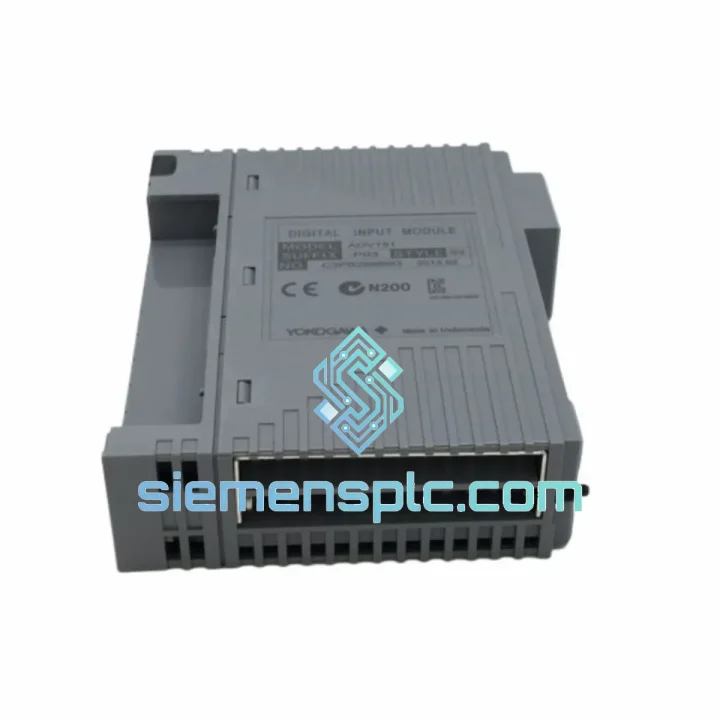
Request verified availability, condition, replacement risk review, packing options and courier lead time for ADV151-P03.
Click Request Quote and the part number is inserted into the inquiry form automatically.
Core fields for model confirmation and RFQ routing. Detailed product narrative remains below.
The ADV151-P03 S2 occupies a structurally critical position within the CENTUM VP and CS 3000 Field Control Station (FCS) I/O architecture. As a 32-channel discrete input module, it serves as the primary signal acquisition boundary between field-level binary devices — limit switches, solenoid feedback contacts, motor run/stop relays, and proximity sensors — and the deterministic control logic executing on the FCS CPU. Every discrete state transition in the field must pass through this module before it can influence a control loop, interlock condition, or alarm annunciation. That boundary function demands electrical robustness, channel-level isolation, and sub-cycle scan latency that the ADV151-P03 S2 is specifically engineered to deliver.
In a CENTUM VP FCS node, the module slots into the I/O unit and communicates with the FCS processor over the internal V-net backplane bus. The FCS builder software automatically identifies the module type and revision suffix (S2) upon insertion, assigning channel addresses without manual configuration. This plug-and-recognize behavior is essential in brownfield environments where minimizing engineering intervention during module replacement is a hard operational requirement.
Real-time Stock & RFQ: [email protected] | WhatsApp: +86 18359268345
| Parameter | Specification |
|---|---|
| Model | ADV151-P03 S2 |
| Manufacturer | YOKOGAWA Electric Corporation |
| Module Function | 32-Channel Digital Input (DI) |
| Compatible Platform | CENTUM VP, CENTUM CS 3000 |
| Channel Count | 32 channels per module slot |
| Rated Input Voltage | 24 VDC nominal |
| ON-State Threshold | 15 – 30 VDC |
| OFF-State Threshold | 0 – 5 VDC |
| Input Current per Channel | ≈ 7 mA @ 24 VDC |
| Isolation Architecture | Opto-isolation, channel-to-backplane bus |
| IEC Compliance | IEC 61131-2 Type 1 / Type 2 |
| Input Filter / Response Time | ≤ 10 ms (software-configurable debounce) |
| Field Connector | 40-pin MIL connector via Field Terminal Unit (ADT151) |
| Module Form Factor | Single-slot, hot-swap capable under FCS power |
| Power Consumption | ≤ 3.5 W typical |
| Operating Temperature | 0 °C to +55 °C |
| Storage Temperature | −25 °C to +70 °C |
| Relative Humidity | 5 % – 95 % RH, non-condensing |
| Hardware Revision | S2 (second production revision) |
| Certifications | CE, UL, cUL |
| Country of Origin | Japan |
| Warranty | 12 months from date of shipment |
The ADV151-P03 S2 implements a per-channel opto-isolation stage using high-speed photocouplers rated for continuous 30 VDC field-side exposure. Each photocoupler presents a defined input impedance that limits inrush current to approximately 7 mA, preventing contact welding on low-energy relay outputs while maintaining a clean logic transition at the 15 VDC ON threshold. The optical barrier provides a minimum 500 V isolation boundary between field wiring and the backplane bus, suppressing common-mode transients generated by inductive field loads — motor contactors, solenoid valves — that would otherwise couple noise into the FCS I/O bus.
On the bus side, the 32 isolated channel outputs are multiplexed through a dedicated I/O ASIC that serializes channel state data and transmits it to the FCS CPU over the V-net internal bus at each scan cycle. The S2 revision incorporates updated EMC filtering on the bus interface layer, reducing susceptibility to radiated interference in high-density cabinet installations where multiple I/O modules share a common backplane. This is particularly relevant in petrochemical environments where variable-frequency drives and high-current switching equipment generate broadband electromagnetic noise across the 150 kHz – 30 MHz range.
The configurable input filter (debounce time ≤ 10 ms) is implemented in firmware on the module’s local microcontroller, not in the FCS CPU scan logic. This means contact bounce suppression occurs before the signal enters the backplane, preventing false state transitions from propagating into the control database and triggering spurious alarms or interlock actions. The filter value is set via the CENTUM VP FCS builder and stored in non-volatile module memory, surviving power cycles without requiring re-download from the engineering station.
Hot-swap capability is implemented through a controlled power sequencing circuit on the module’s backplane connector. When the module is inserted under power, the sequencing circuit pre-charges the local supply rails before enabling the bus interface, preventing the voltage transient that would otherwise cause a bus fault on adjacent modules. Extraction follows the reverse sequence, tri-stating the bus interface before disconnecting supply. This mechanism allows maintenance personnel to replace a failed DI module during live process operation without shutting down the FCS node or affecting channels on adjacent modules.
Every ADV151-P03 S2 unit supplied through siemensplc.com is sourced as genuine YOKOGAWA OEM hardware. Each module carries the original YOKOGAWA factory label with full model number, hardware revision suffix, serial number, and date code — all verifiable against YOKOGAWA’s product documentation. Units are inspected upon receipt for label integrity, connector condition, and physical completeness before being listed as available stock.
Shipments originate from Xiamen, China, with same-day or next-business-day dispatch for in-stock orders confirmed before 15:00 CST. International freight is handled via DHL Express, FedEx International Priority, and TNT Economy Express, with typical transit times of 3–5 business days to Europe, 4–7 days to North America, and 2–4 days to Southeast Asia. All shipments include commercial invoice, packing list, and HS code classification (HS 8537.10) for customs clearance. Export documentation and ECCN classification are available upon request for regulated-destination shipments.
Packaging follows ESD-safe protocols: each module is sealed in an anti-static bag, cushioned with foam inserts, and shipped in a rigid outer carton sized to prevent movement in transit. Connector pins are protected with end caps to prevent mechanical damage during handling. A 12-month warranty covers manufacturing defects and functional failure under normal operating conditions from the date of shipment.
Email: [email protected]
WhatsApp: +86 18359268345
Web: siemensplc.com
Location: Xiamen, China
© 2026 siemensplc.com. All rights reserved.
We check the full part number, brand, series and visible nameplate information before quotation.
Sales confirms stock path, condition option, quantity and realistic lead time for export dispatch.
DHL, FedEx, UPS or buyer courier arrangements can be reviewed with packing requirements.
Similar brand or category products for fast comparison and multi-item RFQ lists.