Siemens
RFQ Ready
Siemens 6ES7321-1BL00-0AA0 Digital Input Module
SIMATIC
Origin DE
PLC Digital Input Module
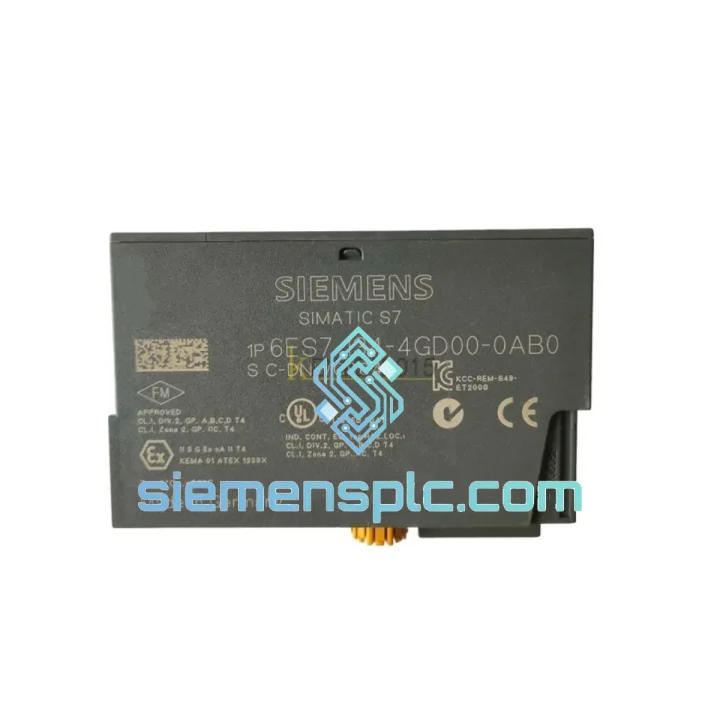
Request verified availability, condition, replacement risk review, packing options and courier lead time for 6ES7134-4GD00-0AB0.
Click Request Quote and the part number is inserted into the inquiry form automatically.
Core fields for model confirmation and RFQ routing. Detailed product narrative remains below.
The 6ES7134-4GD00-0AB0 occupies a specific and non-substitutable position in the SIMATIC ET 200S signal chain: it is the interface between field-level 2-wire loop-powered transmitters and the deterministic data bus of a PROFIBUS DP or PROFINET-connected distributed I/O station. Each of its two channels accepts a 4–20mA current signal from a 2-wire transmitter, converts it to a 13-bit signed digital value, and places that value on the ET 200S backplane within a fixed 52 ms cycle per channel. This conversion latency is not incidental — it is a hardware-defined constant that allows the upstream CPU to build deterministic scan-cycle budgets without jitter compensation logic.
In a typical process control loop, the 6ES7134-4GD00-0AB0 sits between a SITRANS P pressure transmitter and a SIMATIC S7-1500 CPU executing a PID_Compact block. The module’s wire-break detection circuit monitors loop current continuously; when current drops below 3.6mA — the IEC 61131-2 underflow threshold — it sets a channel-level diagnostic bit in the process image and simultaneously triggers a hardware interrupt to the interface module. The CPU receives this interrupt within one PROFIBUS DP cycle (typically 1–10ms at standard baud rates), enabling alarm escalation before the process variable is even read by the application program. This diagnostic architecture is the functional difference between a module that reports faults and one that anticipates them.
The module draws approximately 30mA from the ET 200S backplane bus and requires no separate field-side power supply for the transmitter loop — the 2-wire transmitter is powered directly through the module’s terminal block, which sources 24VDC loop excitation from the station’s power module (6ES7138-4CA01-0AA0 or equivalent). This eliminates a discrete power distribution rail in the marshalling cabinet, reducing terminal count and potential fault points per loop by two.
Electrically, the module’s input stage uses optocoupler isolation between the field terminals and the backplane logic. The isolation barrier is rated to withstand 500VAC test voltage between channel and backplane, and 75VDC between channels. This isolation topology prevents ground loops from corrupting the digital conversion result — a common failure mode in installations where transmitters share a common negative rail with motor drives or other high-current equipment. The module’s EMC design follows EN 61000-4-2 (ESD), EN 61000-4-4 (EFT/Burst), and EN 61000-4-5 (Surge) immunity levels, consistent with the SIMATIC ET 200S family’s industrial-grade EMC classification.
The 13-bit plus sign resolution maps the 4–20mA input range to a value range of 0 to 27648 in the S7 process image (per SIEMENS standard scaling). At full scale, one LSB corresponds to 0.579µA of input current change, or approximately 0.0036% of full-scale span. For a 0–100 bar pressure transmitter, this translates to a digitization granularity of 3.6 mbar — well within the accuracy budget of most industrial pressure measurement loops. The module does not perform linearization or engineering-unit scaling internally; that function is delegated to the CPU’s FC105 (SCALE) or equivalent TIA Portal instruction, maintaining a clean separation between signal acquisition hardware and application-layer data processing.
Mechanically, the module slots into any ET 200S terminal module of the TM-E15S24-01 or TM-E15C24-01 type, occupying a 15mm width slot. It supports hot insertion and removal under power, provided the interface module’s configuration permits dynamic reconfiguration — a parameter set in the hardware configuration tool (STEP 7 HW Config or TIA Portal Device Configuration). The module’s housing is rated IP20, suitable for installation in standard IEC 60529-compliant control cabinets with filtered ventilation.
All units supplied by siemensplc.com are genuine Siemens production parts sourced through verified channels, shipped from Xiamen, China with a 12-month warranty against manufacturing defects. Each unit is individually inspected prior to dispatch.
📧 Real-time Stock & RFQ: [email protected] | WhatsApp: +86 18359268345
| Parameter | Value |
|---|---|
| Order Number | 6ES7134-4GD00-0AB0 |
| Product Family | SIMATIC ET 200S |
| Module Function | Analog Input, 2-wire transmitter |
| Number of Channels | 2 |
| Input Signal Type | Current, 4–20mA (2-wire loop-powered) |
| Resolution | 13-bit + sign (0–27648 S7 scaled) |
| Conversion Time per Channel | 52 ms |
| Digitization Granularity | 0.579µA / LSB (~0.0036% FS) |
| Loop Excitation Voltage | 24VDC (sourced from ET 200S power module) |
| Backplane Current Consumption | ~30mA |
| Channel-to-Backplane Isolation | 500VAC test voltage |
| Channel-to-Channel Isolation | 75VDC |
| Wire-Break Detection Threshold | <3.6mA (IEC 61131-2 underflow) |
| Overflow Detection Threshold | >22.8mA |
| Operating Temperature | 0°C to +60°C |
| Storage Temperature | −40°C to +70°C |
| Degree of Protection | IP20 (IEC 60529) |
| Slot Width | 15mm |
| Dimensions (W×H×D) | 15 × 81 × 52 mm |
| Weight | ~50g |
| Compatible Terminal Module | TM-E15S24-01 / TM-E15C24-01 |
| Hot-Swap Support | Yes (configuration-dependent) |
| EMC Immunity Standards | EN 61000-4-2, EN 61000-4-4, EN 61000-4-5 |
| Certifications | CE, UL, cULus, ATEX Zone 2, FM, RoHS |
| Warranty | 12 months from shipment date |
The 6ES7134-4GD00-0AB0’s internal signal path follows a three-stage architecture: loop current reception → optocoupler isolation → sigma-delta analog-to-digital conversion. The sigma-delta converter topology is significant: unlike successive-approximation (SAR) ADCs, sigma-delta converters inherently integrate the input signal over the conversion period, providing first-order noise rejection proportional to the oversampling ratio. At a 52ms conversion time, the module’s effective noise bandwidth is approximately 9.6Hz, which attenuates 50Hz and 60Hz power-line interference by more than 40dB without any external filtering components. This is the hardware mechanism behind the module’s specified common-mode rejection — it is not achieved through passive RC filtering but through the converter’s oversampling architecture.
The optocoupler isolation stage uses a current-mode optical link rather than a voltage-mode link. This distinction matters for EMC performance: current-mode optocouplers are inherently less susceptible to capacitively-coupled transients on the isolation barrier because the signal is encoded as a current ratio (CTR), not a voltage level. The result is that fast transients (EFT/Burst per EN 61000-4-4) that couple across the isolation capacitance do not produce false logic transitions at the digital output of the optocoupler — a failure mode that affects lower-cost voltage-mode isolation designs.
The wire-break detection circuit operates independently of the ADC conversion cycle. It monitors loop current on a continuous basis using a dedicated comparator with hysteresis, set to trip at 3.6mA falling and reset at 4.0mA rising. This hysteresis band prevents chattering on noisy loops near the detection threshold. The comparator output drives a latch in the module’s local ASIC, which sets the corresponding diagnostic bit in the ET 200S backplane data frame on the next bus cycle — decoupled from the 52ms ADC cycle. This means a wire-break event is reported to the CPU within one PROFIBUS DP cycle (typically 1–10ms), not within the next 52ms ADC window.
The backplane interface logic implements the ET 200S slot protocol, which uses a time-division multiplexed serial bus. The module’s ASIC arbitrates its slot access window deterministically — there is no collision-avoidance or retry logic at the backplane level. Each module is assigned a fixed time slot by the interface module during station initialization, and data transfer occurs within that slot on every bus cycle. This determinism is what allows the ET 200S system to guarantee bounded latency from field signal to CPU process image, a requirement for IEC 61511 SIL-rated safety loops when used with appropriate interface modules.
Every 6ES7134-4GD00-0AB0 unit dispatched by siemensplc.com is a genuine Siemens production part. Units are stored in ESD-controlled, climate-regulated warehouse conditions in Xiamen, China, consistent with Siemens’ recommended storage parameters (15–35°C, 45–75% RH, non-condensing). Prior to shipment, each unit undergoes visual inspection of housing integrity, label authenticity markers, and connector pin condition. A 12-month warranty against manufacturing defects and authenticity failures is provided from the date of shipment.
Logistics from Xiamen covers all major industrial procurement destinations. DHL Express and FedEx International Priority provide 2–5 business day transit to Europe, North America, Southeast Asia, and the Middle East. All shipments include commercial invoice, packing list, country-of-origin declaration (Germany), and HS code 8537.10 classification documentation. For bulk orders, sea freight consolidation and air freight charter options are available. In-stock units ship within 1–2 business days of payment confirmation. Export compliance assessment is available upon request for restricted-destination countries.
Packaging follows anti-static ESD bag + foam-lined inner carton + moisture-barrier outer carton protocol. Original Siemens retail packaging is preserved where available. A Certificate of Conformity (COC) referencing the batch number and inspection date is included inside every carton.
📧 Email: [email protected]
📱 WhatsApp: +86 18359268345
🌐 Web: siemensplc.com
📍 Location: Xiamen, China
© 2026 siemensplc.com. All rights reserved.
We check the full part number, brand, series and visible nameplate information before quotation.
Sales confirms stock path, condition option, quantity and realistic lead time for export dispatch.
DHL, FedEx, UPS or buyer courier arrangements can be reviewed with packing requirements.
Similar brand or category products for fast comparison and multi-item RFQ lists.