Siemens
RFQ Ready
Siemens A5E03378158 Communication Processor – SIMATIC S7-300 CP 343-1
SIMATIC S7-300
Origin DE
Communication Processor
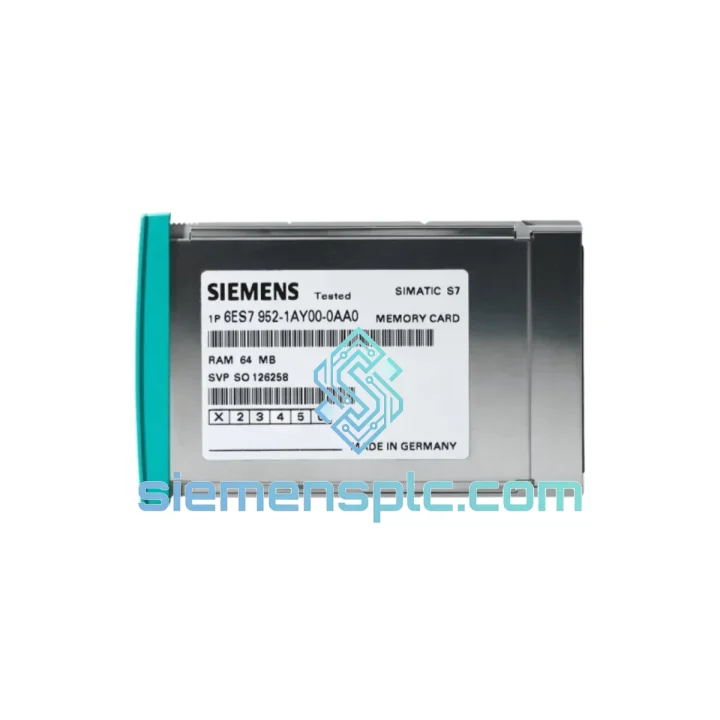
Request verified availability, condition, replacement risk review, packing options and courier lead time for 6ES7952-0KH00-0AA0.
Click Request Quote and the part number is inserted into the inquiry form automatically.
Core fields for model confirmation and RFQ routing. Detailed product narrative remains below.
The Siemens 6ES7952-0KH00-0AA0 is a 64 KB Micro Memory Card (MMC) built on NOR-type Flash EEPROM technology, designed exclusively for the SIMATIC S7-300 PLC family. Its primary function within the S7-300 control architecture is to act as the CPU’s load memory — the persistent storage layer from which the processor copies user programs, data blocks (DBs), system data objects (SDOs), and firmware images into volatile internal work RAM at each power-up cycle. This hardware-enforced separation between load memory and work memory is a deliberate architectural decision by Siemens: it guarantees that the executable image in RAM always originates from a verified, write-protected source, eliminating the class of faults caused by RAM corruption during unexpected power loss events.
Unlike battery-backed SRAM modules used in earlier S5 and early S7 generations, the 6ES7952-0KH00-0AA0 requires no auxiliary power source to maintain data integrity. The NOR Flash cell array retains stored charge — and therefore all programmed content — for a rated minimum of 10 years at 25 °C ambient, with no degradation in data fidelity across the full operating temperature range of 0 °C to +60 °C. For plant operators managing assets in remote substations, offshore platforms, or geographically distributed process cells, this characteristic eliminates an entire category of scheduled preventive maintenance: battery inspection, replacement, and the associated CPU downtime.
The card’s physical interface is a 22-contact proprietary connector integrated into the CPU front-panel MMC slot. The slot’s mechanical design enforces correct card orientation and incorporates a write-protect interlock that the CPU firmware interrogates before permitting any write operation. During normal RUN-mode execution, the CPU treats the MMC as a read-only device; write access is granted exclusively during STOP-mode download sequences initiated from STEP 7 or TIA Portal. This hardware-software co-design prevents accidental program overwrite — a failure mode with potentially severe consequences in safety-instrumented or continuous-process environments.
Real-time Stock & RFQ: [email protected] | WhatsApp: +86 18359268345
| Parameter | Specification |
|---|---|
| Order Number | 6ES7952-0KH00-0AA0 |
| Brand | Siemens AG |
| Product Series | SIMATIC S7-300 |
| Module Classification | Micro Memory Card (MMC) — Load Memory |
| Memory Technology | NOR Flash EEPROM (non-volatile, byte-addressable) |
| Usable Capacity | 64 KB |
| Supply Voltage | 3.3 V DC (sourced from CPU MMC slot) |
| Read Access Time | < 100 ns (typical, NOR architecture) |
| Write Endurance | ≥ 100,000 program/erase cycles per block |
| Data Retention | ≥ 10 years at 25 °C (per JEDEC Flash retention standard) |
| Operating Temperature | 0 °C to +60 °C |
| Storage Temperature | −40 °C to +85 °C |
| Relative Humidity (operating) | 10 % to 95 %, non-condensing |
| Mechanical Dimensions | 25 mm × 32 mm × 3.3 mm (W × H × D) |
| Weight | Approx. 5 g |
| Compatible CPU Families | S7-300 CPU 312, 313, 314, 315, 316, 317, 318, 31xC series |
| Interface | 22-contact proprietary SIMATIC MMC slot (front panel) |
| Certifications | CE, UL, cULus, RoHS 2011/65/EU, REACH |
| Country of Origin | Germany |
| Warranty | 12 months from confirmed shipment date |
The selection of NOR Flash over NAND architecture in the 6ES7952-0KH00-0AA0 is not incidental — it reflects a specific requirement of the S7-300 CPU’s memory controller. NOR Flash supports random byte-level read access with deterministic latency, whereas NAND Flash requires page-level reads and an intermediate buffer, introducing variable latency that is incompatible with the S7-300’s fixed-window initialization sequence. At cold start, the CPU’s load memory controller performs a sequential block transfer of the entire 64 KB program image from the MMC into internal SRAM. With NOR read latency below 100 ns per byte, this transfer completes well within the CPU’s watchdog initialization timeout — a hard constraint that NAND-based storage cannot reliably satisfy at this capacity range.
The 22-contact interface carries a multiplexed address/data bus alongside discrete control lines: Chip Enable (CE#), Output Enable (OE#), Write Enable (WE#), and a card-detect signal used by the CPU to confirm card presence before initiating the boot sequence. The absence of a valid card-detect signal causes the CPU to halt with a specific diagnostic code (SF LED + BF LED pattern), immediately directing maintenance personnel to the correct fault source without ambiguity.
From an electromagnetic compatibility standpoint, the MMC’s passive read profile — no clock generation, no active switching during read operations — means the card contributes negligible conducted or radiated emissions to the S7-300 backplane environment. Write operations, which involve charge-pump activation within the Flash array, are infrequent and brief. The card’s metal-contact interface and the CPU slot’s mechanical enclosure provide inherent shielding, maintaining compliance with IEC 61000-4-2 (ESD, 4 kV contact), IEC 61000-4-3 (radiated immunity, 10 V/m), and IEC 61000-4-4 (fast transient/burst, 2 kV) without supplementary filtering components.
The MMC also exposes a diagnostic register set accessible via the CPU’s MMC protocol layer. The CPU periodically polls remaining write-cycle headroom and error-correction status flags, logging this data into the S7-300 diagnostic buffer. When thresholds are approached, the CPU generates an OB82 interrupt, which SCADA or HMI systems can surface as a predictive maintenance alert — enabling card replacement to be scheduled during planned downtime rather than forced during an unplanned fault event.
Each 6ES7952-0KH00-0AA0 unit shipped from siemensplc.com carries Siemens AG factory markings: a machine-readable part label with order number, date code, and production batch identifier. Units are warehoused in Xiamen, China under ESD-controlled conditions (relative humidity 40–60 %, temperature 18–25 °C), individually sealed in anti-static poly bags with silica gel desiccant packs rated for 90-day moisture protection during sea freight transit.
Pre-dispatch inspection covers four checkpoints: label authenticity verification against Siemens part number format, housing integrity assessment for contact damage or mechanical deformation, connector contact cleanliness inspection under magnification, and anti-static packaging seal confirmation. Units failing any checkpoint are quarantined and not dispatched. A 12-month warranty from the confirmed shipment date covers manufacturing defects and confirmed DOA (dead-on-arrival) units; replacement or credit is processed without dispute upon receipt of the defective unit and photographic documentation.
Export logistics from Xiamen operate via DHL Express, FedEx International Priority, and UPS Worldwide Expedited, with typical door-to-door transit times of 3–5 business days to Europe and North America, 2–4 business days to Southeast Asia, and 4–7 business days to the Middle East and South America. Full export documentation — commercial invoice, packing list, certificate of origin, and HS Code 8473.30 customs declaration — is prepared for every shipment. For orders of 10 or more units, sea freight LCL consolidation is available with volume pricing; submit an RFQ to the sales team for a formal quotation with lead time confirmation.
Email: [email protected]
WhatsApp: +86 18359268345
Web: siemensplc.com
Location: Xiamen, China
© 2026 siemensplc.com. All rights reserved.
We check the full part number, brand, series and visible nameplate information before quotation.
Sales confirms stock path, condition option, quantity and realistic lead time for export dispatch.
DHL, FedEx, UPS or buyer courier arrangements can be reviewed with packing requirements.
Similar brand or category products for fast comparison and multi-item RFQ lists.