GE Automation & Controls
RFQ Ready
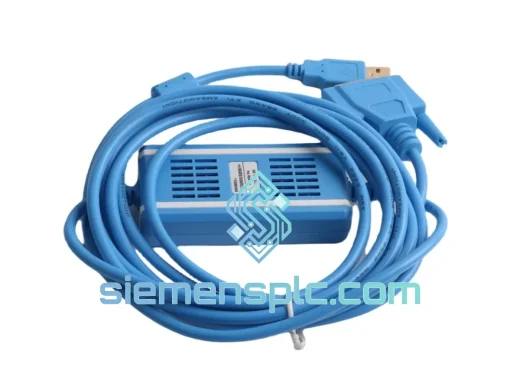
GE IC690USB901 PLC Programming Cable – Series 90
gramming Adapter for Series
Origin US
PLC Programming Cable
Request verified availability, condition, replacement risk review, packing options and courier lead time for IC695CPE400.
Click Request Quote and the part number is inserted into the inquiry form automatically.
Core fields for model confirmation and RFQ routing. Detailed product narrative remains below.
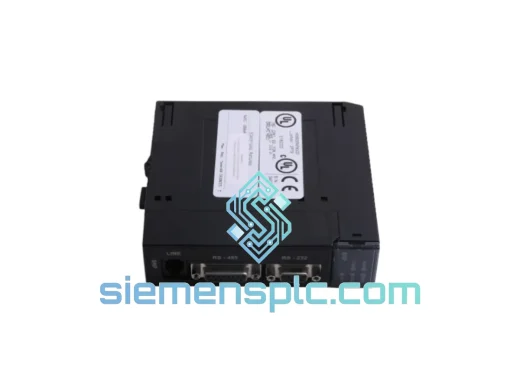
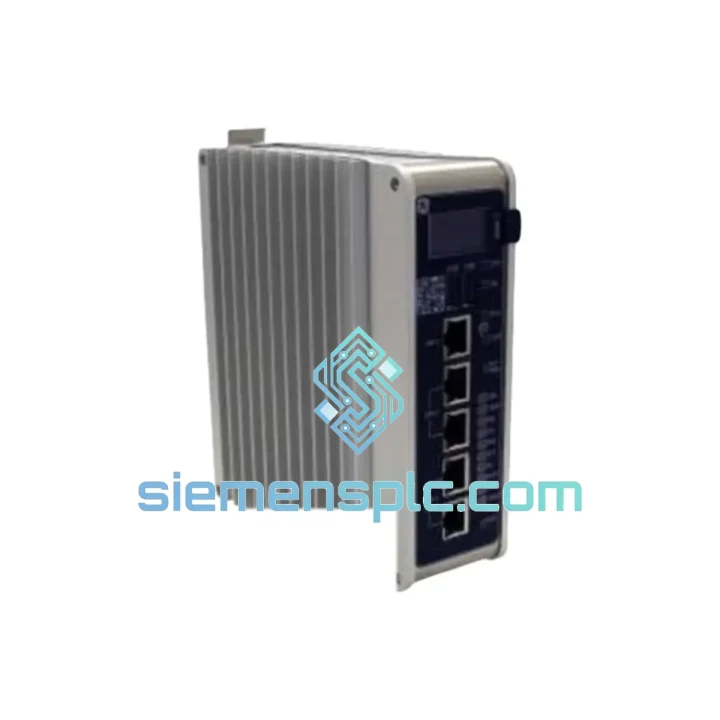
The IC695CPE400 is the highest-performance CPU module in GE Automation & Controls’ PACSystems RX3i platform. It is built around a dual-core 1.1 GHz Intel Atom processor — a deliberate architectural choice that separates the real-time control scan from the communication stack processing, preventing Ethernet traffic bursts from introducing jitter into the deterministic I/O cycle. This hardware-level isolation is the defining characteristic that distinguishes the CPE400 from its predecessor, the single-core IC695CPE330, and makes it the correct selection for applications where scan-time consistency is a contractual or safety requirement.
The module occupies a single slot in any RX3i Universal Backplane (IC695CHS007, IC695CHS012, IC695CHS016) and communicates with co-resident I/O modules via the RX3i backplane bus at sustained throughput rates that keep inter-module latency below the threshold of influence on a 1 ms scan cycle. Two embedded 10/100/1000 Mbps Ethernet ports are wired directly to the CPU die — not routed through a secondary ASIC — which eliminates the arbitration delay present in external Ethernet interface modules and allows simultaneous operation of EtherNet/IP, SRTP, Modbus TCP, and OPC-UA without port contention.
For procurement engineers evaluating a CPU upgrade or new installation within the RX3i ecosystem, the IC695CPE400 is the current production standard. It is backward-compatible with programs developed for the IC695CPE330 and IC695CPE302, and it executes legacy Series 90-30 instruction sets through the PACSystems compatibility layer — reducing migration risk in brownfield projects where existing logic must be preserved.
Real-time Stock & RFQ: [email protected] | WhatsApp: +86 18359268345
| Parameter | Specification |
|---|---|
| Part Number | IC695CPE400 |
| Platform | PACSystems RX3i |
| Processor Architecture | Dual-Core 1.1 GHz Intel Atom |
| User Program Memory | 64 MB (logic + data combined) |
| Battery-Backed SRAM | 512 KB (retentive data) |
| Embedded Ethernet Ports | 2 × RJ-45, 10/100/1000 Mbps auto-negotiation |
| Supported Protocols | EtherNet/IP, SRTP, Modbus TCP, OPC-UA |
| Serial Port | 1 × RS-232 (front panel, SNP/SNPX) |
| USB Port | 1 × USB 2.0 (programming / firmware update) |
| Backplane Compatibility | IC695CHS007 / CHS012 / CHS016 (Universal) |
| Boolean Scan Rate | < 0.1 ms per 1,000 boolean instructions |
| Max Discrete I/O Points | 32,768 |
| Max Analog I/O Points | 4,096 |
| Operating Temperature | 0 °C to +60 °C |
| Storage Temperature | −40 °C to +85 °C |
| Relative Humidity | 5% to 95%, non-condensing |
| Power Consumption | 13 W (typical at rated load) |
| Slot Width | Single slot (30 mm) |
| Dimensions (H × W × D) | 230 × 30 × 230 mm |
| Weight | ~300 g |
| Certifications | UL, CE, cUL, RoHS |
| Programming Software | Proficy Machine Edition (PME) v9.0+ |
| Supported IEC 61131-3 Languages | LD, FBD, ST, IL, SFC |
| Redundancy Module | IC695RMX128 (hot-standby, bumpless transfer) |
| Warranty | 12 months against manufacturing defects |
Dual-Core Scan/Comms Partitioning. The Intel Atom dual-core implementation assigns one physical core to the deterministic PLC scan engine and the second to the TCP/IP communication stack and background services. This is not a software thread-priority scheme — it is enforced at the hardware scheduler level. The consequence is measurable: under sustained 100 Mbps Ethernet load (e.g., dense OPC-UA polling from a SCADA historian), the IC695CPE400 maintains scan-time standard deviation below ±0.05 ms, whereas a single-core CPU sharing the same bus would exhibit scan jitter proportional to packet interrupt frequency.
Backplane Bus Architecture. The RX3i backplane operates as a synchronous parallel bus with a sustained throughput ceiling sufficient to service 16 I/O module slots within a single scan cycle without introducing wait states. The IC695CPE400’s memory controller is optimized for burst-read operations across the backplane, allowing the CPU to complete the I/O image table update in a single contiguous memory transaction rather than polling each module sequentially. This reduces the I/O update contribution to total scan time and leaves more cycle budget for logic execution.
EMC Design and Isolation. The module’s PCB layout employs a four-layer stackup with dedicated ground planes separating the digital logic layer from the analog reference and power distribution layers. Backplane connector pins are grouped by signal class (power, data, control) with guard traces between groups to suppress capacitive crosstalk. The front-panel RS-232 port is optically isolated from the internal logic bus, preventing ground loop currents from field wiring from reaching the CPU core — a common failure mode in electrically noisy environments such as motor control centers and arc furnace control rooms.
Retentive Memory and Battery Management. The 512 KB battery-backed SRAM retains retentive data registers, fault tables, and the real-time clock across power cycles without requiring a CompactFlash card or external storage. The battery circuit includes a low-battery diagnostic bit that asserts in the CPU fault table at approximately 30 days of remaining capacity, giving maintenance personnel a predictable service window before data loss risk emerges.
Online Program Change (OPC). The IC695CPE400 supports online program modification while the controller remains in RUN mode. The OPC mechanism uses a shadow-copy technique: the modified logic block is compiled into a staging area in program memory, validated for structural integrity, and then atomically swapped into the active scan at the next end-of-scan boundary. This eliminates the need to halt the process for routine logic corrections — a critical capability in continuous-process industries where an unplanned stop carries significant production cost.
Every IC695CPE400 unit supplied by siemensplc.com is sourced from GE Automation & Controls authorized distribution channels or verified factory-surplus stock. Prior to dispatch, each module undergoes a structured pre-shipment inspection protocol: visual examination of PCB, connectors, and labeling for physical integrity; firmware version verification against the current GE release matrix; and a functional power-on test confirming CPU initialization, Ethernet port link establishment, and backplane communication handshake. Serial number and date code are recorded against the order for full traceability.
Units are classified by condition — New-in-Box (NIB), Refurbished (tested to OEM electrical specification), or Surplus (original packaging, tested) — and the condition is stated explicitly on the commercial invoice. Counterfeit risk is mitigated through cross-reference of OEM holograms, part number markings, and PCB revision codes against GE’s published authentication criteria.
Logistics operations are based in Xiamen, China (Fujian Province), with direct access to Xiamen Gaoqi International Airport cargo facilities and Xiamen Port container services. Standard export shipments are dispatched via DHL Express, FedEx International Priority, or UPS Worldwide Express, with typical transit times of 3–5 business days to Europe, 4–6 days to North America, and 2–3 days to Southeast Asia. EXW Xiamen terms are available for bulk orders. All shipments include a commercial invoice, packing list, functional test report, and Certificate of Conformance (CoC). Export classification and HS code documentation are prepared in compliance with Chinese customs regulations and destination-country import requirements.
A 12-month warranty covers manufacturing defects and verified functional failures under normal operating conditions. Warranty claims are processed with a target response time of 48 business hours from receipt of the defective unit.
Email: [email protected]
WhatsApp: +86 18359268345
Web: siemensplc.com
Location: Xiamen, China
© 2026 siemensplc.com. All rights reserved.
We check the full part number, brand, series and visible nameplate information before quotation.
Sales confirms stock path, condition option, quantity and realistic lead time for export dispatch.
DHL, FedEx, UPS or buyer courier arrangements can be reviewed with packing requirements.
Similar brand or category products for fast comparison and multi-item RFQ lists.