BENDER
RFQ Ready
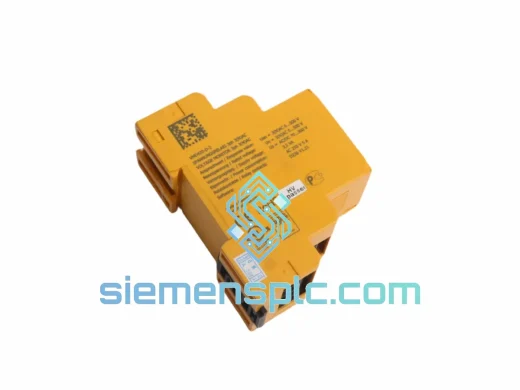
BENDER VMD420-D-2 Voltage Monitoring Relay – VMD Series
Dual Relay Output
Origin Germany
Voltage Monitoring Relay
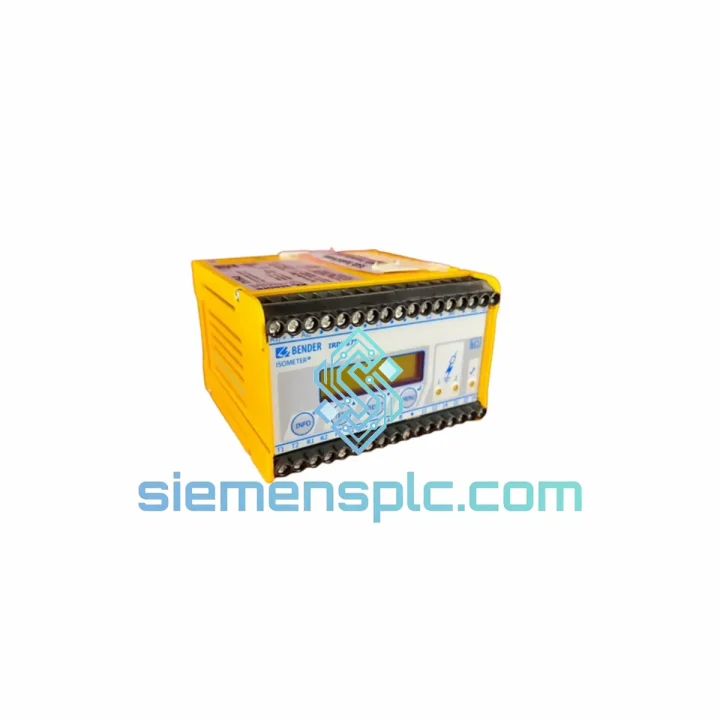
Request verified availability, condition, replacement risk review, packing options and courier lead time for IRDH275B-425.
Click Request Quote and the part number is inserted into the inquiry form automatically.
Core fields for model confirmation and RFQ routing. Detailed product narrative remains below.
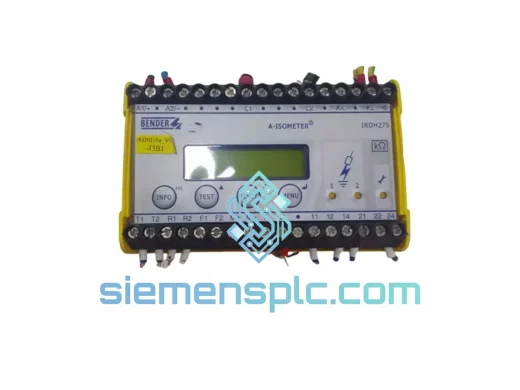
In unearthed IT systems, the first ground fault does not interrupt supply — it creates a latent hazard. The second fault, occurring anywhere on the network, completes the circuit and produces a fault current that can damage equipment, trigger arc flash events, or endanger personnel. The BENDER IRDH275B-425 is the instrument that closes this detection gap. It continuously measures the total insulation resistance between the active conductors of an IT network and earth, issuing an alarm the moment that resistance falls below a configurable threshold — before the second fault can occur.
This is not a passive monitoring function. The IRDH275B-425 applies a low-level DC measuring voltage (≤12 V) superimposed on the monitored network, independent of system frequency and voltage waveform. This method, standardized under IEC 61557-8, allows the device to monitor AC systems, DC systems, and mixed-frequency networks — including those with significant harmonic content from variable-frequency drives — without generating interference or requiring system shutdown. The measurement is continuous, real-time, and unaffected by normal load switching events.
For procurement engineers and system integrators specifying safety instrumentation for hospitals, offshore platforms, industrial drive systems, or renewable energy installations, the IRDH275B-425 represents a mature, field-proven implementation of IT system insulation monitoring with a communication architecture that integrates directly into modern SCADA and building management environments.
Real-time Stock & RFQ: [email protected] | WhatsApp: +86 18359268345
| Manufacturer | BENDER GmbH & Co. KG |
| Part Number / SKU | IRDH275B-425 |
| Series | IRDH275B |
| Function | Insulation Monitoring Device (IMD) for unearthed IT systems per IEC 61557-8 |
| Nominal System Voltage (Un) | AC 0–690 V / DC 0–1000 V |
| Measuring Voltage | DC ≤ 12 V (superimposed, non-intrusive) |
| Response Threshold (Ran) | Adjustable: 1 kΩ – 10 MΩ |
| Supply Voltage (Us) | AC/DC 24–240 V (universal input, no external PSU required) |
| Frequency Range | DC, 0 Hz, 50 Hz, 60 Hz |
| Output Relays | 2 × changeover contacts — Alarm relay (Ran) + Fault relay (configurable) |
| Communication Interface | RS-485 — BCOM protocol and Modbus RTU |
| Display | Backlit LCD — live insulation resistance readout in kΩ/MΩ |
| Enclosure Protection | IP30 (IP40 front panel with protective cover fitted) |
| Operating Temperature | −25 °C to +70 °C |
| Mounting | 35 mm DIN rail or panel surface mount |
| Certifications | IEC 61557-8, UL 61010-1, CE, cULus |
| Country of Origin | Germany |
| Packaged Weight | Approx. 4,460 g |
| Lead Time — In-Stock | 3–7 business days to most international destinations |
| Lead Time — Sourced | 10–20 business days; confirmed at quotation stage |
| Warranty | 12 months from shipment date |
| Accepted Currencies | USD, EUR, CNY, HKD — T/T, L/C, select digital payment methods |
Superimposed DC Measurement Principle: The IRDH275B-425 injects a low-amplitude DC test signal (≤12 V) onto the monitored IT network via internal coupling capacitors. This signal is galvanically isolated from the device’s own supply circuit and rides on top of the network’s AC or DC operating voltage without disturbing load operation. The device measures the return current through the earth reference path and calculates the total insulation resistance using Ohm’s law. Because the measurement signal is DC, it is inherently immune to the capacitive leakage currents generated by long cable runs and EMC filter capacitors — a known source of false alarms in AC-injection IMD designs.
EMC Design and Interference Rejection: Industrial IT networks in drive-intensive environments carry significant common-mode noise from PWM switching transients. The IRDH275B-425 incorporates digital filtering algorithms that distinguish the device’s own DC measurement signal from superimposed high-frequency noise, preventing nuisance alarms triggered by EMC events rather than genuine insulation degradation. The internal signal processing applies adaptive averaging over the measurement cycle, ensuring that transient disturbances — such as motor start inrush or capacitor bank switching — do not produce false threshold crossings.
Dual-Relay Output Architecture: The device provides two independent changeover relay outputs. The primary alarm relay activates when the measured insulation resistance falls below the configured Ran threshold. The second relay can be configured for pre-alarm, device fault indication, or system-level interlock functions. Both relays are fail-safe by design: the alarm relay is energized in the healthy state and de-energizes on fault or supply loss, ensuring that a device power failure does not suppress an active insulation alarm.
RS-485 Communication with BCOM and Modbus RTU: The integrated RS-485 port supports BENDER’s proprietary BCOM protocol for native integration with BENDER BMS, COM465 gateways, and BENDER EDS earth fault location systems. Modbus RTU mode allows direct integration with third-party SCADA platforms, PLCs, and building management systems from Siemens, Schneider Electric, ABB, and Rockwell Automation. The communication interface transmits live insulation resistance values, alarm status, device diagnostics, and configuration parameters — enabling remote monitoring without physical access to the switchgear panel.
Universal Supply Input: The AC/DC 24–240 V universal supply input eliminates the need for a dedicated 24 V DC power supply in installations where only AC distribution is available, and equally supports DC-bus-powered control cabinets. This single-SKU supply range simplifies global procurement and reduces the risk of specification errors when deploying across multiple sites with different control voltage standards.
Every BENDER IRDH275B-425 unit supplied by siemensplc.com is sourced from verified OEM channels with documented chain of custody. BENDER’s factory calibration to IEC 61557-8 is performed at the point of manufacture and is not repeatable in the field — sourcing from unverified channels introduces the risk of receiving units with compromised calibration records or undisclosed repair history. siemensplc.com’s procurement process requires batch traceability documentation for every unit, and pre-shipment inspection confirms physical integrity, connector condition, and label authenticity before dispatch.
All international shipments originate from Xiamen, China — a Tier-1 container port with direct sea freight routes to Southeast Asia, the Middle East, Northern Europe, and the Americas. For time-critical orders, Xiamen Gaoqi International Airport provides air freight access with door-to-door transit times of 3–5 business days to most major industrial centers. Export documentation — commercial invoice, packing list, certificate of origin, and HS code classification — is prepared in compliance with Xiamen Customs requirements, eliminating the risk of customs holds at destination ports that commonly extend lead times when sourcing from non-compliant exporters.
ESD-safe anti-static packaging and moisture barrier protection are applied as standard for all electronic component shipments. Shipment tracking is provided from dispatch to delivery, with carrier-diversified routing to maintain delivery reliability across multiple destination regions.
Email: [email protected]
WhatsApp: +86 18359268345
Web: siemensplc.com
Location: Xiamen, China
© 2026 siemensplc.com. All rights reserved.
We check the full part number, brand, series and visible nameplate information before quotation.
Sales confirms stock path, condition option, quantity and realistic lead time for export dispatch.
DHL, FedEx, UPS or buyer courier arrangements can be reviewed with packing requirements.
Similar brand or category products for fast comparison and multi-item RFQ lists.