Yokogawa
RFQ Ready
Yokogawa SAI143-H63/PRP S3 DCS Analog Input Module
CENTUM VP
Origin JP
DCS Analog Input Module
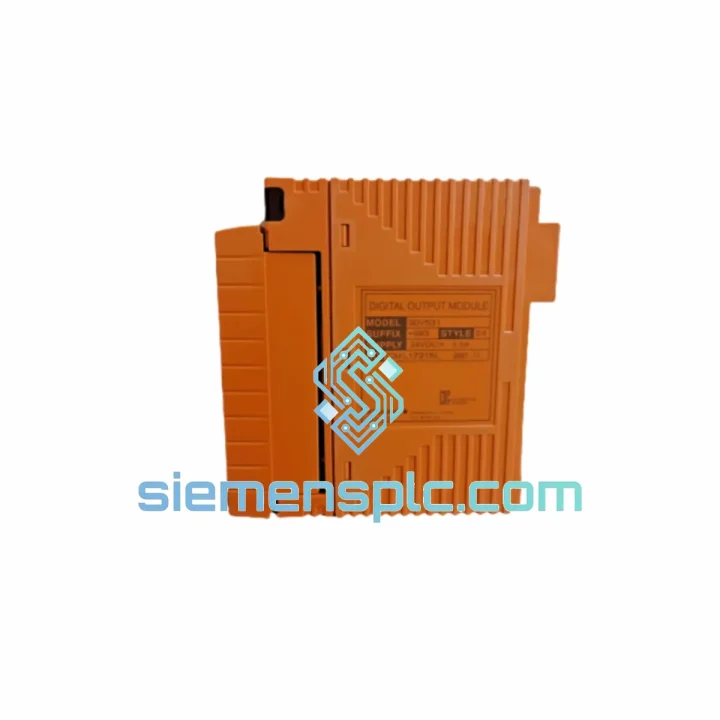
Request verified availability, condition, replacement risk review, packing options and courier lead time for SDV531-S63.
Click Request Quote and the part number is inserted into the inquiry form automatically.
Core fields for model confirmation and RFQ routing. Detailed product narrative remains below.
The SDV531-S63 occupies a well-defined position in the CENTUM VP I/O architecture: it is the high-density discrete output interface between the Field Control Station (FCS) backplane and field-side actuators. Each of its 32 transistor sink channels drives a 24 V DC load — solenoid valves, motor starter coils, relay inputs, indicator lamps — at up to 100 mA per point. The module plugs directly into a CENTUM VP I/O nest and communicates with the FCS processor over the Enhanced Serial Backplane (ESB) bus at a fixed scan cycle, contributing zero jitter to the control loop’s output phase. In large-scale DCS architectures where hundreds of discrete outputs must be coordinated within a single scan period, the SDV531-S63’s deterministic output latency is a measurable engineering advantage over relay-based or fieldbus-bridged alternatives.
The S63 suffix designates the screw-type terminal base. This mechanical distinction is operationally significant: field wiring terminates permanently on the S63 base, while the SDV531 module itself can be extracted and reinserted without disturbing a single field conductor. In continuous-process plants — refineries, ethylene crackers, power stations — where a planned module swap must be executed within a narrow maintenance window, this hot-swap architecture eliminates the re-termination step entirely and reduces the risk of wiring errors during replacement.
Real-time Stock & RFQ: [email protected] | WhatsApp: +86 18359268345
| Parameter | Specification |
|---|---|
| Model Number | SDV531-S63 |
| Platform | YOKOGAWA CENTUM VP (R4.xx / R5.xx / R6.xx) |
| Module Function | Digital Output (DO) — Transistor Sink Type |
| Output Channels | 32 channels per module |
| Output Circuit Type | Open-collector NPN transistor (sink) |
| Rated Load Voltage | 24 V DC (field supply) |
| Maximum Load Current | 100 mA per channel |
| Total Module Load Current | Refer to YOKOGAWA nest power budget (typically ≤ 3.2 A aggregate) |
| ON-State Voltage Drop | ≤ 1.5 V DC at rated current |
| OFF-State Leakage Current | ≤ 0.1 mA |
| Isolation Method | Photocoupler (optical) isolation — field side vs. system bus |
| Isolation Voltage | 500 V AC (1 minute, field to system) |
| Terminal Base Type | S63 — screw-type, 32-point field wiring base |
| Connector Interface | Plug-in to CENTUM VP I/O nest (ESB bus) |
| Hot-Swap Capability | Yes — module replaceable without field wiring disconnection |
| Operating Temperature | 0 °C to +55 °C |
| Storage Temperature | −25 °C to +70 °C |
| Relative Humidity | 5 % to 95 % RH (non-condensing) |
| Module Weight | Approx. 1,380 g (module + S63 terminal base) |
| Manufacturer | YOKOGAWA Electric Corporation, Japan |
| Country of Origin | Japan |
| Warranty | 12 months from date of shipment |
The SDV531-S63’s output stage is built around NPN open-collector transistors arranged in a 32-point array. Each transistor is driven by a dedicated photocoupler whose LED side is controlled by the ESB bus interface logic. This two-stage isolation topology — digital logic → photocoupler → power transistor → field load — creates a hard galvanic barrier that prevents field-side ground potential differences from propagating into the FCS backplane. In heavy industrial environments where field cables run alongside 480 V AC motor feeders, induced common-mode voltages of 50–200 V are not uncommon; the 500 V AC isolation rating of the photocoupler stage provides a quantified margin against these transients.
The transistor sink configuration means the module provides the current return path (low side switching). Field loads — solenoid coils, relay coils, indicator lamps — connect between the 24 V DC field supply positive rail and the module’s output terminal. When the FCS commands a channel ON, the transistor conducts and completes the circuit through the load to the common negative rail. This architecture is preferred in process plants because it is inherently fail-safe for normally-energized loads: a loss of field supply or a broken output wire de-energizes the load, which in most valve and interlock designs corresponds to the safe state.
The S63 terminal base uses a captive-screw wiring system with individual terminal blocks rated for conductors up to 2.5 mm². The mechanical keying between the SDV531 module body and the S63 base prevents incorrect module insertion — a critical feature in multi-module nests where adjacent slots may carry different I/O types. The module’s front-panel LED array provides per-channel output status at a glance, with a separate RUN/FAIL indicator for module-level health. These hardware diagnostics reduce mean time to repair (MTTR) by allowing field technicians to isolate a faulty channel without connecting a laptop or navigating the CENTUM VP HIS.
EMC performance is addressed at the PCB level through ground plane partitioning between the field-side and system-side circuits, transient voltage suppressor (TVS) diodes on each output terminal for inductive load flyback suppression, and ferrite bead filtering on the ESB bus interface lines. The module meets IEC 61000-4-4 (electrical fast transient) and IEC 61000-4-5 (surge immunity) requirements, which are the two most demanding EMC tests for discrete output modules in industrial control panels.
Every SDV531-S63 unit dispatched from our Xiamen, China facility is sourced through verified industrial automation supply channels and subjected to a structured pre-shipment inspection protocol:
Logistics from Xiamen are executed via DHL Express, FedEx International Priority, and UPS Worldwide Expedited, with typical transit times of 3–5 business days to Europe, 2–4 days to Southeast Asia, and 4–7 days to North America. Export documentation complies with Chinese customs regulations and destination-country import requirements. For urgent plant shutdowns or emergency replacements, same-day dispatch is available for in-stock units when orders are confirmed before 14:00 CST.
Email: [email protected]
WhatsApp: +86 18359268345
Web: siemensplc.com
Location: Xiamen, China
© 2026 siemensplc.com. All rights reserved.
We check the full part number, brand, series and visible nameplate information before quotation.
Sales confirms stock path, condition option, quantity and realistic lead time for export dispatch.
DHL, FedEx, UPS or buyer courier arrangements can be reviewed with packing requirements.
Similar brand or category products for fast comparison and multi-item RFQ lists.