
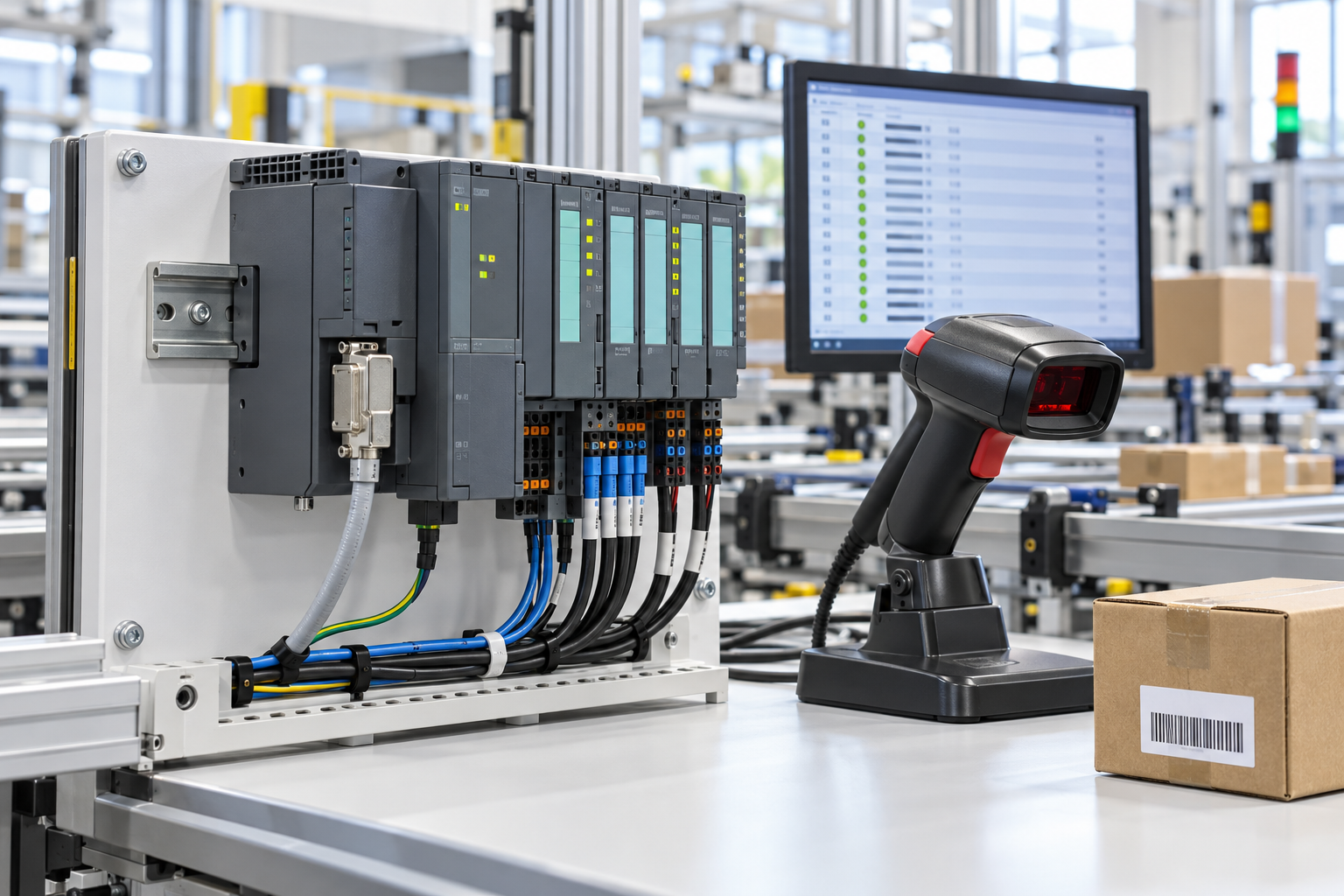
A serial interface can have the expected connector, the expected electrical standard and the wrong communications function. That is why an ET 200S spare request reading only 1SI RS485 module is incomplete. The middle characters of the order number can carry a distinction that the cabinet photograph does not reveal.
The comparison between 6ES7138-4DF01-0AB0 and 6ES7138-4DF11-0AB0 is a useful case. Both appear in the 1SI serial-interface context, but the protocol descriptions must be checked against the exact order number. Treating DF01 and DF11 as an insignificant revision difference risks ordering the wrong device.
Begin with the exact manufacturer’s description
The Siemens DF01 product datasheet describes a serial interface supporting ASCII and 3964R, with RS232, RS422 and RS485 interfaces. The DF11 product description identifies the MODBUS/USS variant. That is a functional distinction, not proof that one can replace the other by changing a connector.
Keep electrical signalling and message handling separate in the discussion. RS485 identifies an electrical interface; it does not by itself identify Modbus, the device role or the meaning of the data exchanged. A compatible-looking cable cannot resolve an application-level mismatch.
Build the spare record from the installed transaction
Start with the module label and retain the entire order number, including the final suffix. Add the installed hardware and firmware information available in the equipment record. Photograph the surrounding assembly so terminal and station context are not lost.
For a station using the ASCII/3964R variant, an enquiry for a 6ES7138-4DF01-0AB0 interface spare should explicitly retain that protocol requirement. A generic ET 200S communications description is not enough to distinguish it from nearby catalog entries.
If the installed requirement is the MODBUS/USS variant, preserve the identity of the 6ES7138-4DF11-0AB0 serial module instead. The two links are separate sourcing references. This article does not approve cross-substitution, firmware conversion or a protocol upgrade between them.
Then describe the transaction in ordinary language. Is the station receiving a barcode, reading a measurement or exchanging drive data? Identify the actual connected device and the approved protocol configuration. This description helps a reviewer detect an inconsistent purchase request before it becomes an incorrect shipment.
Preserve the software side of the interface
The module record should point to the approved controller project and communications configuration. Record the responsible owner, project revision and documentation for the relevant data exchange. Keep supported function blocks and dependencies identified where they form part of the installation.
Do not assume that a replacement module restores the application automatically. The delivered unit’s condition and configuration need to be assessed against the site baseline. Similarly, a module that passes a generic bench check has not necessarily demonstrated the transaction used by your machine.
Useful acceptance evidence includes a recognised request and response, correctly interpreted data and the expected handling of an interrupted connection. The responsible engineer should define the test and its limits. There is no universal test telegram that proves every serial installation correct.
Use a controlled comparison when records disagree
Legacy documentation can contain abbreviated descriptions, copied tables or drawings that were not updated after a change. Resolve disagreement using the physical label, exact manufacturer product documentation and the approved project. Do not silently select whichever source best matches the part currently available for sale.
Where the evidence still conflicts, mark the request pending technical identification. This is more useful than asking purchasing to choose between two similar numbers. A small delay for identification can prevent an outage plan built around a spare that does not perform the intended communications function.
Keep any proposed alternative on a separate review path. State which functional differences would have to be addressed, who would approve the change and what acceptance evidence would be required. An alternative is not an exact spare simply because the dimensions are convenient.
What receiving inspection should establish
Compare the delivered order number with the approved request before placing the unit in usable stock. Capture the label and visible condition, and verify that the supplied assembly matches the quotation. Record any missing documentation or unresolved revision issue.
If a functional trial is planned, use an isolated or approved environment and a known test counterpart. Preserve the original machine configuration and do not connect unverified equipment to an operating process. The resulting record should state exactly what was tested and what remains a commissioning responsibility.
Finally, label the stock item with its intended installed role, not just serial module. A technician searching during a fault should be able to distinguish the protocol requirement without reconstructing the whole procurement discussion. That is the practical value of keeping the complete order number throughout the workflow.
Questions from the maintenance desk
Does RS485 imply that the module is a Modbus interface?
No. It describes an electrical interface, not a complete protocol implementation. Check the exact module’s supported protocols and the installation’s configuration before making a spare or substitution decision.
Are DF01 and DF11 simply two revisions of the same function?
Do not treat them that way. The referenced manufacturer descriptions distinguish ASCII/3964R and MODBUS/USS functions. Preserve the complete order number and confirm it against the actual application.
Can we convert one into the other with firmware?
This article establishes no such conversion path. Any claim of conversion would require explicit manufacturer documentation applicable to the exact hardware and an approved engineering assessment. Do not use it as an informal purchasing assumption.
What makes an enquiry technically complete?
Include the label, installed revision information, protocol, connected device, quantity and required condition. Identify the approved project and any unresolved configuration questions. That lets the supplier quote an identified part without implying responsibility for an unspecified redesign.
Send SiemensPLC the full 1SI order number and protocol requirement for a focused spare quotation. Keep hardware sourcing and application validation visible as separate responsibilities throughout the recovery plan.
Image: AI-generated editorial illustration, not an exact product photograph or installation reference.
© 2026 SiemensPLC. All rights reserved. Official Website: https://siemensplc.com Inquiry: [email protected] | WhatsApp/Tel: +86 18359268345