ABB
RFQ Ready
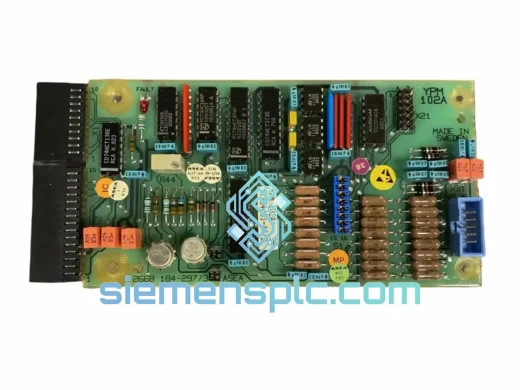
ABB YPM102A YT204001-AA Analog Output Module – AC 800M S800 I/O
S800
Origin SE
Analog Output Module
Request verified availability, condition, replacement risk review, packing options and courier lead time for NIOC-02C.
Click Request Quote and the part number is inserted into the inquiry form automatically.
Core fields for model confirmation and RFQ routing. Detailed product narrative remains below.
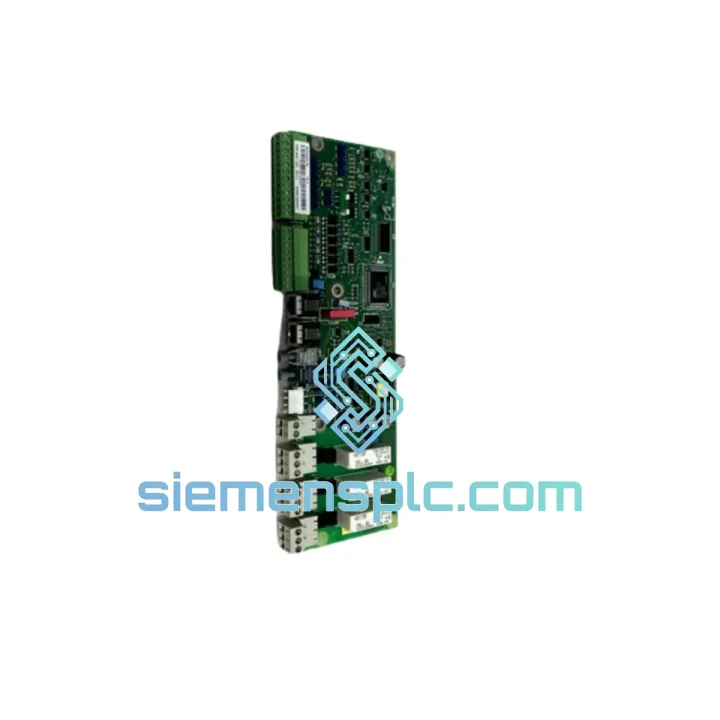
The NIOC-02C (Node I/O Control Board) is a dedicated signal-conditioning and I/O interface module engineered specifically for ABB’s ACS800 series variable frequency drives. Within the ACS800 control architecture, the NIOC-02C occupies the interface layer between the main RMIO-02C motor control board and the external field wiring terminals. Its primary function is to route, buffer, and electrically isolate analog and digital I/O signals, ensuring that transient disturbances originating from motor switching events — with dV/dt values routinely exceeding 1,000 V/µs on 400 V bus systems — do not propagate into the low-voltage logic domain of the drive controller.
The board provides a structured set of analog input channels (typically ±10 V differential, 12-bit resolution), analog output channels (0–20 mA / 4–20 mA selectable), and a complement of 24 VDC digital I/O lines. Each channel group is galvanically isolated from the drive’s internal DC bus reference, a design requirement that becomes critical in multi-drive installations where ground potential differences between cabinet sections can reach several volts under fault conditions. The NIOC-02C’s isolation barrier sustains a minimum of 500 V AC (rms) between field wiring and logic commons, conforming to IEC 61800-5-1 reinforced insulation requirements for drive systems.
In closed-loop process control applications — speed regulation, torque control, tension control in winding machines — the NIOC-02C serves as the physical entry point for feedback signals from field instruments: encoders routed through the RTAC-01 pulse encoder interface, pressure transmitters, load cells, and position sensors. Signal integrity at this interface directly determines the achievable bandwidth of the control loop. ABB’s design specifies a maximum analog input settling time of under 1 ms, which supports process control bandwidths up to approximately 50 Hz without introducing phase lag attributable to the I/O hardware itself.
Real-time Stock & RFQ: [email protected] | WhatsApp: +86 18359268345
| Parameter | Specification |
|---|---|
| Part Number | NIOC-02C |
| Manufacturer | ABB Ltd. |
| Compatible Platform | ACS800 Series Variable Frequency Drives |
| Module Function | Node I/O Control Board — analog/digital signal interface & isolation |
| Analog Inputs | 2 × differential, ±10 V / 0–20 mA selectable, 12-bit ADC resolution |
| Analog Outputs | 2 × 0–20 mA / 4–20 mA, 11-bit DAC resolution |
| Digital Inputs | 6 × 24 VDC, IEC 61131-2 Type 1 compatible |
| Digital Outputs | 3 × relay outputs, 250 VAC / 30 VDC, 2 A resistive |
| Galvanic Isolation | 500 V AC (rms) field-to-logic, reinforced per IEC 61800-5-1 |
| Analog Input Settling Time | < 1 ms (to 0.1% of full scale) |
| Operating Temperature | −10 °C to +55 °C (ambient, with rated airflow) |
| Storage Temperature | −40 °C to +70 °C |
| Relative Humidity | 5–95% RH, non-condensing (IEC 60068-2-78) |
| Vibration Resistance | 3–200 Hz, 1 g (IEC 60068-2-6) |
| EMC Immunity | IEC 61000-4-2 (ESD), IEC 61000-4-4 (EFT/Burst), IEC 61000-4-5 (Surge) |
| PCB Form Factor | Plug-in card, DIN rail-mounted within ACS800 control section |
| Connector Interface | Screw-terminal field wiring + board-to-board ribbon to RMIO-02C |
| Approvals | CE (2014/35/EU, 2014/30/EU), RoHS 2011/65/EU |
| Weight | Approx. 95 g (bare PCB assembly) |
| Warranty | 12 months from date of dispatch, covering manufacturing defects |
The NIOC-02C’s PCB layout reflects a deliberate partitioning strategy: the field-side circuitry — terminal blocks, input protection networks, and relay drivers — occupies a physically separated copper pour from the logic-side components. This split-ground topology, combined with a common-mode choke on each analog input pair, attenuates conducted interference generated by the IGBT switching stage. In a 400 V / 75 kW ACS800 drive operating at a 4 kHz switching frequency, the common-mode noise voltage at the motor terminals can reach 200–400 V peak; the NIOC-02C’s input protection network clamps transients to within the ADC’s absolute maximum input range before the isolation barrier.
The digital input section uses optocoupler isolation with a minimum CTR (current transfer ratio) selected for reliable operation down to 15 VDC input voltage, accommodating the lower end of 24 VDC PLC output voltage tolerance bands (typically ±15%). Input filter time constants are software-configurable via the ACS800 parameter set (parameter group 10), allowing the user to trade off noise rejection against response latency — a 10 ms filter setting provides adequate debounce for mechanical contacts, while a 1 ms setting supports high-frequency digital handshaking with upstream PLCs.
The relay output stage employs bifurcated gold-plated contacts rated for low-level signal switching (10 mA minimum load), which prevents contact oxidation in dry-circuit applications — a common failure mode in relay boards used intermittently for fault signaling. The relay coil drive circuit includes a flyback suppression diode and a series resistor to limit inrush current, extending relay mechanical life beyond the rated 10 million operations under resistive load conditions.
EMC hardening extends to the board’s edge connector: the ribbon cable interface to the RMIO-02C incorporates ground-shielded signal pairs and a defined impedance of 100 Ω differential, minimizing reflections at the interconnect that could introduce jitter into time-critical digital signals. This design detail is particularly relevant in ACS800 configurations where the NIOC-02C is mounted on an extension bracket at distances up to 300 mm from the RMIO-02C.
Every NIOC-02C unit dispatched from our Xiamen, China facility is sourced through verified ABB distribution channels and subjected to a structured incoming inspection protocol. Physical inspection covers PCB surface condition, component population completeness, connector pin integrity, and verification of ABB original part markings against the manufacturer’s label specification. Functional verification — where test fixtures are available — confirms analog channel linearity across the full input range and relay contact continuity under rated load.
Units are stored in a temperature- and humidity-controlled warehouse environment (20–25 °C, 40–60% RH) and handled exclusively in ESD-protected workstations (wrist strap + conductive mat, per IEC 61340-5-1). Outbound packaging uses anti-static PE foam inserts within double-wall corrugated cartons, with desiccant sachets included for shipments to high-humidity destinations.
Logistics from Xiamen port to major industrial hubs: DHL Express to Frankfurt or Chicago in 3–5 business days; FedEx International Priority to Singapore or Dubai in 2–4 business days; sea freight LCL consolidation for bulk orders with 12–18 day transit to European ports. Export documentation — commercial invoice, packing list, certificate of origin (Form E for ASEAN preferential tariff), and HS code 8537.10 customs declaration — is prepared as standard for every shipment. Customers requiring CITES, dual-use, or end-user certificate documentation should advise at the RFQ stage.
Email: [email protected]
WhatsApp: +86 18359268345
Web: siemensplc.com
Location: Xiamen, China
© 2026 siemensplc.com. All rights reserved.
We check the full part number, brand, series and visible nameplate information before quotation.
Sales confirms stock path, condition option, quantity and realistic lead time for export dispatch.
DHL, FedEx, UPS or buyer courier arrangements can be reviewed with packing requirements.
Similar brand or category products for fast comparison and multi-item RFQ lists.