
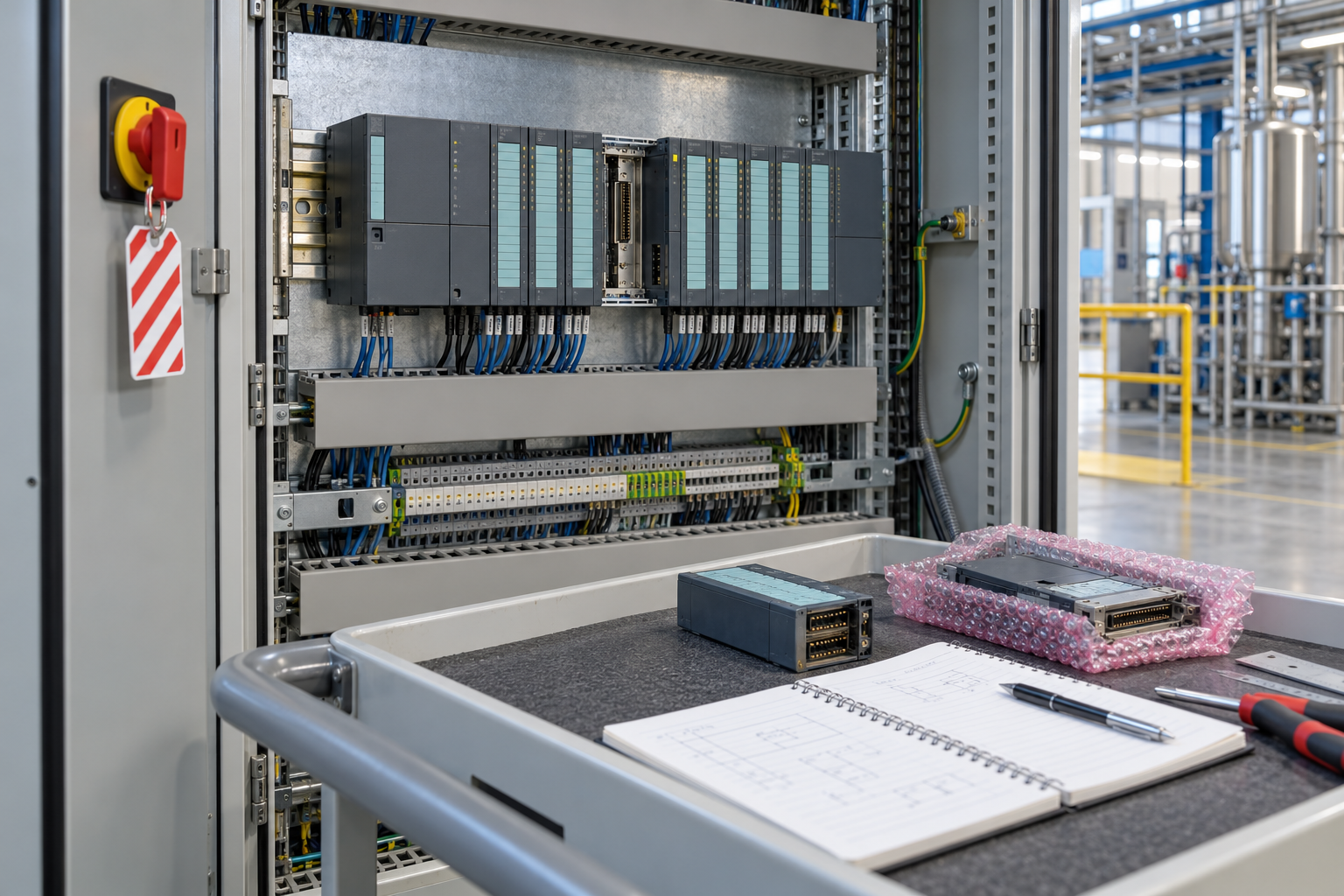
The visible module is not always the part that determines an ET 200M repair window. A signal-module exchange and a repair involving its active bus mounting unit are different jobs. If the stores record names only the front module, maintenance can discover the missing distinction after the cabinet is opened and the outage clock is already running.
Siemens’ public Aftermarket Excellence event agenda for October 22, 2026 highlights service lifecycle engineering and the digital thread. The practical connection here is our own: a useful service record for a legacy station must describe the hardware behind the visible module. The agenda does not announce a new ET 200M support policy or replacement rule.
First identify which job you are planning
The ET 200M operating instructions distinguish configurations that support specified module replacement during operation from work on active bus modules. Installation or removal of the active bus modules requires the station to be de-energized as directed by the manual. An active backplane is therefore not a general permission to remove any station component while energized.
That distinction belongs in the maintenance scope before a spare is ordered. Determine whether the identified work concerns a signal module, the underlying bus mounting unit, the interface module or another station element. Do not assume that similar symptoms imply the same replacement procedure or outage boundary.
The 6ES7195-7HB00-0XA0 backplane bus module is relevant when that specific mounting-unit identity is confirmed. It should not be treated as an interchangeable accessory for every ET 200M row. Use the installed arrangement and applicable documentation to establish its role.
A station record should expose the hidden hardware
Create a station-level record that ties the cabinet designation to the interface identity, signal modules, bus arrangement and associated drawings. Include the information needed to distinguish the approved installation from a superficially similar one elsewhere in the plant. Photos are useful, but avoid opening or dismantling equipment outside the site’s authorized inspection process just to complete the record.
The record should identify which details are confirmed and which remain unknown. A drawing that has not been checked against the installation should be marked accordingly. This is better than allowing an old bill of materials to acquire the status of verified fact through repeated use.
For example, an installed IM153-2 interface with reference 6ES7153-2BA02-0XB0 deserves its own identity entry. That entry helps engineering find the correct documentation and configuration context. It does not mean that buying an interface and a bus module together automatically produces a compatible, commissioned station.
Turn the fault assessment into a repair boundary
A communication or I/O symptom can prompt several different spare requests. Keep the diagnostic evidence with the selected repair scope so purchasing understands why a particular part is required. Where the cause remains uncertain, identify that uncertainty rather than presenting a broad parts purchase as a confirmed repair.
The responsible engineer should define what must be isolated, which process functions are affected and what verification is required afterward. A bus-level intervention can have a different operational consequence from replacing a separately approved module. The outage plan needs to reflect that difference, including coordination with operations and any associated restart checks.
Do not turn an online article into a live-work instruction. The exact procedure depends on the installed station, module type and applicable requirements. Use the manufacturer’s instructions and the site’s approved safe-work process, particularly where removing an underlying component affects several neighboring modules.
Specify the spare as part of an executable job
A useful requisition includes the complete reference, station location, intended work scope and required accessories. State whether the requirement is for an exact identified part or an engineering evaluation of an alternative. That prevents a supplier’s availability suggestion from being mistaken for authorization to change the station.
At receiving, compare the actual label and physical condition with the order. Preserve the packaging and identification record until acceptance is complete. Where several similar mounting units are stocked, separate them clearly and record their approved applicability rather than relying on a technician to recognize them visually during a shutdown.
Also check what the job needs beyond the main spare. Existing connectors, fastening items or adjacent components may have a condition or retention requirement in the approved procedure. Capture those requirements in the work package. Do not assume they are included in the offered module unless the quotation states that explicitly.
Close the loop after maintenance
The as-left record should identify the installed part, the work performed and the required verification results. If the repair changes any configuration or approved hardware reference, update the corresponding documentation through the plant’s change process. A stores transaction alone does not keep the service record current.
Replenish the consumed spare against the confirmed configuration. Otherwise, the next buyer may repeat the original uncertainty and purchase a part that was only a temporary candidate. Over time, this discipline makes the station record a recovery tool rather than an archive of disconnected invoices.
Questions to settle before the outage
Does an active bus mean every ET 200M component is hot-swappable?
No. The operating instructions impose component-specific conditions, and active bus module work has its own de-energization requirements. Confirm the exact job rather than applying a station feature to every component.
Should a bus module be ordered whenever an I/O module fails?
Not automatically. Diagnosis and the approved repair scope should determine the requirement. Stocking a bus module may support a recovery strategy, but it does not establish that the bus module caused a particular fault.
What makes a station record useful to purchasing?
It connects exact hardware identities to an installed location, approved applicability and the intended repair boundary. It should also flag unknowns so the buyer can seek clarification before ordering.
What should accompany a SiemensPLC spare inquiry?
Provide the full installed references, station designation, available photographs, required quantity and outage deadline. State whether the work concerns the signal module, active bus mounting unit or interface, and identify any required accessories.
Send that package to SiemensPLC for a scoped quotation. The goal is to have the right part and the right maintenance plan ready together, with no assumption that a hidden backplane repair follows the same rules as the visible module exchange.
Image: AI-generated editorial illustration, not an exact product photograph or installation reference.
© 2026 SiemensPLC. All rights reserved. Official Website: https://siemensplc.com Inquiry: [email protected] | WhatsApp/Tel: +86 18359268345