
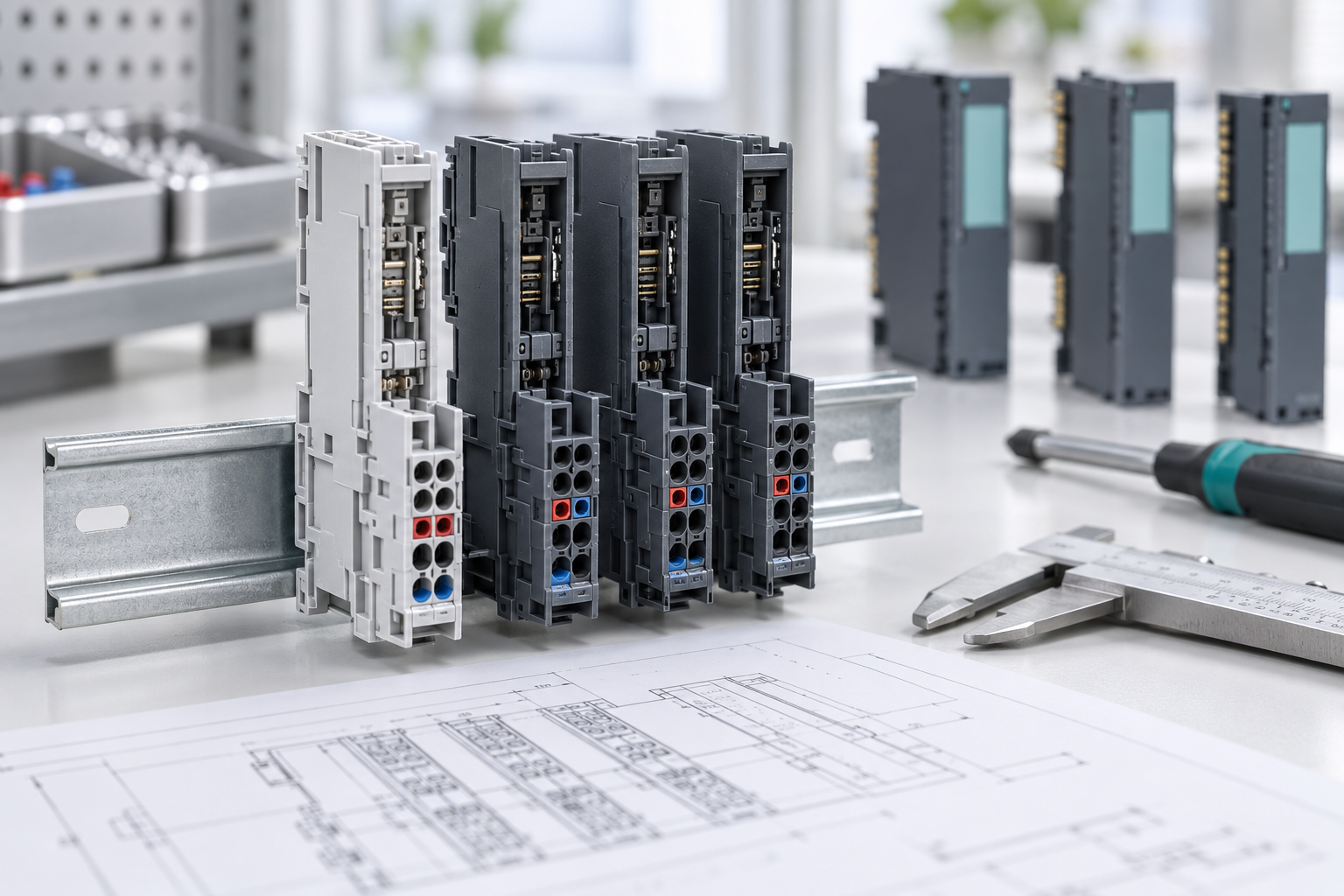
A remote-I/O spare list often gives the electronics more attention than the terminal base beneath them. The input module has a clear ordering code and an assigned shelf location; the BaseUnit is described simply as “the same base.” That shortcut becomes expensive when a replacement changes the intended potential-group boundary or fails to match the module’s permitted base type.
For SIMATIC ET 200SP, BaseUnit selection is part of the electrical design. It should not be reduced to matching the width of the housing. The useful maintenance question is not just whether the electronics can be fitted, but whether the replacement preserves the documented connections, supply grouping and application requirements.
A similar ordering code can describe a different job
The Siemens datasheet for 6ES7193-6BP00-0BA0 identifies this A0 BaseUnit as a version that does not establish a new potential group. The distinction is small on a purchase line but significant in an assembly. Do not read a supplier’s generic “base unit” description as evidence of the required group behavior.
The ET 200SP BaseUnits manual explains the relevant base variants and potential-group arrangements. Use the applicable manual revision and the actual ordering code when reviewing a station. Color can help an experienced technician recognize an arrangement, but it should not replace the code and documented circuit information.
A stock enquiry for the 6ES7193-6BP00-0BA0 BaseUnit should therefore preserve the full suffix. Do not substitute a differently functioning base merely because it belongs to the same ET 200SP family or is readily available.
Review the station as a sequence, not a bag of modules
A useful bill of materials keeps the slot sequence visible. For each position, record the electronics reference, BaseUnit reference, relevant supply-group information and terminal drawing. The position matters because a base participates in an assembled station, not only in an isolated mechanical connection.
When investigating a discrepancy, compare the as-built arrangement with the approved drawings. Photograph readable ordering labels and the complete station while maintaining the site’s safe working boundaries. Do not remove electronics or disturb terminals on an operating system simply to improve a photograph.
The review should identify where a group is intended to begin and which positions belong to it. If that information is absent from the drawing, escalate the documentation gap. Guessing from the neighboring module can perpetuate an earlier installation error.
Keep electronic-module compatibility a separate check
The BaseUnit’s potential-group function is only one selection requirement. The I/O module also has its own permitted BaseUnit types and connection requirements. Verify these from the exact module documentation instead of assuming all modules in a cabinet use one common base.
For example, the 6ES7131-6BF00-0BA0 digital input module should have a distinct entry in the spare-parts register. Linking that module and a BaseUnit in a maintenance article does not certify a particular pairing. Confirm the pairing, terminal arrangement and application conditions before issuing a combined replacement kit.
That separation improves procurement as well. A buyer can quote the requested electronics while asking for clarification on the base, rather than silently treating a complete-looking assembly as equivalent. It also avoids purchasing spare electronics repeatedly when the identified replacement requirement concerns a terminal base or another part of the station.
Build a kit around a documented location
For critical I/O stations, consider organizing replacement kits by approved slot or repeated assembly pattern. Include the correct component references and an associated drawing revision. This is not a recommendation to keep every possible variant; it is a way to prevent an apparently generic spare from being used outside its reviewed purpose.
During receiving, compare the full order code on the physical item with the approved requirement. Keep photographs that show the suffix clearly. A warehouse alias such as “ET200 base” can remain a search aid, but it should never be the only identifier used to accept or issue the item.
After an authorized replacement, update the as-built record if any approved change was made. If no design change was intended, confirm that the resulting assembly still matches the approved arrangement. The maintenance record should distinguish a like-for-like exchange from an engineered modification.
Do not troubleshoot a supply-group problem by blind substitution
Unexpected behavior after an I/O intervention can have several causes. Preserve the before-and-after hardware references, diagnostics and drawing information. An uncontrolled sequence of swaps may make the original discrepancy harder to identify, especially if each swap changes a different part of the assembled station.
Electrical inspection and testing must follow approved isolation and work procedures. This article is a procurement and configuration-control guide, not an instruction to bridge terminals, alter potential groups or make live measurements. Those activities require the responsible electrical and controls engineers to define a safe method.
Questions from ET 200SP maintenance teams
Does 6ES7193-6BP00-0BA0 start a new potential group?
The referenced Siemens datasheet identifies it as not starting a new potential group. Confirm the exact installed ordering code and applicable documentation; do not transfer that behavior to another suffix because the product names look similar.
Can BaseUnit color be used as the purchasing specification?
No. Use the full ordering code and the reviewed station requirements. Color is a useful visual cue in context, but photographs, lighting and shorthand descriptions are not a dependable substitute for component identity.
Should we stock a BaseUnit for every input module?
That depends on the station design, criticality and maintenance strategy. Map the installed variants first, then decide the quantities. Buying one generic base for every module can create unnecessary stock while still missing the required variant.
Can the same-looking input module be supplied with any A0 base?
Do not assume so. Review the electronic module’s permitted bases, the terminal requirements and the intended potential-group arrangement. A shared type designation alone does not complete the installation-level compatibility check.
Make the suffix part of the enquiry
For SiemensPLC sourcing enquiries, provide the complete electronics and BaseUnit references, quantities, label photographs and required condition. Include the station context where a pairing needs confirmation. That gives purchasing a precise requirement while leaving electrical-design approval with the team responsible for the installation.
Image: AI-generated terminal-base illustration, not an exact assembly or wiring reference.
© 2026 SiemensPLC. All rights reserved. Official Website: https://siemensplc.com Inquiry: [email protected] | WhatsApp/Tel: +86 18359268345