ABB
RFQ Ready
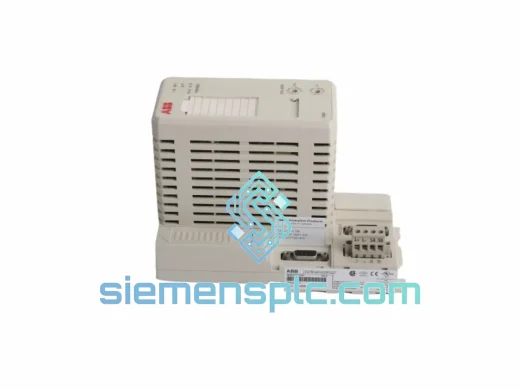
ABB TK851V010 3BSC950262R1 DCS Interface Module – AC800M Series
AC800M
Origin SE
DCS Interface Module
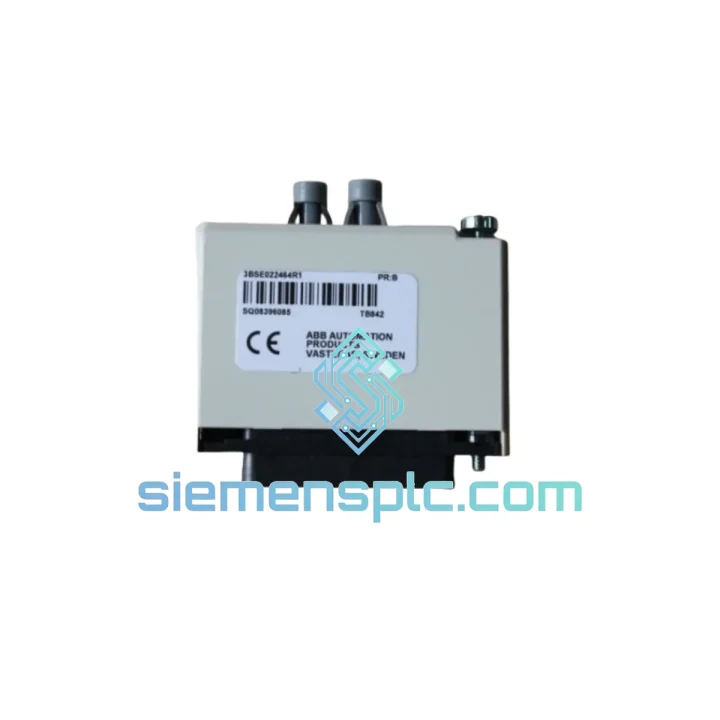
Request verified availability, condition, replacement risk review, packing options and courier lead time for TB842.
Click Request Quote and the part number is inserted into the inquiry form automatically.
Core fields for model confirmation and RFQ routing. Detailed product narrative remains below.
The ABB TB842 is a dedicated optical ModuleBus port module engineered for integration within ABB’s AC800M distributed control system platform. Its primary function is to extend the ModuleBus communication network via plastic optical fiber (POF), decoupling the I/O expansion topology from the electrical noise floor of the control cabinet. In process-critical environments — oil and gas compression trains, power generation auxiliaries, chemical reactor control loops — where ground loops and high-frequency switching transients are endemic, the TB842’s optical interface eliminates the galvanic coupling path entirely, providing a physically isolated, deterministic data channel between the PM8xx controller backplane and downstream S800 I/O clusters.
Unlike copper-based ModuleBus extensions, the TB842 operates on a photonic signal path. The transmitter and receiver circuits convert electrical ModuleBus frames into 660 nm visible-red optical pulses, transmitted over POF at a nominal link rate synchronized to the AC800M scan cycle. This architecture removes the module from the common-mode voltage domain of the field wiring, a design decision that directly reduces susceptibility to conducted EMI from variable-frequency drives, high-current contactors, and thyristor-controlled rectifiers operating in the same panel enclosure.
The TB842 mounts directly onto the AC800M controller unit’s ModuleBus port connector. No external power supply is required; the module draws operating power from the controller backplane bus. The optical fiber connectors — typically HFBR-type snap-lock — accept standard 1 mm POF with a maximum segment length defined by the ABB hardware manual (typically up to 10 m for POF; glass fiber variants extend this further). Each TB842 port supports a defined number of S800 I/O nodes per segment, and multiple TB842 modules can be installed on a single PM8xx controller to expand the total I/O node count across parallel optical bus segments.
From a control loop perspective, the TB842 is transparent to the application layer. The AC800M firmware addresses S800 I/O modules connected via TB842 using the same ModuleBus node addressing scheme as electrical connections. Scan time contribution from the optical link is deterministic and bounded, ensuring that the controller’s cyclic task execution — whether at 10 ms, 50 ms, or 100 ms cycle times — is not subject to variable latency introduced by the communication medium. This determinism is a prerequisite for closed-loop PID control of fast-responding processes such as compressor surge control or turbine speed governing.
Real-time Stock & RFQ: [email protected] | WhatsApp: +86 18359268345
| Parameter | Value |
|---|---|
| Model Number | TB842 |
| Manufacturer | ABB |
| Product Series | AC800M / S800 I/O |
| Module Function | Optical ModuleBus Port Extension |
| Communication Medium | Plastic Optical Fiber (POF), 1 mm diameter |
| Optical Wavelength | 660 nm (visible red) |
| Connector Type | HFBR snap-lock (duplex) |
| Max. Fiber Segment Length | Up to 10 m (POF); consult ABB datasheet for glass fiber options |
| Compatible Controllers | PM851, PM856, PM860, PM861, PM864, PM866 |
| Compatible I/O | ABB S800 I/O module series |
| Power Source | AC800M controller backplane (no external PSU required) |
| Operating Temperature | 0 °C to +55 °C |
| Storage Temperature | -40 °C to +70 °C |
| Relative Humidity | 5% to 95% non-condensing |
| Mounting | Direct plug-in to AC800M ModuleBus port connector |
| Approvals / Certifications | CE, UL (verify current revision with ABB datasheet) |
| Country of Origin | Germany |
| Warranty | 12 months from date of shipment |
Optical Isolation Architecture: The TB842 achieves full galvanic isolation between the controller backplane and the field-side I/O bus by converting ModuleBus electrical signals to optical pulses at the transmit stage and performing the reverse conversion at the receive stage. This eliminates ground potential differences — which in large industrial installations can reach tens of volts — from corrupting the communication frame. The isolation barrier is inherent to the physics of the optical link; no additional opto-coupler ICs or transformer-based isolation circuits are required in the signal path, reducing component count and associated failure modes.
EMC Design Compliance: Because the signal medium is photonic rather than electrical, the TB842 fiber segment is immune to radiated electromagnetic fields. Cables routed near high-voltage bus bars, motor drive output cables carrying PWM switching waveforms at 4–16 kHz, or inductive loads switching at high di/dt rates do not induce noise onto the optical fiber. This allows cable routing flexibility that would be impractical with shielded copper ModuleBus cables, reducing installation labor and conduit segregation requirements.
Deterministic Frame Timing: The ModuleBus protocol operates on a master-slave polling architecture. The AC800M controller (master) issues cyclic poll frames to each addressed S800 I/O node (slave) in a fixed sequence. The TB842 introduces a bounded, fixed propagation delay — governed by the optical path length and the transceiver electronics — that is accounted for in the controller’s communication timing model. There is no collision domain, no CSMA/CD arbitration, and no variable retry latency. Each poll-response cycle completes within a deterministic window, which is a hard requirement for SIL-rated safety loops operating under IEC 61511.
Backplane Interface Logic: On the controller side, the TB842 interfaces directly with the PM8xx backplane bus through a standardized ModuleBus port connector. The module’s internal logic handles signal conditioning, level translation, and the electrical-to-optical conversion without requiring firmware configuration. From the AC800M application perspective, I/O modules connected via TB842 are addressed identically to those on electrical ModuleBus segments, preserving software portability across hardware configurations.
Every ABB TB842 unit supplied through siemensplc.com is sourced from verified industrial automation supply channels with documented provenance. Pre-shipment inspection covers visual examination, label and date code verification, and connector integrity check. Original ABB packaging and accompanying documentation are preserved throughout the storage and handling chain. Serial number traceability is available on request for customers requiring component-level audit records for IEC 61511 management of functional safety documentation.
Counterfeit risk mitigation is applied at the point of procurement: units are cross-referenced against ABB’s published hardware revision records, and any discrepancy in label format, housing material, or connector finish triggers rejection and supplier escalation. This process is particularly relevant for TB842, which — as a mature product in ABB’s AC800M portfolio — has appeared in grey-market channels with non-genuine units.
Logistics operations are based in Xiamen, China, a major export hub with direct access to international freight forwarders serving Europe, the Middle East, Southeast Asia, and the Americas. Standard shipment is via DHL Express or FedEx International Priority, with typical transit times of 3–7 business days to most destinations. Air freight consolidation and sea freight options are available for volume orders. Export documentation — including commercial invoice, packing list, certificate of origin, and ECCN classification — is prepared for each shipment. Customers in regulated industries (nuclear, defense-adjacent) should advise at the time of inquiry for export license review.
All units are covered by a 12-month warranty from the date of shipment. Warranty claims are handled by direct replacement or credit, subject to inspection of the returned unit. Extended warranty and on-site spare management programs are available for customers with large installed bases of AC800M hardware.
Email: [email protected]
WhatsApp: +86 18359268345
Web: siemensplc.com
Location: Xiamen, China
© 2026 siemensplc.com. All rights reserved.
We check the full part number, brand, series and visible nameplate information before quotation.
Sales confirms stock path, condition option, quantity and realistic lead time for export dispatch.
DHL, FedEx, UPS or buyer courier arrangements can be reviewed with packing requirements.
Similar brand or category products for fast comparison and multi-item RFQ lists.